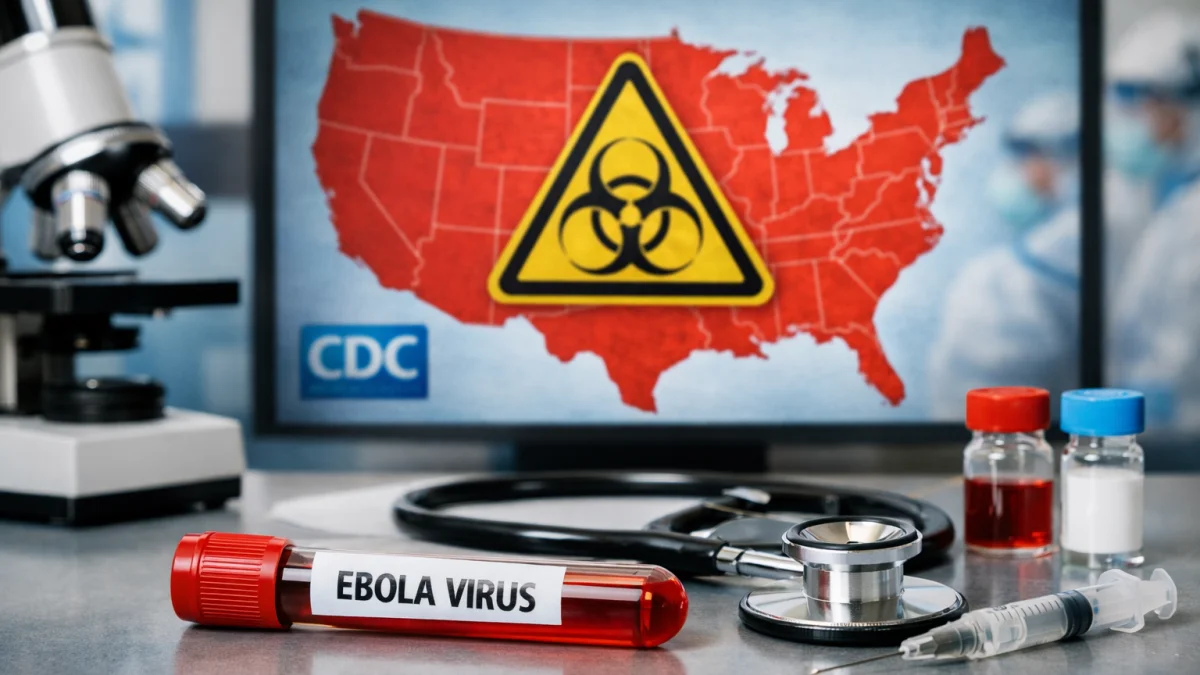


WASHINGTON — U.S. health officials have warned that the ongoing Ebola outbreak in the Democratic Republic of the Congo and Uganda could reach a major scale without accelerated international response efforts, according to statements from the Centers for Disease Control and Prevention and the State Department.
The CDC issued updated assessments on June 5, 2026, indicating that the outbreak, caused by the Bundibugyo virus, has grown rapidly since it was declared in mid-May. As of early June, health authorities reported more than 500 confirmed cases and dozens of deaths in the region, with modeling suggesting the potential for significantly higher numbers if containment measures are not strengthened.


U.S. officials have implemented enhanced screening at designated airports for travelers from affected areas and issued travel advisories. The State Department has coordinated with the CDC on efforts to support response activities, including assistance for Americans potentially exposed in the region.
The outbreak was first confirmed in Ituri Province in northeastern Democratic Republic of the Congo, with subsequent cases reported in Uganda. The World Health Organization declared it a public health emergency of international concern on May 17. Response efforts include contact tracing, isolation measures and community engagement, though challenges such as regional insecurity have complicated operations, officials said.
“CDC is working aggressively with federal and international partners to support response efforts,” a CDC spokesperson said in a briefing on June 5.
The U.S. government has provided financial and technical assistance to affected countries and partners. Measures include temporary relocation support for some Americans in the region and restrictions on travel from high-risk areas. No cases linked to this outbreak have been confirmed in the United States, and the risk to the general public in the country remains low, according to the CDC.
Previous Ebola outbreaks in the region, including a major epidemic in West Africa from 2014 to 2016, prompted global responses that contained the spread. The current outbreak involves a strain for which limited specific medical countermeasures are available, contributing to concerns about its trajectory.
Africa CDC and WHO launched a joint continental preparedness and response plan on June 5, seeking substantial funding to support detection and containment across at-risk areas.
As of the latest reports in early June, cases continue to be recorded in multiple health zones in the Democratic Republic of the Congo, with cross-border transmission confirmed in Uganda. Details on the precise current case totals and response funding status remain subject to ongoing verification by national authorities and international partners.
U.S. officials continue to monitor the situation closely in coordination with global health bodies.