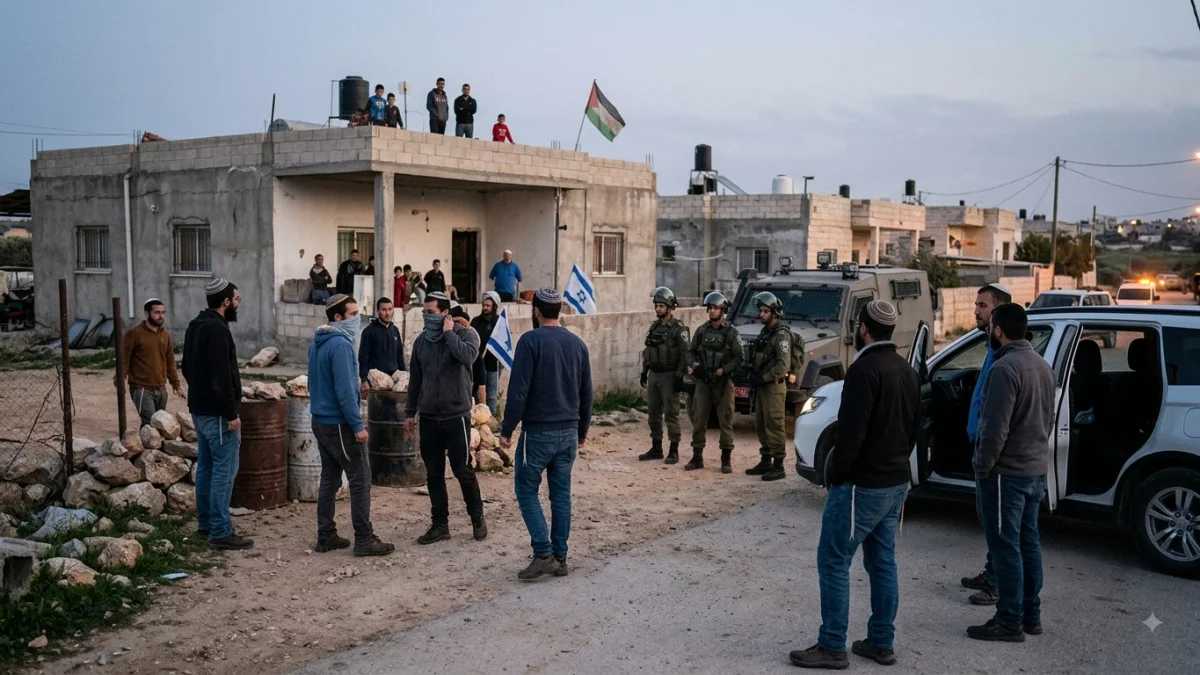


The United States has issued an unusually sharp rebuke of Israeli settlers accused of besieging Palestinian homes in the West Bank village of Qusra, exposing a widening gap between Washington’s strong strategic support for Israel and its concern over increasingly confrontational settler activity.
U.S. Ambassador to Israel Mike Huckabee called the actions of the settlers “terror” and urged Israeli authorities to remove those responsible. The intervention followed nearly a week during which settlers surrounded three Palestinian homes, including one owned by a Palestinian-American, while residents were reportedly prevented from leaving and faced disruptions to water and electricity. Reuters reported that U.S. officials were pressing Prime Minister Benjamin Netanyahu to condemn the episode publicly.


The significance lies less in the rhetoric alone than in what it reveals about the increasingly difficult security and political problem posed by settler violence. The United States has long supported Israel's security and maintained close military and diplomatic ties with successive Israeli governments, but successive U.S. administrations have also warned that unchecked settler violence undermines stability and prospects for a negotiated Israeli-Palestinian settlement. Washington's criticism therefore places the Netanyahu government under pressure over conduct occurring in territory Israel controls militarily but whose final political status remains unresolved.
The Qusra confrontation also illustrates the difficulty Israel faces in maintaining order when violence involves Israeli civilians and Palestinian residents simultaneously. Reuters reported that Israeli forces removed a settler tent and deployed additional troops, while earlier Israeli military intervention included soldiers taking positions inside Palestinian homes. The army said its actions were intended to protect residents and maintain security. But the deployment itself generated criticism because Palestinian residents were effectively displaced or restricted while settlers remained active nearby.
That tension is central to the wider dispute. Palestinian residents and rights groups argue that repeated settler attacks, restrictions on access and seizures of land can create conditions that encourage Palestinians to leave. Israeli authorities, by contrast, have generally characterized violent settlers as a radical minority and say security forces are responsible for preventing violence and maintaining public order. The competing explanations make individual incidents particularly consequential because the question is not only who committed a particular act, but whether state institutions are capable of enforcing the law consistently.
The scale of the broader problem adds weight to the U.S. intervention. Associated Press reported that 1,476 settler attacks had been recorded in the West Bank during 2026, with 87 Palestinians killed in violence involving settlers and Israeli forces. Qusra has been identified as one of the communities experiencing particularly high levels of settler attacks. These figures describe a wider security trend rather than proving that every incident reflects an organized policy.
The dispute comes as Israel is also considering changes to how law enforcement involving Israeli civilians in the West Bank is administered. Defense Minister Israel Katz has instructed the military to prepare a plan for transferring law-enforcement responsibilities concerning settlers to the police. Supporters can portray the move as an effort to place civilian offenses under ordinary policing, while critics argue that changing the institutional framework could further integrate Israeli civilian administration into occupied territory.
The timing makes the issue particularly sensitive. Israel's settlement movement has expanded substantially over decades, while the international community continues to regard Israeli settlements in the occupied West Bank as illegal under international law. Amnesty International reported that by April 2026 there were 163 official settlements and 363 unauthorized outposts in the West Bank, including East Jerusalem, and documented cases in which settler violence and restrictions contributed to Palestinian displacement. Those findings come from a human-rights organization and should be distinguished from official Israeli assessments, which dispute aspects of such characterization.
For Washington, the presence of a U.S. citizen among those affected gives the episode an immediate bilateral dimension, but the implications extend beyond consular concerns. The United States has previously warned Israel that it must do more to prevent and prosecute extremist settler violence. The Qusra episode tests whether such warnings can translate into sustained Israeli enforcement rather than temporary intervention after international attention has intensified.
The confirmed situation remains fluid. Israeli forces have intervened around the homes and moved against some settler structures, while U.S. officials are pressing Netanyahu for a public response. It remains unclear whether Israeli authorities will pursue sustained criminal accountability for those involved, whether the families will regain unrestricted access to their homes and utilities, and whether the planned transfer of law-enforcement responsibilities will alter enforcement on the ground. Those developments, alongside the broader pattern of settler attacks and Palestinian displacement, are the key issues being monitored as the Qusra confrontation moves beyond its immediate security phase.