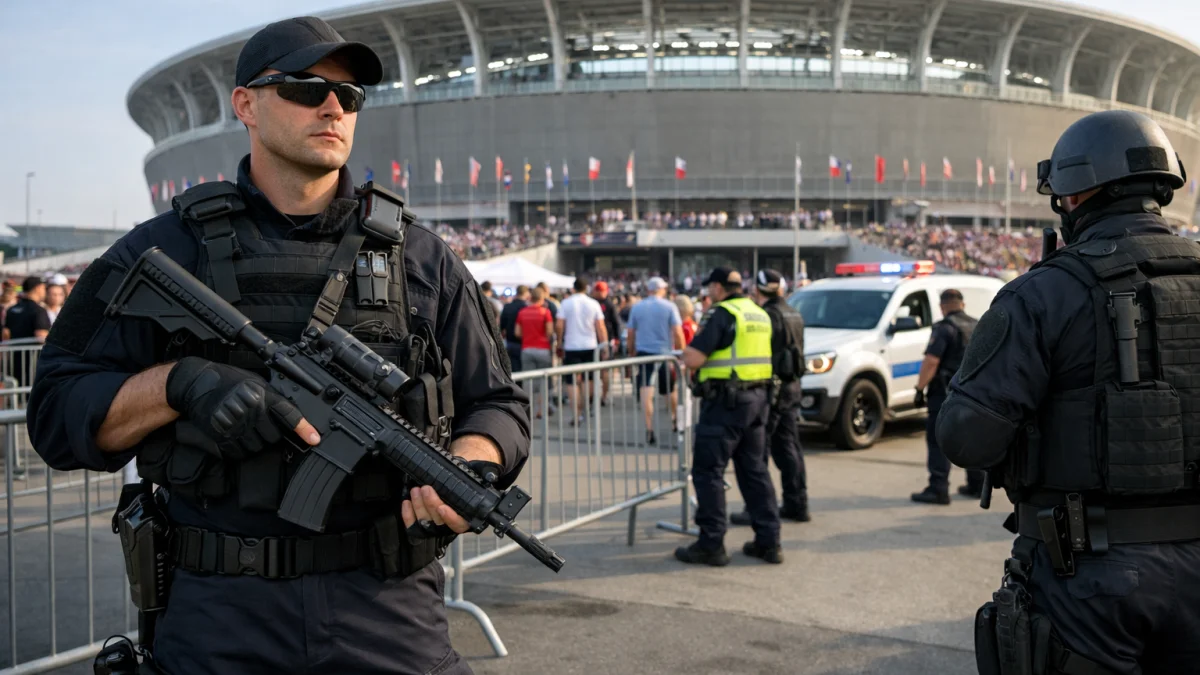


MIAMI — Cities hosting matches during the 2026 FIFA World Cup reported heightened security measures this week as officials across the United States, Canada and Mexico prepared for large crowds, international delegations and an expanded tournament schedule, according to government agencies and event organizers.
The World Cup, which opened on June 11 and runs through July 19, is being held across 16 host cities in North America. Federal, state and local authorities have increased security operations around stadiums, transportation hubs, fan zones and team facilities, citing the scale of the event and the need to address a range of potential threats, including drones, cyberattacks and public safety risks. According to U.S. officials, the tournament has been designated a Special Event Assessment Rating Level 1 event, the highest federal security classification.


In Seattle, officials recently activated additional surveillance cameras near stadium areas and installed perimeter fencing and vehicle barriers around match venues. Mayor Katie Wilson said the measures were intended to support crowd management and public safety during the tournament. Local authorities said hundreds of police officers would be deployed on match days.
Federal agencies in the United States have coordinated with local law enforcement and international partners to strengthen security planning. FBI Director Kash Patel said in a Reuters interview that the tournament represented one of the most complex security operations undertaken by the agency. “We are prepared,” Patel said, citing coordination among federal, state and international partners.
Officials have identified drones as a significant concern. The Federal Aviation Administration has imposed temporary flight restrictions around stadiums on match days, while law enforcement agencies have expanded drone-detection programs and operator-tracking capabilities. Security planners said counter-drone systems were being deployed in multiple host cities as part of broader efforts to protect spectators and participants.
In Canada and Mexico, authorities have also expanded security operations. Publicly announced plans include increased surveillance, border-screening measures and multi-agency command structures. Mexican officials have previously outlined additional deployments of law enforcement personnel and expanded camera networks in and around host cities.
Public health preparedness has also formed part of security planning. Medical officials said hospitals and emergency-response agencies had conducted training exercises and threat assessments to prepare for health-related incidents during the tournament. Experts described the risk of major disease outbreaks as low but said monitoring systems remained active.
As of Monday, host cities continued implementing traffic controls, venue security procedures and crowd-management plans ahead of upcoming matches. Authorities said security operations would remain in place throughout the tournament, while specific deployment details remained limited for operational reasons.