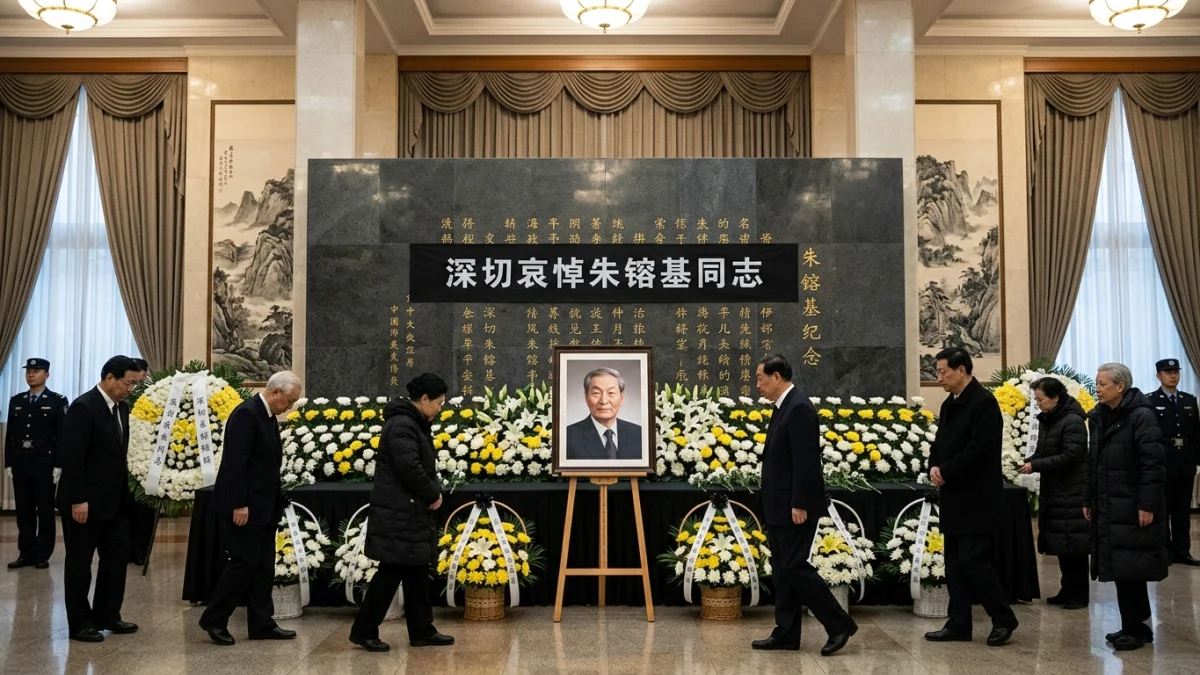


BEIJING — Former Chinese Premier Zhu Rongji, a blunt-speaking economic reformer who helped steer China through sweeping market changes and into the World Trade Organization, has died at the age of 97, state media reported on Wednesday.
Zhu died in Beijing on Aug. 12, according to reports citing Chinese state media. No further details on the circumstances of his death were immediately available from the official sources reviewed.


Zhu served as premier from 1998 to 2003 under then-President Jiang Zemin, after rising to national prominence as mayor and Communist Party chief of Shanghai. He became vice premier in 1991 and was closely involved in economic policymaking during a period when China was accelerating its transition from a centrally planned economy toward a more market-oriented system.
As premier, Zhu oversaw major reforms of state-owned enterprises, fiscal changes that strengthened central government revenues and measures aimed at controlling inflation. His government also expanded housing reforms that helped establish private home ownership as a major part of China's economy.
One of Zhu's most consequential achievements was helping secure China's entry into the WTO in 2001 after years of negotiations. The accession marked a major step in China's integration into the global trading system and contributed to the country's rapid expansion as a manufacturing and exporting power.
His restructuring of state-owned industries also resulted in large-scale layoffs and was politically contentious. Zhu nevertheless defended the need to make state enterprises more efficient while maintaining state ownership in key sectors.
Born in Changsha, Hunan province, in 1928, Zhu studied electrical engineering at Tsinghua University and joined the Communist Party in 1949. His political career was disrupted during the political upheavals of the Mao era, but he was later rehabilitated and rose through economic and government posts before becoming Shanghai's mayor and then its Communist Party chief.
Zhu largely withdrew from public political life after leaving office in 2003. His speeches and writings continued to attract attention, including published collections documenting his years in Shanghai and the central government.
Zhu is survived by his wife, Lao An, and two children, according to reports.