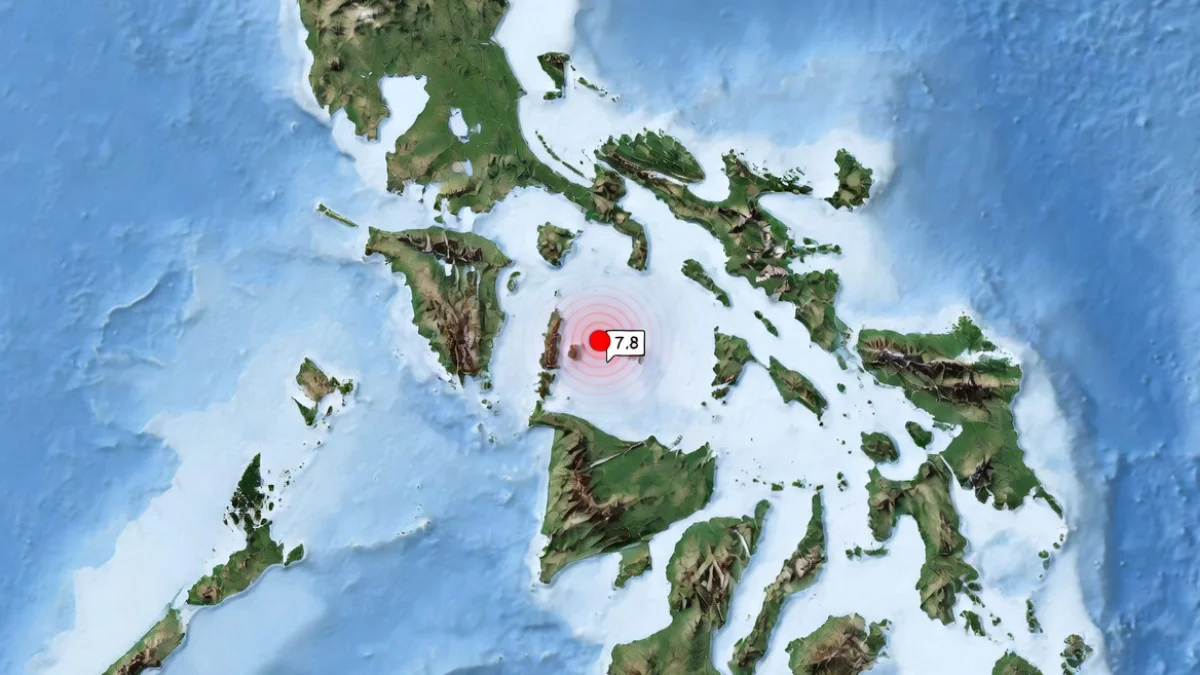


MANILA — A 7.8-magnitude earthquake struck off the southern Philippines early Monday, prompting tsunami warnings for coastal areas, officials said.
The quake hit at about 7:37 a.m. local time near Kablalan in Sarangani province, according to the Philippine Institute of Volcanology and Seismology (PHIVOLCS) and the U.S. Geological Survey. It was centered offshore in the Mindanao region, with strong shaking reported in General Santos and surrounding areas.


PHIVOLCS issued tsunami warnings for parts of the southern Philippines, advising residents in coastal areas to move to higher ground. Tsunami alerts were also raised for neighboring countries including Indonesia, with waves possibly exceeding one meter above normal tide levels, authorities said.
In General Santos, buildings including a shopping mall, a university, and a radio station collapsed, local officials reported. At least one person was killed and four others injured, according to initial reports from emergency services. Details on the full extent of casualties and damage remained unclear in the immediate hours after the quake, with rescue operations ongoing.
The Pacific Tsunami Warning Center and national agencies in the region monitored the situation for potential waves. No major tsunami waves had been confirmed along the affected coasts as of early Monday, PHIVOLCS said.
The earthquake occurred in a seismically active area along the Philippine Trench. The region has experienced significant seismic events in recent years, including a 7.4-magnitude quake off Davao Oriental in October 2025 that triggered similar tsunami concerns.
President Ferdinand Marcos Jr. ordered the suspension of classes across Mindanao and directed government agencies to provide immediate assistance to affected areas, his office said in a statement.
"Residents should remain vigilant for aftershocks and follow official advisories," a PHIVOLCS spokesperson said in a briefing.
Power outages were reported in several parts of the region, and authorities urged people to avoid damaged structures. Aftershocks continued in the hours following the main quake, according to monitoring agencies.
As of early Monday, assessment teams were deployed to evaluate infrastructure damage and support search and rescue efforts. Full details on the impact were expected to emerge as communications and access improved in the affected zones.