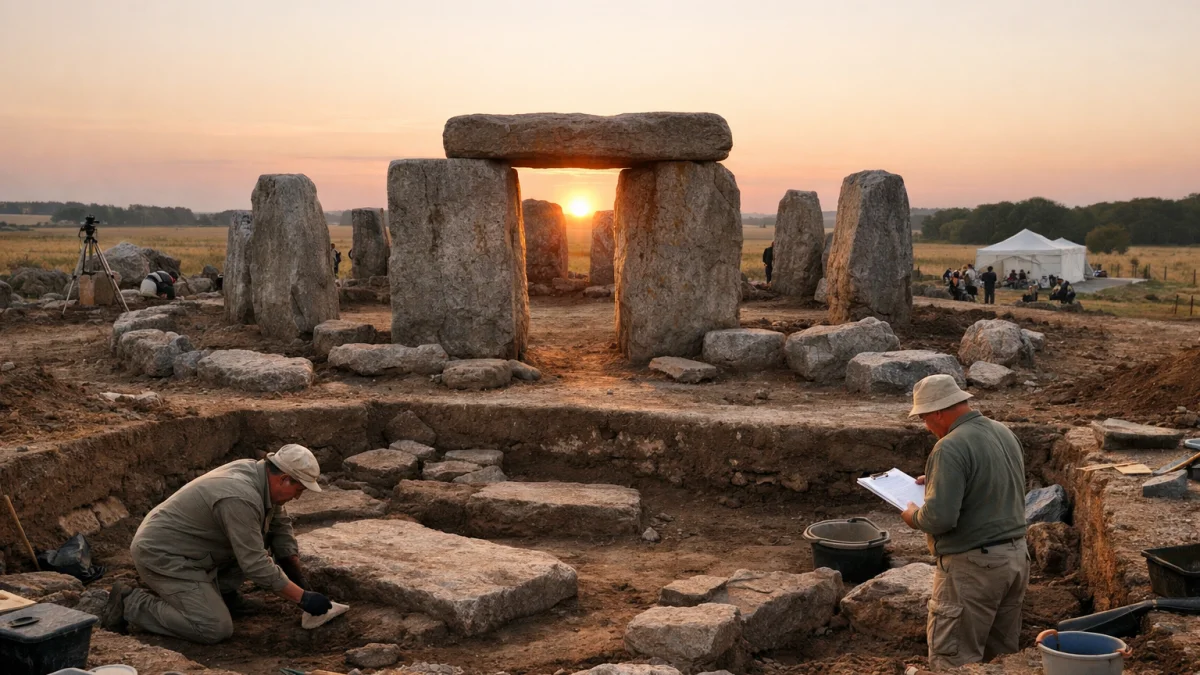


BULFORD, England — Archaeologists have discovered the remains of a 5,000-year-old wooden structure near Stonehenge in southern England that appears aligned with the summer and winter solstices, potentially serving as an early prototype for the famous stone monument’s astronomical features.
The site, located about 5 kilometers (3 miles) from Stonehenge in Bulford, Wiltshire, consists of two large postholes that once held wooden poles roughly 120 meters apart. Researchers with Wessex Archaeology, led by Phil Harding, uncovered the features during excavations between 2015 and 2017 ahead of a U.K. Ministry of Defence housing development. Radiocarbon dating places the activity at the site around 2950 B.C., contemporary with the earliest earthworks at Stonehenge and about 500 years before the erection of its massive sarsen stones.


Analysis by skyscape archaeologist Dr. Fabio Silva confirmed the alignment, showing the posts would have pointed to within about one degree of the midsummer sunrise and midwinter sunset positions as visible from the site in that era. The structure’s remains include 48 pits containing artifacts such as grooved-ware pottery, animal bones, flints, charcoal and a rare disc-shaped flint knife, suggesting large gatherings for feasting and ceremonies.
Harding, a veteran archaeologist known for his work on the television series “Time Team,” described the find at a news conference. “In a few days’ time, Stonehenge will be filled with people celebrating midsummer solstice,” he said. “But what few will realise is that 5,000 years ago on a nearby hillside overlooking modern day Bulford, people were doing the exact same thing – revering and celebrating the sunrise on midsummer’s day.”
The discovery provides evidence of early interest in solstice alignments in the Stonehenge landscape. Stonehenge’s own solstice alignments, involving the massive stones, date to around 2500 B.C. Archaeologists suggest the Bulford site may represent an earlier, temporary monument that influenced or paralleled the development of the more permanent stone circle.
Matt Leivers, senior research manager at Wessex Archaeology, noted the religious significance. “The discovery at Bulford is fundamental because it’s the earliest example of people building things here that aim directly at the solstice,” he said in a statement.
Some experts have expressed caution about interpreting two postholes as a definitive monument. The posts have long since rotted away, leaving only pits, and further study is ongoing. Details of how the structure was used remain subject to interpretation.
The excavations were conducted on behalf of the Ministry of Defence’s Army Basing Programme. The findings are expected to be detailed in an upcoming article for the Prehistoric Society and a major publication on the Army Basing Programme later this year.
The site is not accessible to the public. Thousands continue to gather at Stonehenge for solstice celebrations, as they have for millennia.