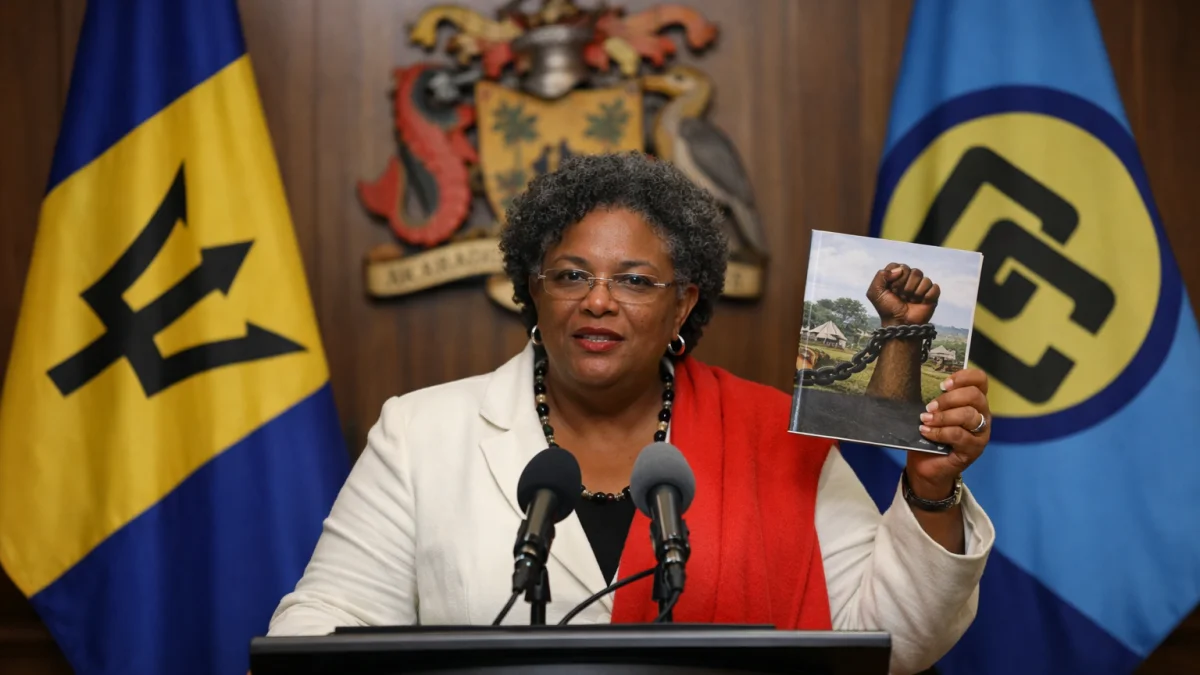


BRIDGETOWN — Barbados Prime Minister Mia Mottley has unveiled an updated Caribbean manifesto on slavery reparations, calling for renewed international engagement on what she described as the moral, ethical and legal consequences of the transatlantic slave trade, according to documents presented at a conference in Ghana this week.
Mottley announced the revised proposal on Thursday during a gathering in Accra focused on reparatory justice, held after the United Nations adopted a resolution earlier this year recognizing the trafficking of enslaved Africans as a crime against humanity and encouraging dialogue on reparations. The document updates the Caribbean Community’s (CARICOM) long-standing 10-point reparations plan and is expected to be reviewed by regional governments before formal adoption.


According to the draft manifesto, the revised framework expands previous demands for reparatory justice by addressing the disproportionate impact of slavery on women and girls. The document includes a call for compensation related to gender-based violence committed during slavery and highlights historical research on the treatment of enslaved women. It also links reparations discussions to issues including climate justice and support for Indigenous communities affected by colonial expansion.
“Caricom demands monetary compensation as reparations,” the document states, while also calling for formal apologies, educational initiatives and other measures from former colonial powers and institutions that benefited from slavery. The manifesto does not specify a monetary figure, describing itself as a framework for pursuing reparatory justice rather than a detailed compensation claim.
Speaking at the conference, Mottley said the initiative was intended to promote dialogue and recognition of historical injustices. “The language used from this platform this morning is not one of aggression, is not one of violence but it is one of the necessities for healing for humanity,” she said, according to remarks reported from the event.
The reparations movement has gained visibility in recent years across the Caribbean and Africa. CARICOM governments have advocated since 2013 for reparatory justice related to slavery and colonialism, while regional leaders earlier this year agreed to review the updated reparations framework ahead of future international meetings.
The conference in Ghana brought together representatives from more than 80 countries, including heads of state, ministers, legal experts and civil society groups, according to organizers. Participants also discussed mechanisms for implementing the recent U.N. resolution and strengthening international cooperation on reparatory justice.
As of Friday, the revised manifesto had not yet received formal endorsement from CARICOM governments. Regional officials said discussions on the proposal will continue in the coming months as member states consider next steps in advancing the reparations agenda.