

The Danube has long shaped life in the villages that line its banks, carrying cargo, fishermen and tourists through the heart of Europe. This summer, however, many residents are looking not at the water but at what is no longer hidden beneath it.
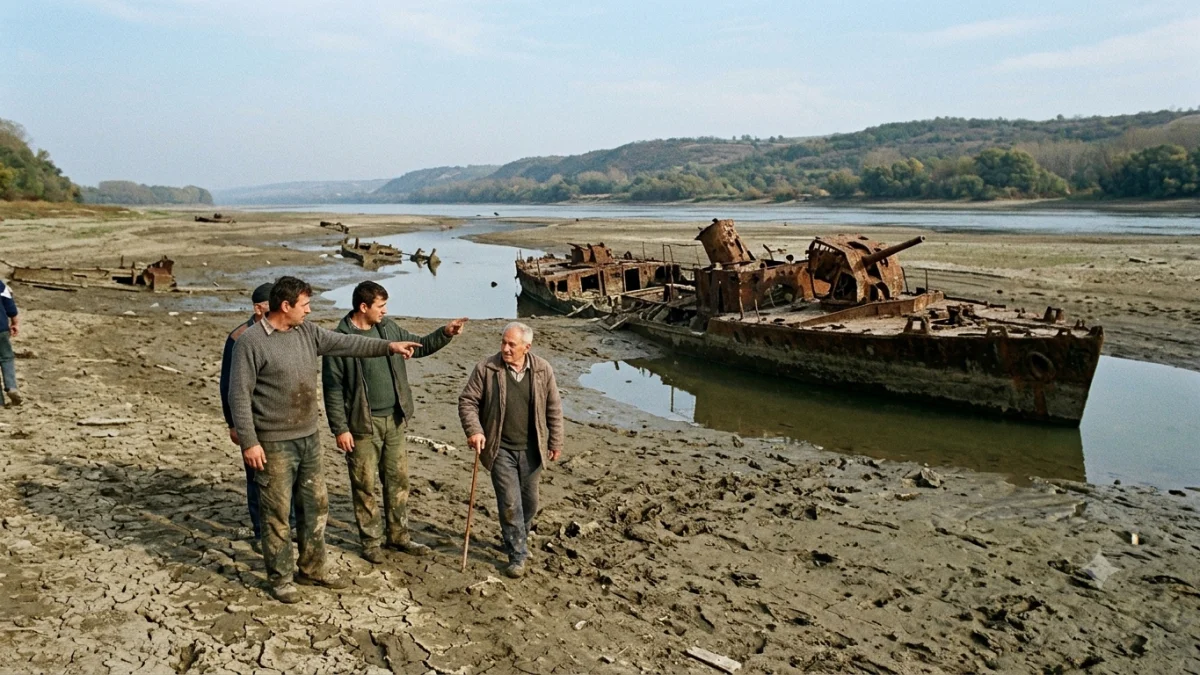
As one of the most severe droughts in recent memory pushed the river to exceptionally low levels across parts of Central and Eastern Europe, decades-old shipwrecks emerged from the riverbed, transforming familiar stretches of the Danube into reminders of both wartime history and a changing climate. In eastern Serbia, near the river town of Prahovo, the rusting remains of German World War Two warships once again surfaced after lying submerged for decades, while farther upstream and downstream other long-forgotten vessels became visible as the river retreated.


For communities that have lived alongside the Danube for generations, the exposed wrecks are more than historical curiosities. They have become visible markers of a river that many residents say they scarcely recognize.
In the Croatian municipality of Lovas, Mayor Lea Vidić said older residents could not remember seeing the river so low. A cargo ship that sank in 1937 has become clearly visible near Opatovac, a sight few locals had witnessed before.
"As we record one of the lowest water levels in history, a ship that sank way back in 1937 has surfaced," Vidić told Reuters in July, identifying it as the Hungarian cargo vessel Fulton, which had been carrying coal to Novi Sad when it sank.
The reappearance of the Fulton reflects a broader transformation taking place along Europe's second-longest river. Stretching nearly 2,900 kilometers from Germany's Black Forest to the Black Sea, the Danube links 10 countries and serves as one of Europe's busiest inland waterways. This year, prolonged heat, scarce rainfall and drought have reduced sections of the river to levels that have disrupted shipping, tourism, agriculture and power generation.
Near Prahovo, the emerging silhouettes are even older and more dangerous.
Dozens of German vessels from the Nazi Black Sea Fleet were deliberately scuttled in September 1944 as German forces retreated before the advancing Soviet Army. Many of the wrecks still contain ammunition and explosives, making them both historical relics and continuing navigation hazards. Although some vessels have been removed over the decades, many remain embedded in the riverbed.
The wrecks have become a recurring feature during recent years of unusually low water. They first drew widespread international attention during the European drought of 2022, reappeared again in 2024 and have now become visible once more as another exceptionally dry summer grips the region.
For residents whose livelihoods depend on the river, the consequences extend well beyond history.
Local resident Krsta Brandić told the Associated Press that shipping along the Danube had nearly stopped because water levels had fallen so dramatically. Barges have been forced to carry lighter loads or suspend operations on some stretches altogether, increasing transport costs throughout the region.
In Serbia, fisherman Zvonimir Balić said he had never seen the river so depleted.
"I don't remember the Danube ever being lower than it is now," he told Reuters. He said measurements suggested the river had reached levels unseen in more than a century, while pointing to prolonged drought, limited snowfall in the Alps and broader environmental changes as possible contributing factors.
Residents elsewhere along the river describe similar experiences.
In Novi Sad, local resident Zoran Tasić told Reuters that the exposed riverbed looked like "a natural disaster," noting the absence of rain and winter snow that normally replenish the river through seasonal melting.
Experts say the drought's effects extend beyond navigation. Reduced river flow has strained hydroelectric production and forced authorities in Romania to take emergency measures to maintain cooling water for nuclear power generation. Hungary has also reduced output at its Paks nuclear power station as water shortages intensified.
Environmental observers say the Danube's shrinking water level illustrates how climate pressures are intersecting with Europe's historic waterways.
Vladimir Stakić, editor-in-chief of the Serbian magazine Ribolov ("Fishing"), told Reuters that increasing water consumption, intensive agriculture, reduced rainfall and rising temperatures together contribute to unusually low river levels through greater evaporation and declining inflows.
"When everything comes together," he said, "we get the situation we have now: extremely and worryingly low water levels across Europe."
The exposed wrecks have also drawn archaeologists, photographers and curious visitors. In some locations across the Danube basin, receding waters have revealed not only ships but unexploded wartime ordnance and other historical artifacts, prompting safety concerns alongside renewed historical interest. Authorities continue to warn that some areas remain hazardous because of submerged explosives and unstable wreckage.
For villages that have watched the river rise and fall for generations, the newly visible hulls offer an unusual view into the past while underscoring uncertainty about the future.
The Danube has always carried traces of Europe's history beneath its surface. This year, as drought stripped away the water that concealed them, those traces became impossible to ignore. For many riverside communities, the rusting ships emerging from the riverbed are not only reminders of a war fought more than eight decades ago but also evidence of a river whose changing rhythms are reshaping everyday life.