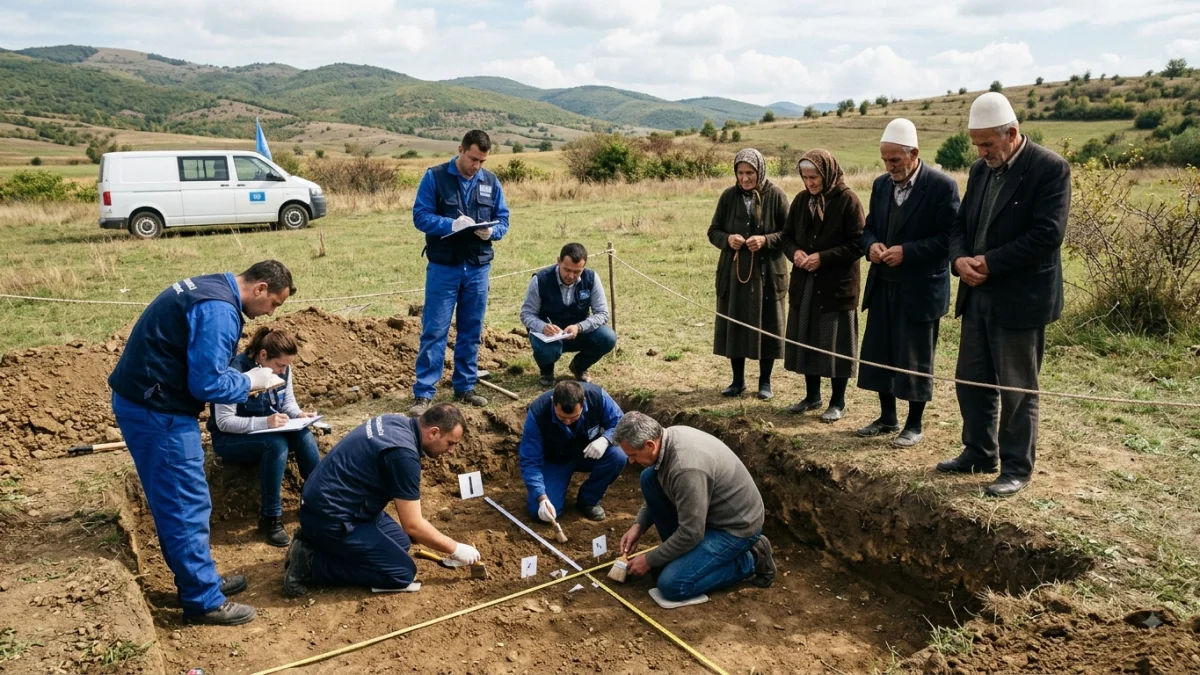


Near the northern Kosovo village of Kalluder e Vogel, forensic teams are digging into ground that may hold an answer families have waited nearly three decades to receive.
The excavation began after human remains were discovered in the area of Zubin Potok, a municipality where the site had not previously been excavated as part of the search for evidence from the 1998-99 Kosovo war. Preliminary forensic assessments confirmed that the remains were human and of forensic significance, according to Ditor Haliti, a member of Kosovo's Institute of Forensic Medicine.


For families of people who disappeared during the war, the excavation carries a significance that goes beyond the discovery of a possible grave. It offers the possibility of replacing decades of uncertainty with an identified body, a burial place and, perhaps, an account of what happened.
Among those watching the excavation is Erblin Ademi, who was 9 when he last saw his father, Adem Ademi, a prominent surgeon. His father disappeared in April 1999 together with 22 other intellectuals from Mitrovica. The group has remained among the unresolved cases from the conflict.
Ademi told The Associated Press that the latest excavation brought both hope and pain. “Always, when we hear about the beginning of the excavations, there is a mixed feeling, a feeling of hope and a feeling of pain,” he said. “No matter how many years pass, the feeling of pain will always exist ... but at the same time there has always been hope, a feeling that finally the truth will be revealed.”
The location has intensified that hope. Kosovo authorities have said the remains could belong to the 23 intellectuals, who were abducted and forcibly disappeared on April 19, 1999, but officials have stressed that the identities have not been established. Acting Prime Minister Albin Kurti said the possibility was the authorities' immediate suspicion after the discovery, while emphasizing that forensic authorities must determine what was found.
That distinction is important. A discovery of human remains is only the beginning of a process that can involve excavation, forensic examination, DNA comparison and the reconstruction of a person's identity. Kosovo's Institute of Forensic Medicine is responsible for the search, recovery and examination of remains connected to people missing from the war, as well as identification and the return of remains to families.
The process has already accounted for thousands of people. The International Commission on Missing Persons says more than 2,600 missing-person cases from the Kosovo conflict have been resolved through forensic work, including DNA testing, while more than 1,600 people remain missing.
The missing come from different communities. The Humanitarian Law Center estimates that roughly 1,200 of those still missing are ethnic Albanians, around 400 are ethnic Serbs and dozens are Roma, illustrating that the unresolved legacy of the war extends beyond a single community.
For the families, the absence of remains can make mourning difficult to complete. The International Committee of the Red Cross has said that families of more than 1,600 missing people were still waiting for answers more than 25 years after the conflict. Its work with families and institutions includes efforts to clarify the fate and whereabouts of missing relatives.
The search has also become entangled with the unresolved relationship between Kosovo and Serbia.
The 1998-99 war ended after a NATO bombing campaign forced the withdrawal of Serbian forces from Kosovo. Thousands were killed, most of them ethnic Albanians, and the conflict left a large number of people missing. Kosovo declared independence from Serbia in 2008, a step Belgrade has never recognized. The political dispute continues to shape cooperation over the missing.
In May 2023, Kosovo and Serbia agreed to commitments aimed at clarifying the fate of people who disappeared during the conflict. In January this year, the first trilateral meeting of a Joint Commission on Missing Persons was held with European Union participation. The commission's stated purpose is to oversee implementation of the missing-persons declaration and help provide answers to families.
The European Union has said the commission is also expected to support cooperation on identifying burial sites and conducting follow-up excavations, as well as improving access to records and other information that could help locate mass graves.
But cooperation has remained difficult. Kosovo officials have accused Serbia of failing to cooperate in efforts to establish the fate of the missing, while Serbian authorities have rejected Kosovo's actions in the Kalluder case. Serbia's government condemned the recent arrests of two Kosovo Serbs linked by investigators to the case as “terrorism, revenge and intimidation,” according to the Associated Press. The suspects were arrested on suspicion of war crimes against civilians.
The arrests and excavation have therefore unfolded against a political dispute that remains unresolved more than a quarter-century after the war. Yet for families, the immediate question is more personal than diplomatic: where are their relatives, and what happened to them?
International organizations working on missing persons have increasingly emphasized that families should remain informed and involved in the search process. In June, the International Commission on Missing Persons brought together Kosovo Albanian and Kosovo Serb family associations with Kosovo institutions to discuss transparency, communication and continued engagement.
For Ademi, the excavation is tied to the possibility of finally giving his father a place where the family can remember him.
“Every human being has the right to have a grave where they can be visited, where they can be honored, where they can be remembered,” he said. “We are very hopeful that this will be the end, no matter how long the whole process will take, we will wait until we can honor them as they deserve.”
The excavation may yet confirm whether the remains belong to the missing group of intellectuals or to others whose families have spent years searching for them. Until forensic examination establishes who is buried there, the ground at Kalluder e Vogel can offer only a possibility.
For the families still waiting, however, even that possibility represents something that has been absent for decades: the prospect that an unanswered disappearance may finally have an identifiable place, a name and a grave.