

The first task for many families displaced by the Bald Range wildfire was not deciding what to rebuild, but figuring out where they would sleep.
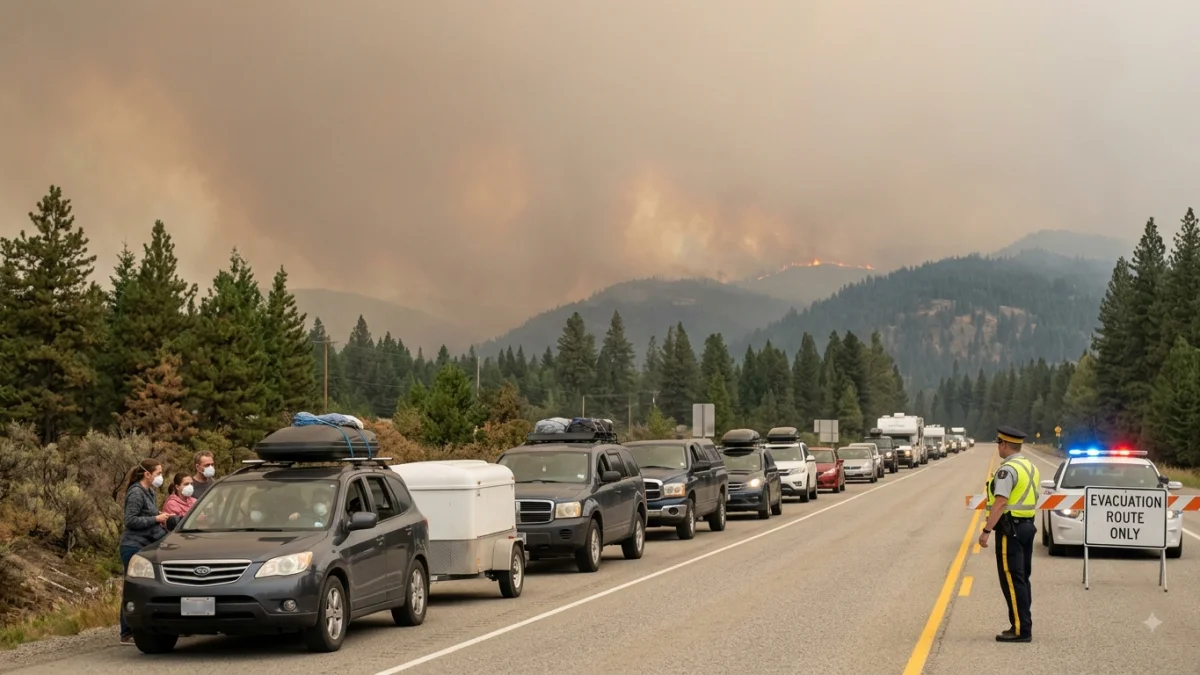
In the early hours of Saturday, as flames advanced toward Summerland and Peachland in British Columbia’s Okanagan Valley, residents packed vehicles and left under evacuation orders. Terry Fries of Summerland had been watching a football game Friday night when a neighbour warned him to prepare. After authorities ordered the evacuation around midnight, Fries and his family drove about 45 km north to Kelowna, according to Reuters.


For others, the departure was even more uncertain. At an evacuation centre in Penticton, Summerland resident Anette Boulet said the approaching fire “looked like doomsday.” She fled before dawn with her family and five dogs, unsure whether her home was still standing, the Associated Press reported.
That uncertainty has become the defining reality for thousands of people displaced by one of British Columbia’s fastest-moving wildfires this summer. Before families can assess damaged houses, replace lost possessions or decide whether they can return, they must secure temporary accommodation and wait for authorities to determine which neighbourhoods remain safe.
The Bald Range wildfire, first reported on Friday evening, expanded with extraordinary speed. By Saturday it had grown to about 9,500 hectares, according to Reuters, while evacuation orders covered Summerland, Peachland and other areas west of Okanagan Lake. More than 20,000 people across British Columbia had been forced from their homes, making it the province’s largest evacuation event of the summer at that point.
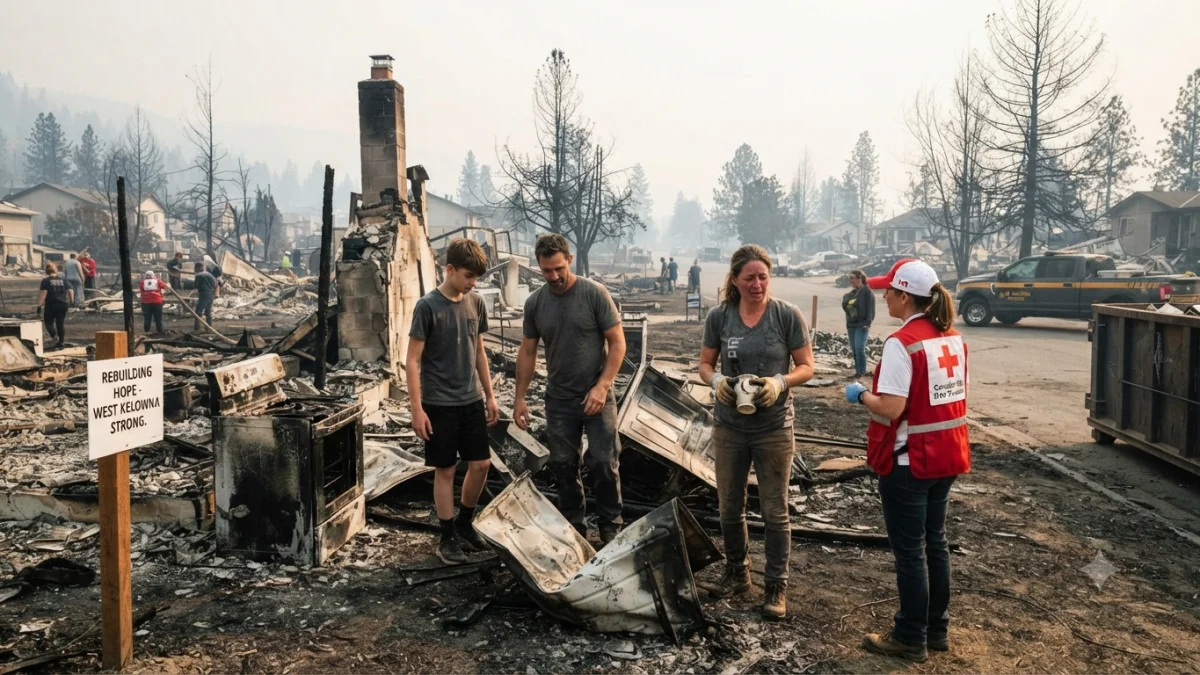
Summerland, a community of about 12,000 people, was ordered evacuated overnight. About 8,000 people in and around Peachland were also ordered to leave. Provincial officials said there had been significant structure loss but that the extent of the destruction could not yet be assessed because the fire remained an active emergency.
For some families, evacuation itself became an exercise in improvisation.
Erick Thompson, an emergency official with the Regional District of Okanagan-Similkameen, was among those forced to abandon his emergency operations centre. In a video recorded from his vehicle as traffic backed up, he explained that he had left the centre to collect his family and take them south.
“I had to leave the EOC to come and get my family to leave this area. We’re heading south,” he said, according to AP.
The experience illustrated how quickly the fire overwhelmed normal routines. Emergency officials themselves became evacuees, while roads filled with residents attempting to move away from the fire. Highway 97, a major route through the region, was closed between Peachland and Penticton as the evacuation unfolded. Firefighting aircraft were also used in rescues, with British Columbia Forests Minister Ravi Parmar saying more than 50 people had been rescued by aircraft.
By Saturday, Summerland had lost power and issued a boil-water notice after untreated water entered the system when the wildfire bypassed the municipal treatment plant, according to Reuters. Such disruptions mean that recovery extends well beyond the condition of individual homes. Electricity, drinking water, roads, workplaces, schools and access to basic services all become part of the calculation families face when they begin considering what comes next.
The human cost has also become clearer. Police said an 80-year-old woman died while attempting to leave her home in the Summerland area, while the British Columbia Coroners Service investigates the circumstances. Her death adds a fatal dimension to an evacuation in which residents were already confronting rapidly changing conditions.
The provincial government declared a state of emergency on Aug. 8, giving authorities additional powers to coordinate evacuations, restrict travel and secure accommodations. Federal authorities subsequently agreed to assist British Columbia with shelter and accommodation for people displaced by the fires around Summerland and Peachland.
The federal response is an indication of how large the immediate recovery challenge has become. On Aug. 9, Emergency Management and Community Resilience Minister Eleanor Olszewski said federal officials would work with the province to ensure displaced residents received support. The assistance came as the Bald Range fire had grown beyond 10,300 hectares, according to Reuters.
Yet the rebuilding question remains unsettled because the fire has not allowed authorities to make a complete accounting of what was lost.
Summerland Mayor Doug Holmes told Reuters that many farms had been affected and officials did not yet know how many structures had been destroyed.
“We have to brace ourselves for the worst,” Holmes said.
The uncertainty is particularly significant in the Okanagan, where homes and agricultural properties sit close to forested landscapes and where vineyards, orchards and other farms form an important part of the local economy. Reuters reported that the region produces most of British Columbia’s wine and is Canada’s second-largest wine-producing area.
The fire is also unfolding against a wider season of severe wildfire activity. More than 100 fires were burning across British Columbia as the Bald Range blaze intensified, with nearly half considered out of control. About 1,500 firefighting personnel were working across the province, while crews from countries including Mexico, Australia, France and New Zealand assisted Canadian firefighters.
British Columbia had already been preparing for an increasingly demanding wildfire season. In April, the BC Wildfire Service supported a wildfire-risk reduction project near Summerland and Faulder involving forest thinning, pruning, surface-fuel cleanup and prescribed burning. The project was intended to reduce wildfire severity and strengthen protection for nearby communities.
For residents now staying away from those communities, however, long-term planning is still secondary to the immediate work of displacement: finding a bed, caring for children and animals, keeping track of belongings and waiting for reliable information about whether a house can still be entered.
The first rebuilding therefore begins away from home.
It begins in evacuation centres, temporary accommodation and the homes of relatives and friends. It begins with families trying to restore ordinary routines while the landscape they left remains inaccessible. And for residents such as Fries and Boulet, it begins with a question that cannot yet be answered: what, exactly, will be waiting for them when they are finally allowed to go back?