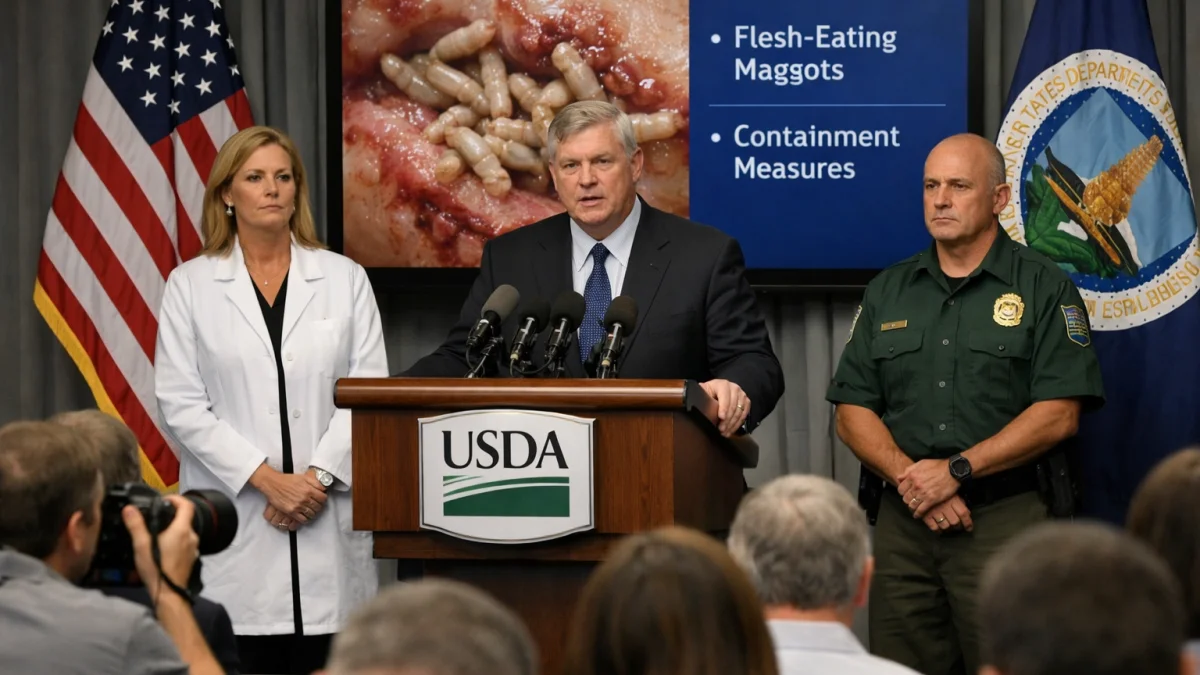


WASHINGTON — The U.S. Department of Agriculture (USDA) is reviewing and expanding its response to an outbreak of New World screwworm, a flesh-eating parasite whose larvae feed on living tissue, after confirmed detections in livestock and pets in the southern United States prompted heightened containment efforts, federal officials said this week.
The review comes as USDA and state animal health authorities continue emergency measures following the confirmation of New World screwworm cases in Texas and New Mexico earlier this month. The parasite, which had been eradicated from the United States decades ago, re-emerged after an outbreak that spread northward through Central America and Mexico, according to the USDA and the U.S. Centers for Disease Control and Prevention.


USDA’s Animal and Plant Health Inspection Service first confirmed the parasite in a calf in Zavala County, Texas, on June 3. Additional cases were subsequently identified in Texas and New Mexico, prompting movement controls, surveillance operations and the release of sterile flies aimed at disrupting the pest’s reproductive cycle, the agency said.
New World screwworm larvae burrow into the living tissue of warm-blooded animals, including livestock, wildlife and pets. Human infestations are rare, and the CDC said no locally acquired human cases have been reported in the United States during the current outbreak.
“Protecting our livestock industry is a national security issue of the utmost importance, and USDA is wasting no time in taking action,” Dudley Hoskins, USDA under secretary for marketing and regulatory programs, said in a statement issued after the initial detection.
The outbreak has raised concerns among ranchers and animal health officials because screwworm infestations can cause severe wounds and economic losses if left untreated. USDA has established response zones, expanded trapping efforts and continued aerial releases of sterile insects in affected areas, according to agency statements.
International organizations have also increased involvement. On Thursday, the International Atomic Energy Agency and the U.N. Food and Agriculture Organization announced a project to support containment efforts through sterile insect programs, citing concerns about the pest’s spread across the Americas.
Industry groups have called for additional resources to increase sterile-fly production, which experts consider a key tool for controlling the outbreak. Current production capacity remains below levels some officials say may be required if detections expand.
As of Friday, USDA said response operations were continuing in coordination with state authorities. The agency maintains movement restrictions in affected areas and has urged animal owners to report suspected cases immediately while investigations and surveillance efforts remain ongoing.