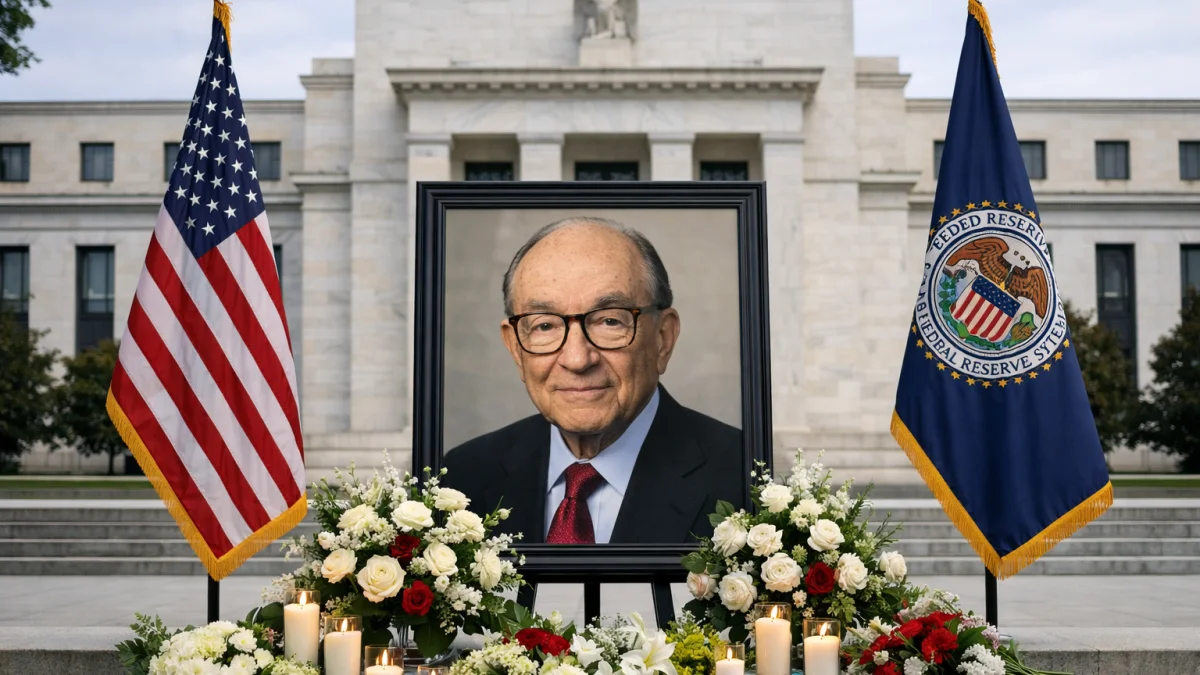


WASHINGTON — Alan Greenspan, the economist who served as chairman of the Federal Reserve for more than 18 years under four U.S. presidents, died on Monday at the age of 100, his wife announced.
The influential economist died at his home from complications of Parkinson's disease, said his wife of 29 years, Andrea Mitchell, the chief Washington correspondent and chief foreign affairs correspondent for NBC News.


"Alan passed away at our home this morning at the age of 100 from complications of Parkinson's Disease," Mitchell said in her statement. "He was a giant of a man who helped shape the U.S. economy for decades under presidents of both parties, but was always honest in acknowledging his mistakes."
Greenspan served five terms as Fed chairman under four presidents, starting with Ronald Reagan, who nominated him in 1987. His term under George W. Bush expired in 2006. His eighteen-and-a-half year tenure is the second longest as head of the nation's central bank.
During his more than 18 years at the helm of the Fed, Greenspan presided over a sustained era of American growth and prosperity. Originally appointed by President Ronald Reagan in 1987, Greenspan was immediately tested after the stock market suffered one of its worst single-day losses in U.S. history. He assured Wall Street that the Fed would supply as much money to the financial system as was needed to restore calm, and stocks recovered.
He also led the economy through the 1997–1998 Asian and Russian financial contagion, the collapse of the dot-com stocks bubble in 2000, and the turbulent economic aftermath of the September 11, 2001, attacks.
"Under his leadership, the Federal Reserve achieved a sustained era of price stability that supported economic growth and helped anchor the public's confidence in the institution," the U.S. Federal Reserve said in a statement on Monday.
Greenspan suffered a reputational blow not long after his term ended in 2006, when the U.S. housing market collapsed, triggering the worst economic recession since the 1930s. Critics pointed to his policies that fuelled a series of asset price bubbles and laid the groundwork for the 2007–2009 financial crisis.
"I think the deification that came just before the financial crisis was never really deserved, and I think the lambasting that he took after he left was never fully deserved either," Stephen Oliner, a former senior Fed official, told the Reuters news agency.
In 2011, the bipartisan Financial Crisis Inquiry Commission determined that the crisis was triggered in part by Greenspan's failure to discourage trade in securities backed by subprime mortgage loans amid an unsustainable housing boom and his promotion of financial industry deregulation.
"His extraordinary 18 years as chairman left behind an enduring legacy, and his dedication to the institution, the field of economics and public service continues to inspire generations of central bankers," said John Williams, president and CEO of the Federal Reserve Bank of New York.
Greenspan was born on March 6, 1926, in New York City. He married Mitchell in 1997 in a ceremony officiated by the late Supreme Court Justice Ruth Bader Ginsburg. Details on funeral arrangements were not immediately available.