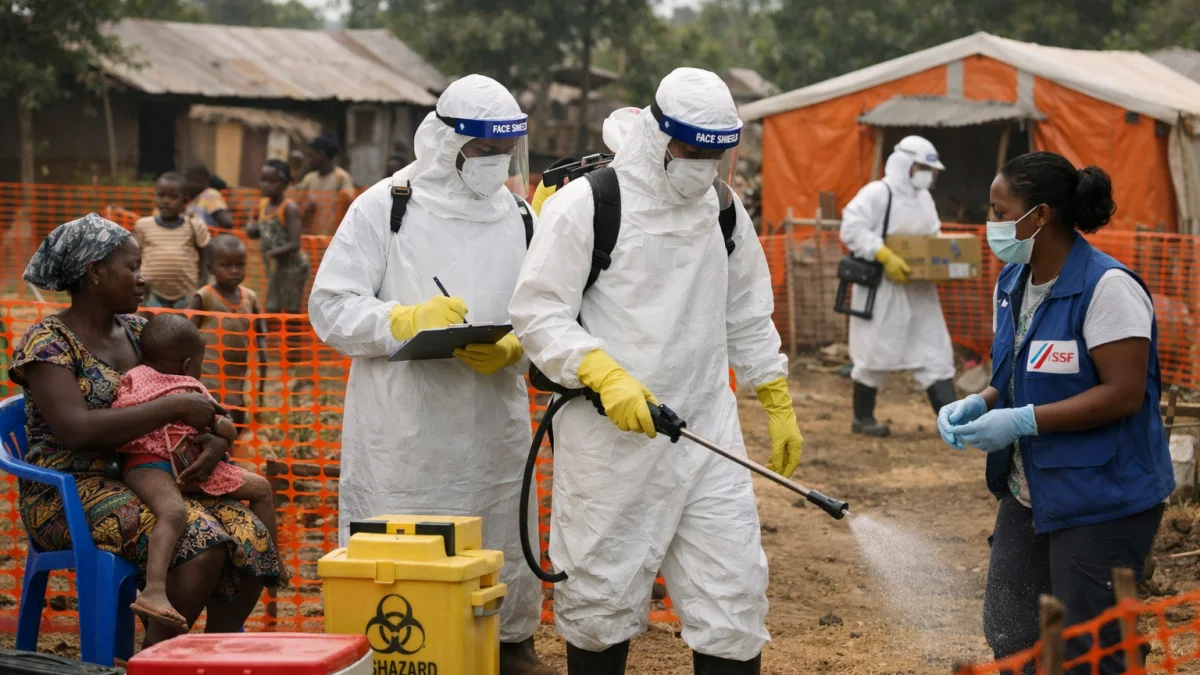
In the eastern Democratic Republic of the Congo, where conflict has displaced communities and strained already fragile health services, the work of stopping Ebola often begins with a conversation rather than a medical procedure.
Health workers, volunteers and humanitarian teams move from village to village, health facility to health facility, explaining symptoms, tracing contacts and encouraging families to seek care despite fear, misinformation and the disruption caused by violence. Their work has become an essential part of an increasingly urgent response to the largest recorded outbreak of the Bundibugyo strain of Ebola virus, one that the World Health Organization says has continued to outpace containment efforts.
The challenge extends well beyond treating patients. Humanitarian organizations are trying to protect children, preserve routine health services and maintain trust in communities where years of conflict have made outside intervention a source of suspicion as often as reassurance.
That human dimension has become central to the response. As confirmed Ebola cases surpassed 1,000 in June, UNICEF warned that nearly 3 million children and adolescents in eastern Congo faced growing risks—not only from the virus itself but also from disruptions to education, nutrition, vaccination and child protection services. Children account for a significant share of confirmed infections and deaths, while many others have lost parents or caregivers during the outbreak.
The outbreak, first officially identified in May after the virus had circulated undetected for months, has spread primarily through Ituri province while also reaching neighboring Uganda through cross-border transmission. WHO has described the risk inside the Democratic Republic of the Congo as very high, citing expanding geographic spread, population movement and the pressures created by insecurity.
Containing Ebola depends on rapidly identifying cases, isolating patients, tracing contacts and maintaining infection prevention measures. Those tasks become considerably harder when humanitarian workers cannot safely reach communities.
WHO Director-General Tedros Adhanom Ghebreyesus has warned that violence against health workers and attacks on response facilities have repeatedly disrupted operations. Several security incidents have targeted frontline personnel, while distrust surrounding burial practices and misinformation about the disease have complicated efforts to identify contacts before further transmission occurs.
In some displacement camps, health teams have been unable to follow up with people who may have been exposed after local residents rejected the diagnosis of Ebola and prevented response teams from entering. Officials say such interruptions create opportunities for the virus to spread unnoticed.
The outbreak is also unfolding in mining areas where many workers move frequently between communities, making traditional contact tracing more difficult. WHO says expanded laboratory capacity has dramatically increased daily testing, allowing authorities to identify more infections that previously would have gone undetected. The rising case numbers therefore reflect both continuing transmission and improved surveillance.
Humanitarian agencies stress that protecting communities requires more than emergency treatment centers. Maintaining maternal health care, childhood immunization, nutrition programs and clean water supplies helps reduce the wider consequences of the outbreak while encouraging families to continue using health services.
UNICEF has expanded community engagement efforts, distributed infection-prevention supplies and supported water, sanitation and hygiene programs alongside public health messaging. Local volunteers and community leaders have become important partners in explaining how Ebola spreads and why early treatment matters, particularly in areas where rumors circulate quickly through social media and word of mouth.
For families already displaced by armed conflict, daily priorities often extend beyond avoiding infection. Many live in crowded settlements with limited access to health care, clean water or stable incomes. Those conditions increase both the difficulty of containing the virus and the broader humanitarian needs that accompany the outbreak.
Health workers themselves face considerable risks. WHO has reported infections among healthcare personnel, underscoring the importance of protective equipment, training and infection-control procedures inside clinics that remain under pressure from rising patient numbers.
The scientific response is also continuing. Because no approved vaccine currently exists for the Bundibugyo strain, UNICEF, Gavi, WHO and other partners have launched efforts to accelerate vaccine development and manufacturing should candidate vaccines prove effective. International agencies say expanding future vaccine availability could strengthen preparedness for similar outbreaks, although immediate containment still depends on traditional public health measures and sustained community cooperation.
Funding remains another concern. International health agencies have appealed for additional resources to support surveillance, treatment, logistics and essential humanitarian services. Officials warn that inadequate financing could slow both emergency medical operations and the broader assistance vulnerable communities require.
Despite the scale of the crisis, frontline responders continue to emphasize that local participation remains one of the strongest tools available against Ebola. Community health workers, religious leaders, teachers and volunteers often become the first trusted voices families encounter, helping bridge the gap between public health guidance and local experience.
Their work rarely attracts the attention given to laboratory breakthroughs or emergency declarations. Yet each conversation that persuades someone to report symptoms, accept testing or cooperate with contact tracers can interrupt another chain of transmission.
As the outbreak continues, humanitarian workers are balancing two responsibilities that cannot easily be separated: containing a dangerous virus while supporting communities already coping with conflict, displacement and fragile public services. Their success depends not only on medical expertise but also on the difficult task of sustaining trust under some of the most challenging conditions facing global public health.