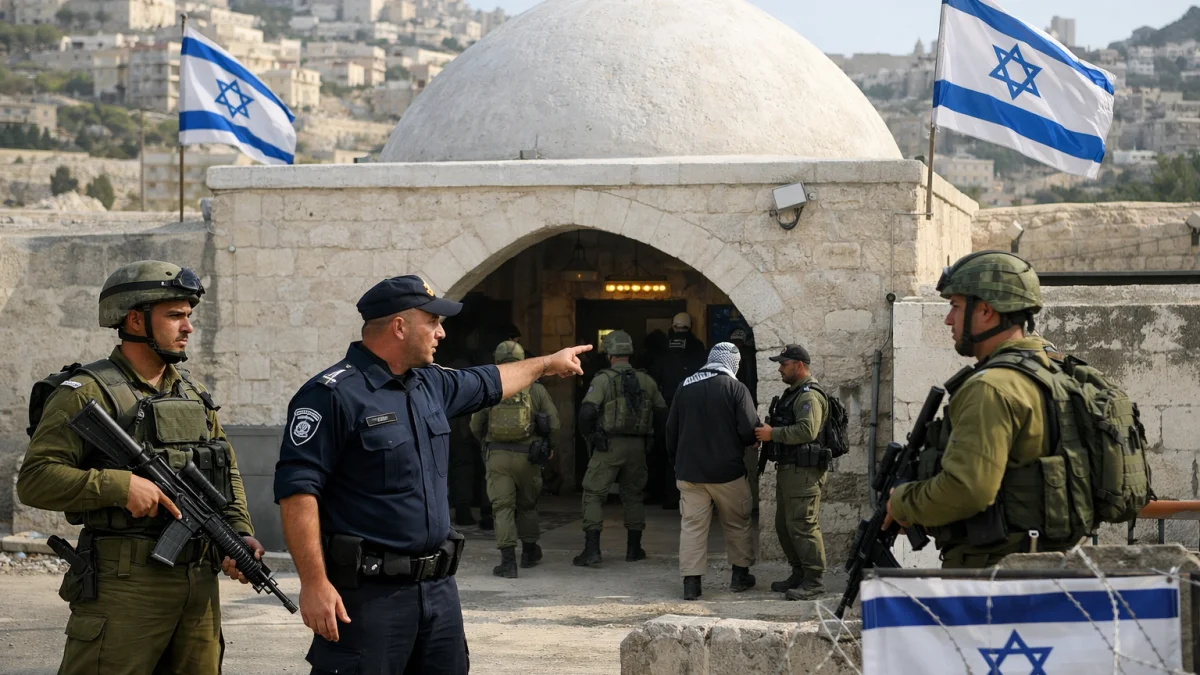


JERUSALEM — Israel has taken control of planning and construction powers at a religious site in the occupied West Bank from Palestinian authorities, altering parts of an arrangement that had been in place since the 1990s, according to Israeli and Palestinian officials.
Israeli Finance Minister Bezalel Smotrich said on June 16 that he had approved the transfer of authority over planning and construction matters affecting the Tomb of the Patriarchs, revered by Jews, and the adjoining Ibrahimi Mosque, a major Muslim holy site in the city of Hebron. Under the 1997 Hebron Agreement, Palestinian authorities held responsibility for planning and construction across the city, including the shrine area.


Smotrich described the move as a “historic step” that would strengthen Israeli authority in the West Bank, according to remarks reported by Israeli media and Reuters. The decision was announced alongside broader measures supporting Israeli settlement activity in the territory.
The shrine, known to Jews as the Tomb of the Patriarchs and to Muslims as the Ibrahimi Mosque, is among the most sensitive religious sites in the Israeli-Palestinian conflict. Jews believe it is the burial place of the biblical patriarchs Abraham, Isaac and Jacob and their wives, while Muslims revere Abraham and regard the site as a major mosque.
The office of Palestinian President Mahmoud Abbas condemned the decision, calling it “an infringement upon the political and legal status of Hebron” and a violation of international law. Palestinian officials said the measure undermines existing agreements governing the city and its historic center.
Israel’s Foreign Ministry said the broader Hebron Agreement remains in force but accused the Palestinian municipality of failing to cooperate on matters related to the site, according to Reuters.
The move follows a series of actions by the government of Prime Minister Benjamin Netanyahu that have expanded Israeli administrative powers in the West Bank and facilitated settlement development, measures that have drawn criticism from Palestinian leaders and several foreign governments.
As of Thursday, there was no indication that the decision would be reversed. Israeli authorities have also advanced additional construction plans in Hebron, while Palestinian officials continue to oppose the transfer of powers and maintain that it violates longstanding agreements governing the city.