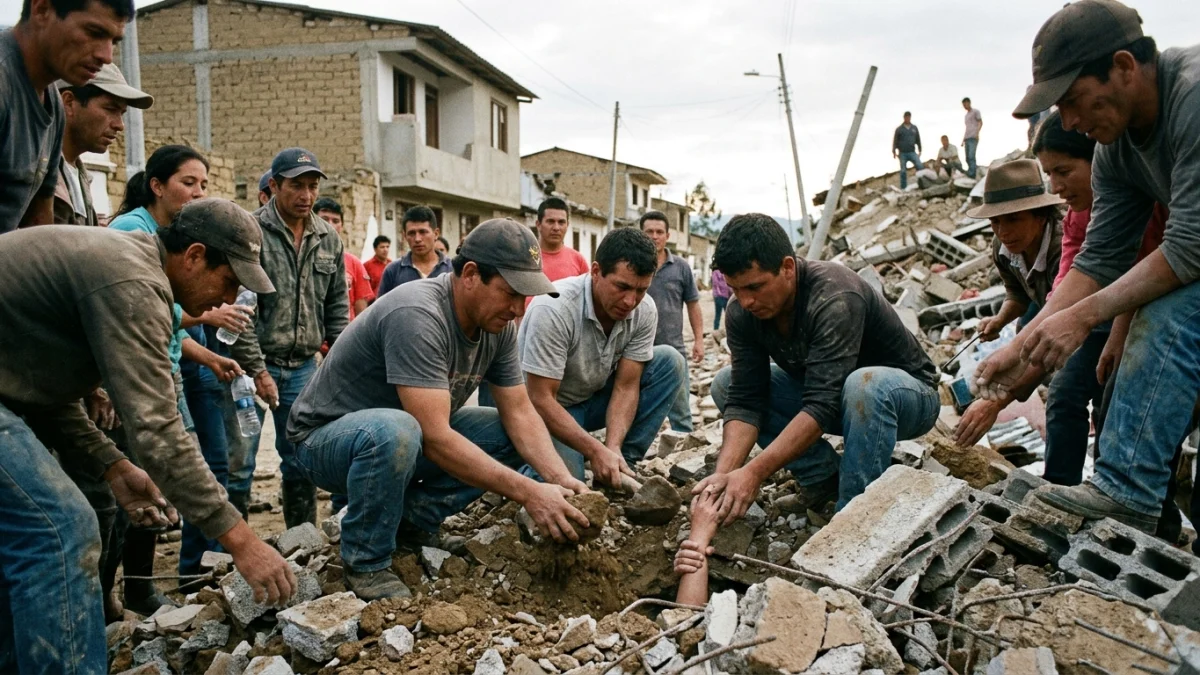


At the ruins of a collapsed apartment complex in Cali, the search for survivors became a race measured not only in hours but in the strength of human hands.
After a 7.4-magnitude earthquake struck western Colombia on Aug. 10, residents, volunteers and professional rescuers converged on damaged buildings, clearing concrete and debris in the hope that someone might still be alive beneath it. Reuters reported that residents joined rescue crews, using both machinery and their hands as they searched through the wreckage.


For those gathered around the ruins, the work had an immediate purpose: find the people who could not get themselves out.
The earthquake, centered in the department of Chocó, became one of the most destructive seismic events Colombia had experienced in decades. By Aug. 12, authorities reported 265 confirmed deaths, nearly 500 people missing and more than 3,770 injured. More than 9,550 homes had been destroyed, according to Reuters, with major damage in cities including Cali and Pereira.
Yet amid the scale of the disaster, individual rescues gave the search a human dimension.
At the Torres del Limonar complex in Cali, rescuers and civilians worked among collapsed sections of the building as families waited for news. One rescue brought cheers when a woman was pulled alive from the debris, Reuters reported.
Another rescue involved a baby found beneath the rubble. Local volunteer Brian Osorio Zuluaga was trying to make his way home after the earthquake when he heard faint sounds coming from the wreckage, according to reports. He and other rescuers investigated and found a trapped man with an infant. They cleared debris together and eventually lifted a concrete slab that had blocked their progress, freeing the child.
The rescues illustrated a reality familiar after major earthquakes: before sophisticated equipment can reach every damaged structure, ordinary people are often already there.
Residents know the buildings, the streets and the people who live nearby. In the first hours after a disaster, that familiarity can become an essential part of the search. But working inside or beside unstable structures is also dangerous, particularly when aftershocks continue.
More than 100 aftershocks were recorded after Monday's earthquake, Reuters reported, adding another hazard to already precarious rescue operations. Authorities subsequently worked to control access around collapsed buildings, warning that large numbers of volunteers could interfere with specialized equipment and rescue procedures.
The tension between the urgency to help and the need for organized rescue became increasingly important as the first 72 hours passed.
That period is widely regarded by rescue teams as a critical window for finding survivors. By Wednesday, crews were still working through collapsed structures while families waited for information about relatives who remained missing. Reuters reported that international rescue teams, including personnel from Mexico and Peru, had joined the response.
The disaster also exposed differences in how quickly help could reach communities.
In parts of Chocó near the epicenter, Indigenous communities were cut off from basic services and faced difficulties receiving assistance, Reuters reported. Damaged infrastructure and disrupted communications complicated efforts to establish the full scale of the disaster.
For families in the affected areas, the statistics offered only part of the picture. A missing-person figure could represent a parent, child, neighbor or friend whose fate remained unknown. Each collapsed building could contain another search, another family waiting behind a cordon, another possibility that someone might still answer from beneath the concrete.
That uncertainty kept residents returning to the rubble even as the professional response expanded.
Colombia had already demonstrated the importance of trained search-and-rescue capacity earlier this year, when its USAR COL-1 team deployed to Venezuela after deadly earthquakes there. The Colombian government said the team included 63 rescuers and four specialized dogs and had rescued an 11-year-old boy who had spent hours trapped beneath debris.
Back home, however, the scale of the August disaster meant that professional teams could not be everywhere at once. Volunteers and neighbors became part of the first response, searching alongside firefighters, soldiers and other emergency personnel.
Their contribution was not a substitute for specialized rescue operations. It was the human response that began before the full machinery of disaster relief could reach every site.
By the third day, the search was becoming more difficult. The window for finding survivors was narrowing, the number of confirmed deaths had risen and thousands of families were facing damaged or destroyed homes. President Abelardo De La Espriella pledged an emergency reconstruction fund for homes, hospitals, schools and infrastructure, while rescue operations continued at collapsed buildings.
But for those still waiting at the edge of the rubble, reconstruction remained a distant concern.
The immediate question was simpler: Was someone still alive underneath?
Across Cali and other hard-hit communities, that question kept rescuers moving debris, kept residents waiting for news and kept hands reaching into the wreckage. In a disaster measured in deaths, injuries and destroyed buildings, the rescues offered a smaller measure of what was at stake — one person at a time, one family at a time, one life that could still be brought out.