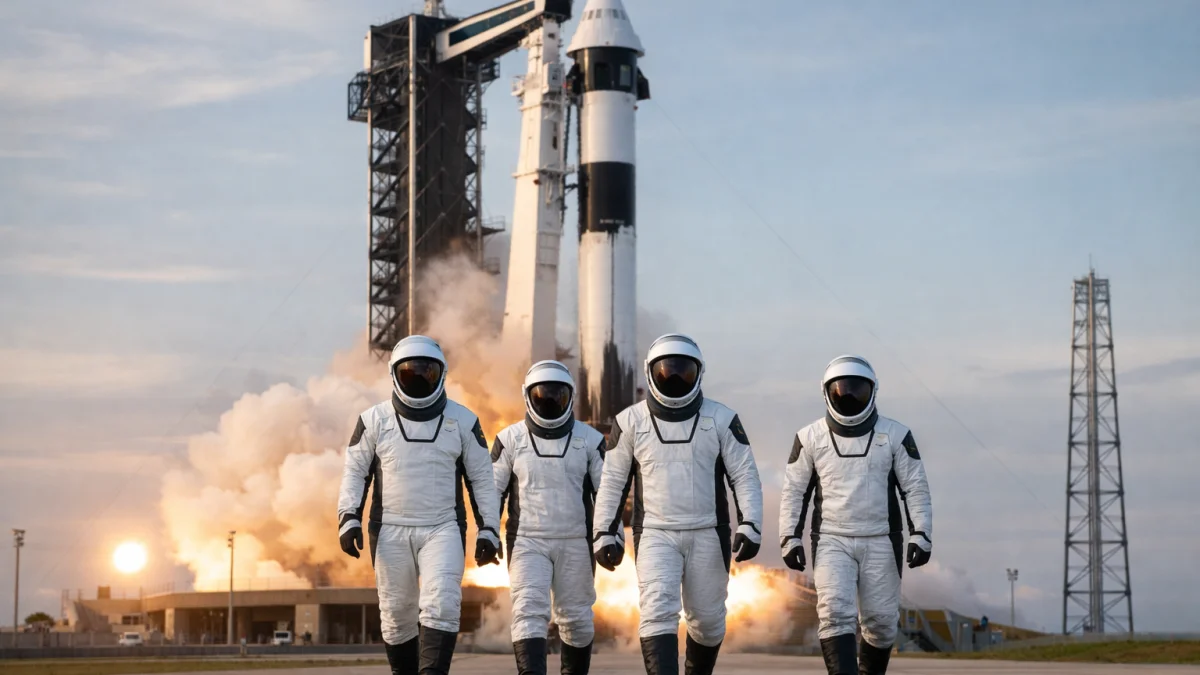
HOUSTON — The commercial space industry reached a new milestone in crewed spaceflight this year as private companies expanded their role in transporting astronauts and developing missions that support future operations in low Earth orbit, according to announcements from NASA and industry participants.
The latest milestone was highlighted by NASA’s decision in January to award Axiom Space a fifth private astronaut mission to the International Space Station (ISS), marking the continuation of a program that has increasingly shifted human spaceflight activities toward commercial providers. NASA said the mission, known as Axiom Mission 5, is scheduled to launch no earlier than January 2027 from the agency’s Kennedy Space Center in Florida.
“The award of our fifth private astronaut mission shows that commercial space is not a distant promise, but a present reality,” NASA Administrator Jared Isaacman said in a statement announcing the mission order. NASA said the flight is expected to spend up to two weeks at the ISS and will carry a privately organized crew pending regulatory and international approvals.
Private astronaut missions have become a central component of NASA’s strategy to encourage commercial activity in orbit while the agency focuses on lunar and deep-space exploration. Since 2022, Axiom Space has flown four private astronaut missions to the ISS, carrying government-sponsored astronauts, researchers and commercial participants from multiple countries.
NASA officials said the missions serve as a testing ground for future commercial operations and support the development of privately operated space stations intended eventually to succeed the ISS. Dana Weigel, manager of NASA’s International Space Station Program, said private missions help create new markets and research opportunities while contributing to a growing space economy.
The milestone comes amid broader growth in the private space sector. Companies including Axiom Space and Vast Space have received NASA support for future privately organized astronaut missions, while several firms continue work on commercial orbital platforms designed to host research, manufacturing and future crews.
Industry participants have also continued raising capital to support human-spaceflight projects. Earlier this month, Axiom Space announced the closing of a financing round valued at more than $525 million, saying the funds would support its human spaceflight programs, spacesuit development and plans for a commercial space station.
The expansion of commercial crewed missions is occurring alongside NASA’s Artemis program, which increasingly relies on partnerships with private companies for spacecraft, lunar landers and other exploration systems. NASA recently named the crew for its Artemis III mission, which will involve spacecraft developed by commercial partners as part of preparations for future lunar operations.
As of Thursday, private astronaut missions remained a growing segment of the space industry, with additional crewed flights planned and commercial station development continuing. Details regarding future mission crews and launch schedules beyond currently announced flights remain subject to regulatory review and operational planning.