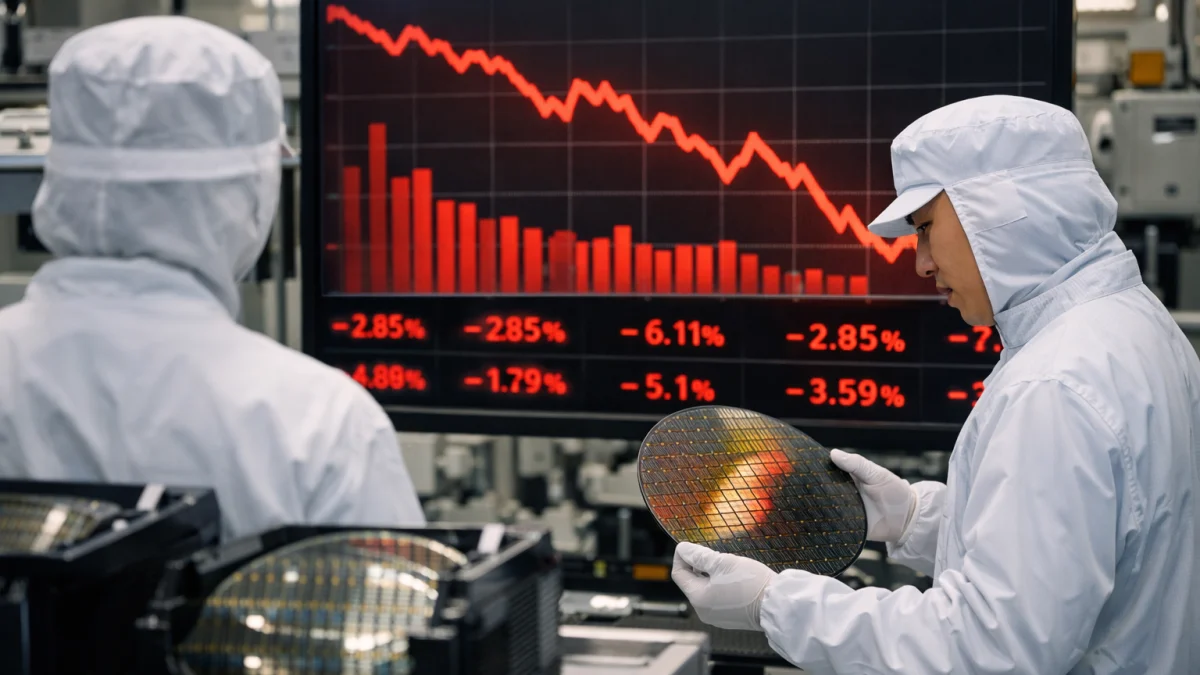


SEOUL — South Korea’s benchmark KOSPI index plunged nearly 10 percent on Tuesday, its steepest drop in more than three months, as overseas investors sold off major chipmakers amid concerns the sector’s rally had become overheated, market participants and regulators said.
The KOSPI closed down 9.99 percent, or 910.71 points, at 8,203.84 points, triggering an automatic 20-minute trading halt in the afternoon, according to the Korea Exchange. Samsung Electronics and SK Hynix, which together account for more than half the market’s value, each fell more than 12 percent.


The sell-off followed regulatory signals cautioning against excessive leverage in the sector and came after the index hit a record high above 9,100 points the previous day. Foreign investors were net sellers of chip stocks, data from the exchange showed.
Samsung Electronics shares declined more than 12 percent, while SK Hynix, a key supplier of high-bandwidth memory chips for artificial intelligence, dropped a similar amount. The two companies had recently joined the ranks of firms with market capitalizations exceeding $1 trillion, fueled by global AI demand.
“Investors appear to be taking profits after the rapid run-up,” a market analyst at a Seoul-based brokerage said, speaking on condition of anonymity.
The decline reflected broader pressure on global technology stocks, with concerns over valuations in the artificial intelligence sector contributing to the pullback. South Korea’s market has been one of the world’s top performers this year, largely on the strength of its semiconductor industry.
Financial Supervisory Service officials had earlier issued cautions regarding leveraged exchange-traded funds tied to Samsung and SK Hynix, highlighting risks from extreme volatility. Retail investors, who hold significant positions, faced amplified losses in such products.
Other sectors also declined, though chipmakers led the losses. The smaller Kosdaq index fell as well. South Korean authorities have been monitoring market stability, with officials noting the concentration risk posed by the dominance of the two chip giants.
As of Wednesday, trading resumed with some stabilization attempts, but volatility remained elevated. Regulators and exchange officials continued to monitor the situation, with no immediate additional measures announced. The investigation into the full extent of foreign outflows and domestic retail positions was ongoing.
The episode underscores the market’s heavy reliance on semiconductor performance amid global demand for AI-related chips.