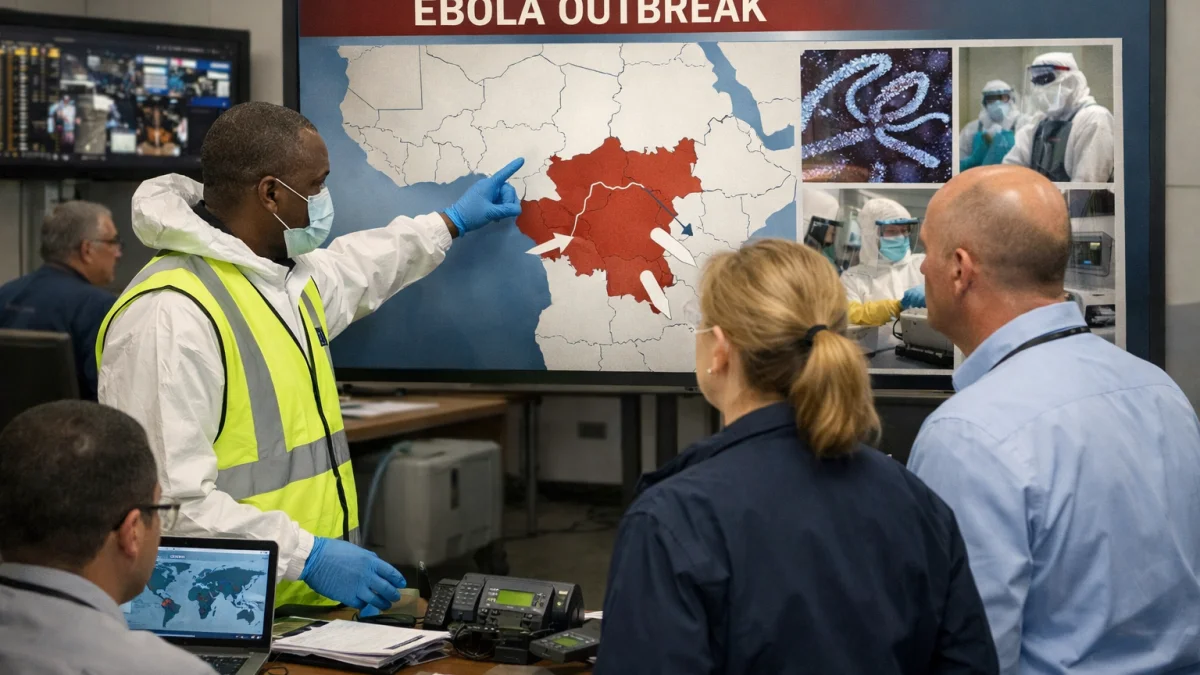


GENEVA — Public health authorities are intensifying surveillance efforts to monitor the potential spread of an Ebola outbreak beyond the Democratic Republic of the Congo, after confirmed cross-border cases were reported in Uganda and health officials warned that transmission remains active in affected regions.
The World Health Organization (WHO) said the outbreak, caused by the Bundibugyo species of the Ebola virus, continues to expand in eastern Congo and has already resulted in imported infections and limited secondary transmission in neighboring Uganda. WHO officials said on Friday that preparedness measures are being strengthened across the region to reduce the risk of further international spread.


According to WHO, Uganda has reported confirmed cases linked to transmission originating in Congo, including infections among contacts and healthcare workers. As of mid-June, Ugandan authorities had not reported evidence of widespread community transmission, but health agencies continued contact tracing and border monitoring operations.
The outbreak was officially declared by Congolese authorities on May 15 after laboratory confirmation of Bundibugyo virus disease. WHO has described the situation as a rapidly evolving public health emergency occurring in a region affected by population movements, insecurity and humanitarian challenges. The agency said there is currently no licensed vaccine or specific treatment approved for the Bundibugyo strain, although candidate therapies and vaccines are being evaluated.
WHO and Congo's health ministry have reported a steady rise in confirmed infections in recent weeks. Government figures released on Thursday showed the number of confirmed cases had increased to nearly 900, while deaths exceeded 200. Health officials cautioned that investigations into earlier suspected cases remain ongoing and that some figures could be revised as surveillance continues.
Healthcare workers have been among those affected. WHO said more than 70 medical personnel have contracted the virus since the outbreak began, highlighting the challenges facing hospitals and treatment centers in affected provinces. “The outbreak is taking a heavy toll on health workers,” WHO emergency director Marie Roseline Belizaire said, according to Reuters.
International agencies, including WHO and the Africa Centres for Disease Control and Prevention, have expanded support for response operations in Congo and Uganda. Measures include surveillance, laboratory testing, contact tracing, infection-control programs and cross-border preparedness activities.
WHO's latest risk assessment classifies the risk within Congo as very high and the risk in Uganda as high because of confirmed cross-border transmission. The agency said the global risk remains lower, but officials continue to monitor developments closely. As of Friday, no additional countries had reported confirmed local transmission linked to the outbreak, according to WHO updates.