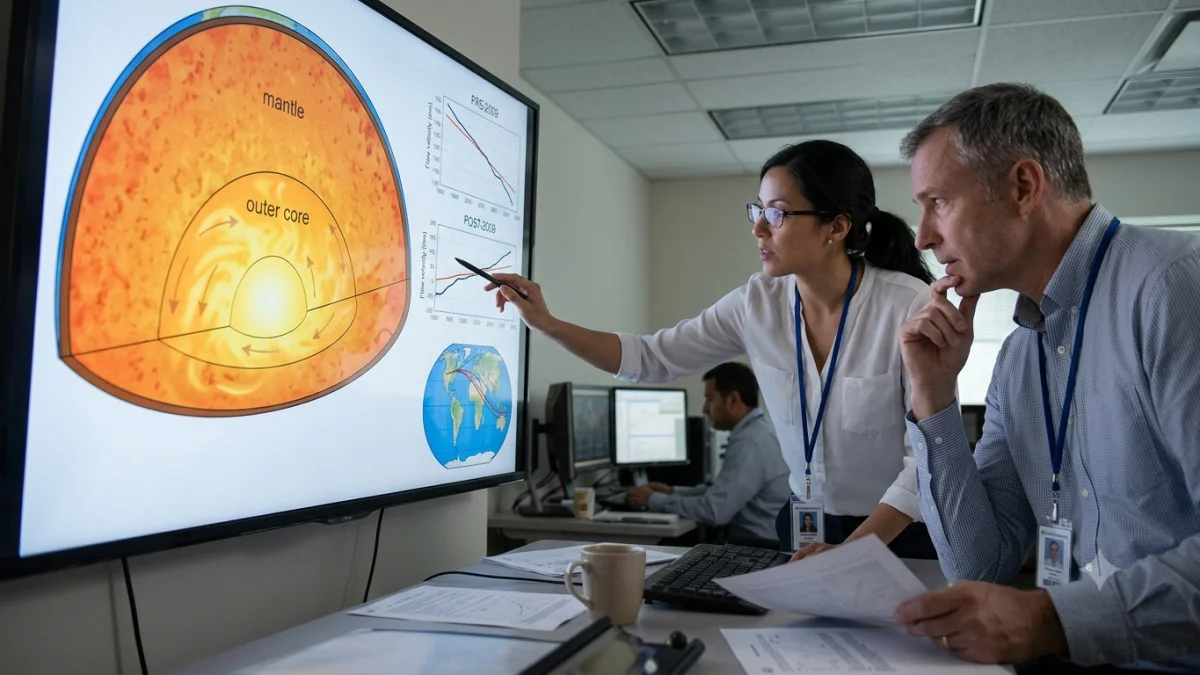


For years, maps of Earth's magnetic field suggested a familiar pattern deep beneath the planet's surface: molten iron circulating through the outer core drifted predominantly westward, helping sustain the geodynamo that shields Earth from harmful solar radiation. Then researchers noticed something unexpected. Beneath the equatorial Pacific, a vast region of that flow changed course around 2010, reversing into a strong eastward current before weakening again roughly a decade later.
The discovery, reconstructed from nearly three decades of satellite observations and ground-based magnetic measurements, has offered scientists an unusually detailed glimpse into one of the least accessible places on Earth. More than 2,000 kilometers beneath the surface, where no instrument can travel directly, subtle changes in the planet's magnetic field have become a window into the movement of liquid iron that drives Earth's magnetic engine.


For the researchers who study Earth's deep interior, the finding represents less a dramatic upheaval than a reminder that the planet remains an evolving system whose hidden dynamics continue to challenge long-held assumptions.
The work, led by Frederik Dahl Madsen of the University of Edinburgh with colleagues from the British Geological Survey and the University of Edinburgh, analyzed observations spanning 1997 through 2025. By combining measurements from ground observatories with magnetic data collected by European satellite missions—including the European Space Agency's Swarm constellation and CryoSat, as well as earlier CHAMP and Ørsted missions—the team reconstructed changing patterns of flow at the top of Earth's outer core.
Historically, those reconstructions showed a predominantly westward circulation, consistent with decades of observations of Earth's slowly changing magnetic field. But beneath the Pacific, researchers found that the pattern shifted markedly around 2010, becoming strongly eastward before gradually diminishing after 2020.
"The large-scale flow reversal beneath the Pacific raises new questions about the behaviour of Earth's deep interior," Madsen said in a University of Edinburgh statement. He said scientists now want to determine whether the reversal represents a short-lived fluctuation, part of a repeating oscillation, or the emergence of a new stable pattern of circulation.
Understanding those possibilities matters because Earth's magnetic field originates in the outer core, where convecting molten iron and nickel generate electric currents through the geodynamo process. Although the newly identified regional reversal is not expected to threaten that protective magnetic field, it offers scientists fresh evidence that the core may be more dynamic than previously understood.
The research also illustrates how advances in space-based observation have transformed a field once limited largely to indirect inference.
ESA's Swarm satellites, launched in 2013, were designed to measure tiny variations in Earth's magnetic field with exceptional precision. Flying in carefully coordinated orbits, the spacecraft can distinguish magnetic signals originating deep within the core from those produced by the crust, oceans and upper atmosphere. Those measurements, combined with decades of observations from earlier missions and magnetic observatories on the ground, enabled researchers to track changes unfolding thousands of kilometers below the surface.
"This study shows that regional changes can emerge rapidly within just a decade," ESA Swarm mission scientist Elisabetta Iorfida said in the agency's announcement. She said the findings could help scientists investigate possible interactions among Earth's outer core, inner core and lower mantle, improving understanding of processes occurring near the core-mantle boundary.
The discovery adds to a growing body of evidence that Earth's interior is neither static nor easily predictable.
Researchers have long documented gradual shifts in the magnetic field, including so-called geomagnetic jerks—rapid changes that appear over periods of months or years—and continuing evolution of features such as the South Atlantic Anomaly. Each observation provides another clue to the complex interaction between heat, rotation and fluid motion inside the planet. Yet many questions remain unresolved because scientists must infer these processes indirectly from magnetic and seismic measurements rather than direct observation.
The newly documented reversal also highlights how scientific understanding evolves as observational records lengthen. Earlier generations of researchers lacked the continuous, high-resolution satellite coverage now available. By extending magnetic records across nearly 30 years, the new analysis captured a regional transition that might previously have gone unnoticed.
The study does not suggest an imminent reversal of Earth's magnetic poles or any immediate consequences for life on the surface. Scientists involved in the research emphasize that the observed change concerns regional flow within the outer core rather than a collapse of the global magnetic field. Instead, the work expands knowledge of the mechanisms that sustain the geodynamo over decades and centuries.
For planetary scientists, the finding is also a reminder of the value of long-term monitoring. Satellites built to measure minute variations in magnetism are revealing processes unfolding in a realm that remains physically unreachable. Every additional year of observations allows researchers to test whether unusual events are isolated episodes, recurring cycles or signs of broader changes within Earth's interior.
The arrows in the researchers' reconstructed maps trace invisible currents through molten metal more than 2,000 kilometers underground. They do not provide all the answers. Instead, they mark the beginning of new questions about how Earth's deepest layers exchange energy, how the magnetic field evolves over time, and how much remains to be discovered beneath the ground on which every human life depends.