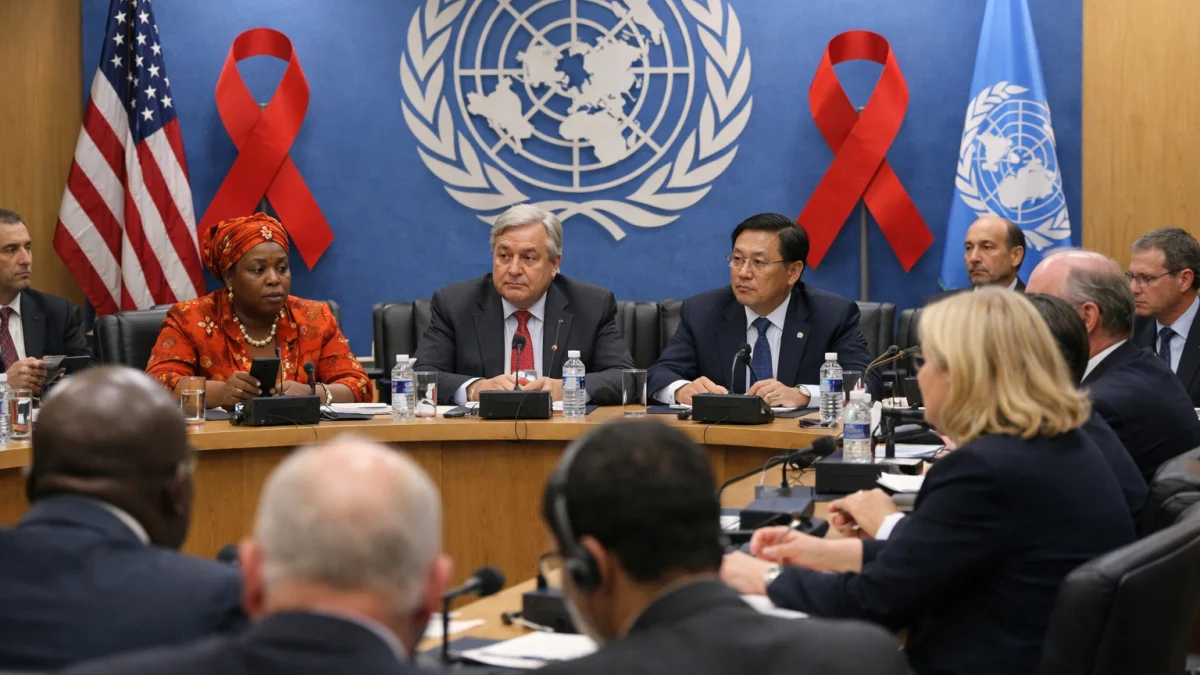


NEW YORK — Preparations are underway for the United Nations General Assembly High-Level Meeting on HIV/AIDS, scheduled to take place on June 22 and 23 at UN Headquarters in New York, as member states review progress toward ending AIDS as a public health threat by 2030.
The meeting, held every five years since 2001, will focus on reviewing advancements since the 2021 High-Level Meeting and adopting a new political declaration, according to UNAIDS and UN documentation. It follows an interactive multi-stakeholder hearing in April and May 2026 that gathered input from civil society, NGOs and affected communities.


On April 24, member states adopted the modalities resolution (A/RES/80/256) outlining the framework for the event, UNAIDS reported. A United Nations Secretary-General’s report on HIV/AIDS, released on June 4, highlighted historic gains alongside risks to continued progress due to funding challenges and uneven implementation.
The gathering occurs under the theme "United to end AIDS" and will inform the Global AIDS Strategy 2026-2031. It serves as a key accountability mechanism ahead of the 2030 target, with discussions expected to address treatment access, prevention services and structural barriers.
Recent data cited in preparatory documents indicate that new HIV infections have declined significantly since 2010, while millions remain without treatment. Global development assistance for HIV has faced cuts, prompting calls for renewed commitments.
"UNAIDS welcomes the release of the United Nations Secretary-General’s report on HIV/AIDS," the agency stated ahead of the meeting. "The world has made historic gains against HIV, but that the gains are increasingly at risk unless governments urgently recommit to the global AIDS response."
Civil society groups have outlined priorities including addressing inequalities, decriminalization of key populations and sustaining community-led efforts, according to statements from networks involved in the preparatory process.
The event will feature an opening segment followed by a general debate and other structured sessions. Participation includes high-level government representatives, with provisions for civil society involvement.
As of mid-June, final agendas and outcomes of negotiations on the political declaration remained under discussion. The meeting represents one of the last major global political checkpoints on HIV before 2030.
Further details on the program and participant lists are expected to be finalized in the days leading up to the June 22 opening.