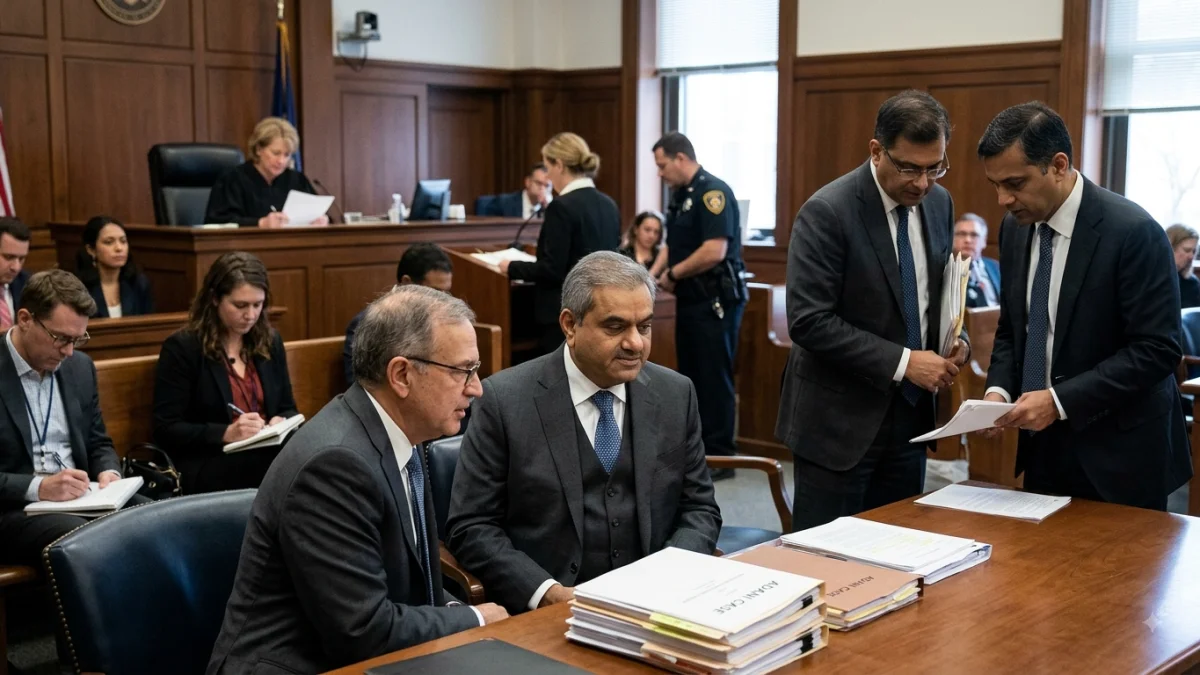


A U.S. judge’s dismissal of criminal charges against Indian billionaire Gautam Adani closes a major legal threat to one of India’s most prominent business groups, but the ruling also leaves a significant question about how the U.S. Justice Department exercised its prosecutorial discretion. U.S. District Judge Nicholas Garaufis approved the government’s request to abandon the fraud and bribery case while making clear that his decision did not amount to a finding that the allegations lacked merit.
The significance extends beyond Adani himself. The case had become a test of how aggressively U.S. authorities can pursue alleged corruption involving transactions largely outside the United States, particularly when American investors and financial markets are involved. It also became an unusual test of judicial oversight after the Justice Department reversed course and sought to end a prosecution initiated during the Biden administration.


Adani was charged in 2024 with agreeing to bribe Indian government officials to help an Adani Group subsidiary secure approval for a major solar-energy project, as well as allegedly misleading U.S. investors about the company’s anti-corruption practices. Adani and the group have consistently denied wrongdoing. Adani never appeared in a U.S. court to answer the criminal charges.
The Justice Department said in May that it would no longer devote resources to the criminal prosecution. After Garaufis initially declined to approve the request without further explanation, prosecutors argued that the case was primarily foreign, difficult to prove and inconsistent with the department’s current priorities. The government also questioned the strength of the U.S. connection to conduct that largely involved Indian nationals, Indian institutions and activity in India.
That reasoning was important because it shifted the central issue from whether the alleged conduct occurred to whether the U.S. government should continue using its criminal-enforcement resources to pursue it. Garaufis had previously said the government’s initial explanation was insufficient and required prosecutors to provide factual support for their decision.
The judge’s eventual decision nevertheless contained a pointed criticism of the process. Garaufis said the irregularities surrounding the dismissal were concerning and criticized senior Justice Department official Trent McCotter for reaching the decision without input from prosecutors and investigators who had worked on the case. McCotter said he made the decision after consulting defense lawyers and Justice Department lawyers and conducting his own research and analysis.
The scrutiny was heightened by Adani’s earlier pledge to invest $10 billion in the United States. In a sworn declaration, Adani acknowledged that his lawyers had told Justice Department officials the investment commitment could form part of a resolution of the case. Garaufis concluded that the pledge did not influence the Justice Department’s decision to dismiss the charges, but said the public could draw its own conclusions about the broader implications of offers of that kind for equal administration of justice.
That distinction is important for investors and companies. The dismissal removes the immediate risk of a U.S. criminal prosecution against Adani on these charges, but it does not constitute a judicial determination that the underlying allegations were false. Garaufis expressly said the dismissal should not be interpreted as agreement with the Justice Department’s reasoning or as an assessment of the merits of the criminal case.
The episode also does not eliminate all U.S. regulatory exposure for the Adani group. Gautam Adani agreed to pay $6 million and his nephew, Sagar Adani, $12 million to resolve related civil charges brought by the U.S. Securities and Exchange Commission. Separately, Adani Enterprises agreed to pay $275 million to the U.S. Treasury Department to settle alleged violations of Iran sanctions. Those resolutions are distinct from the criminal case and illustrate that the legal consequences of the broader controversy have not disappeared entirely.
For Adani Group, the criminal dismissal nevertheless removes one of the most consequential uncertainties hanging over its international expansion. The original indictment had raised questions about financing, investor confidence and the ability of the conglomerate to pursue projects involving international capital. The end of the criminal case should reduce that specific legal overhang, although investors will still have to assess the group on its financial performance, regulatory exposure and the separate civil settlements.
The immediate legal position is therefore clearer but not entirely settled across the wider group of defendants. Garaufis has asked the Justice Department to provide additional information before deciding whether to dismiss charges against other defendants. The confirmed development is that Adani’s criminal case has been dismissed, while the judge’s criticism of the government’s process ensures that questions about prosecutorial decision-making will remain part of the case’s broader significance.