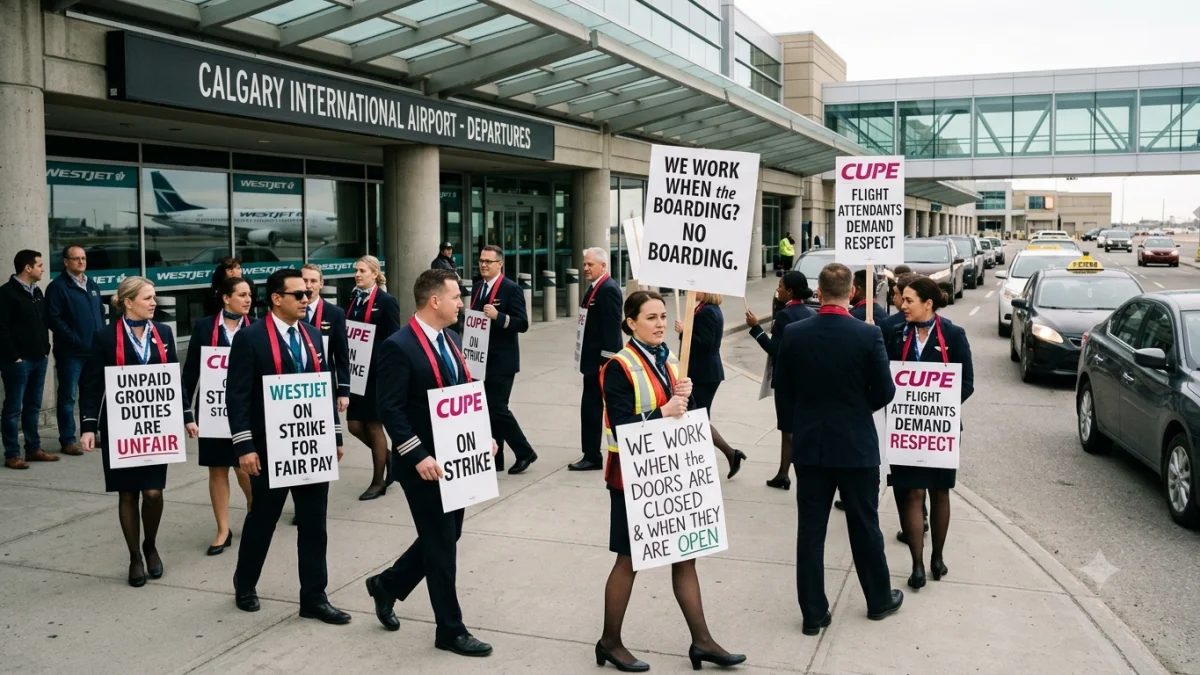


As passengers queued at airport service desks and refreshed flight apps on one of Canada's busiest summer travel weekends, a different kind of work stoppage was unfolding behind the disruption. Thousands of WestJet flight attendants had walked off the job after months of contract negotiations failed to resolve a dispute that centered on an issue many travelers rarely see: the time cabin crews spend working on the ground before an aircraft ever leaves the gate.
The strike, which began Aug. 2, brought widespread cancellations across WestJet's network during the August long weekend, disrupting travel plans for hundreds of thousands of passengers. But for the roughly 4,400 flight attendants represented by the Canadian Union of Public Employees (CUPE), the dispute was about more than a holiday weekend. It reflected a broader debate over how airlines compensate cabin crews for the full scope of their work, particularly the safety and customer-service duties performed before takeoff and after landing.


For many travelers, a flight begins when boarding is announced. For flight attendants, it starts much earlier. Before passengers arrive at the aircraft door, crews conduct mandatory safety checks, verify emergency equipment, prepare cabins, coordinate with pilots and ground personnel, and assist passengers during boarding. The union argues that much of that work is effectively unpaid under WestJet's current compensation model, making ground-duty pay the defining issue in negotiations.
"The fact of the matter is, is when I go to work, I'm not paid for all the hours that I'm at work," flight attendant Rena Kisfalvi said during the bargaining campaign, according to reporting by The Canadian Press. Another union representative, Tyson Conrod, said members hoped the company would reach what he described as "a fair contract" after months of negotiations.
WestJet disputes the characterization that flight attendants work without compensation. The airline says its long-standing "credit hour" system pays cabin crews through a higher blended rate intended to compensate not only for time spent in the air but also for ground duties, delays and other required responsibilities throughout a duty day. Company officials say the structure differs from a conventional hourly wage and includes minimum pay guarantees and additional protections when schedules are disrupted.
That disagreement over how work is measured became the central obstacle in negotiations that had stretched on for nearly a year.
In July, union members voted overwhelmingly in favor of authorizing strike action, with about 99% supporting a mandate if negotiations failed. The timing allowed the union to legally strike during one of Canada's busiest travel periods, increasing pressure on both sides to reach an agreement while highlighting the operational importance of cabin crews.
As the strike deadline approached, WestJet began canceling flights in advance to avoid leaving aircraft and crews stranded across its international network. Once the walkout began, cancellations mounted rapidly. By the second day of the dispute, hundreds of flights had been canceled, affecting an estimated quarter of a million passengers whose vacations, family visits and business trips suddenly required new plans.
The disruption extended beyond airport terminals. Travelers described long waits for rebooking, uncertainty over accommodations and difficulty finding alternative flights during a peak holiday period when available seats were already limited. WestJet said affected customers would be rebooked or refunded where applicable, while advising passengers to monitor flight status updates as negotiations continued.
For airline employees, the dispute also reflected changing expectations across North America's aviation industry.
Flight attendants have increasingly argued that traditional compensation systems no longer reflect the realities of their work, particularly after the COVID-19 pandemic reshaped staffing, inflation and labor markets. The WestJet negotiations followed a similar labor dispute at Air Canada, where compensation for some ground duties became a significant bargaining issue and helped influence contract discussions elsewhere in the industry.
WestJet Chief Executive Alexis von Hoensbroech said the airline had proposed a package that included a substantial initial wage increase, annual raises, retroactive pay and improved benefits. The union rejected the proposal, saying it did not adequately address compensation for work performed before departure and after arrival.
Federal officials urged both parties to continue negotiating, while mediators remained involved. Canada's labor minister described the situation as disappointing but stopped short of signaling immediate government intervention, leaving the outcome to the bargaining table as the strike entered its first days.
For passengers navigating airport terminals, the immediate concern remained canceled flights and uncertain itineraries. For flight attendants, the strike represented an effort to redefine how their work is recognized in an industry where many of the responsibilities essential to a safe flight begin well before an aircraft leaves the ground.
Whether negotiations ultimately produce a new agreement or require further mediation, the dispute has already focused public attention on work that is often invisible to travelers but fundamental to every departure: the hours spent preparing a flight before the cabin doors close and the aircraft begins to move.