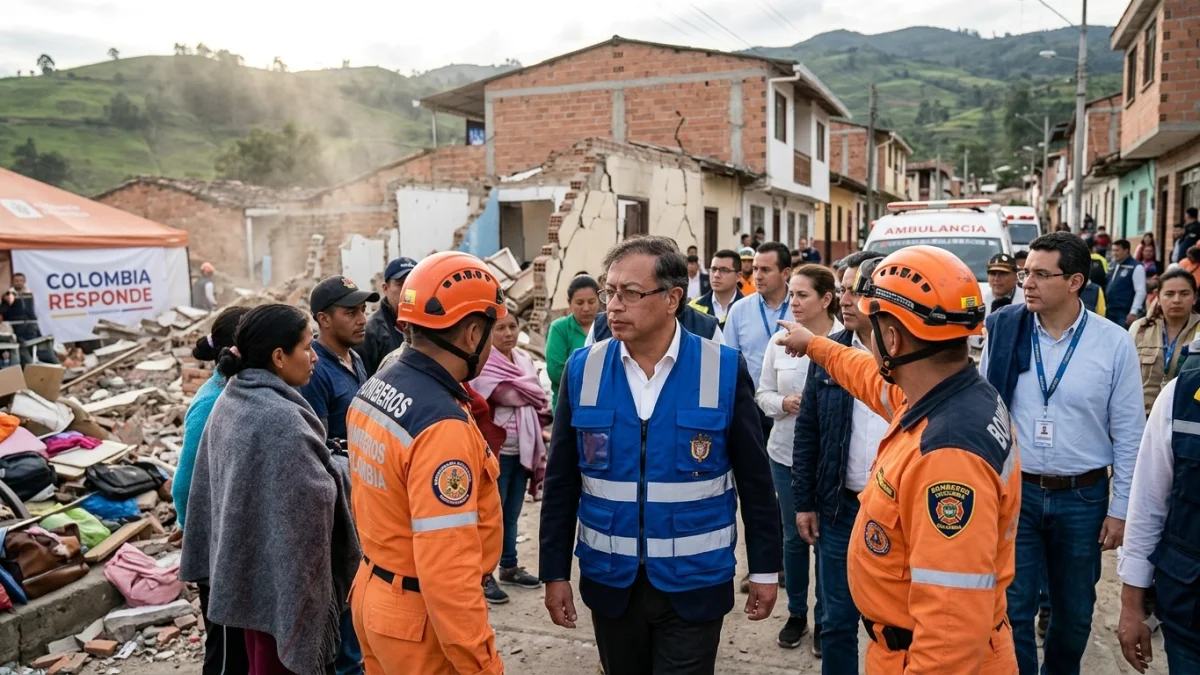


Colombia’s new president, Abelardo De La Espriella, is facing his first major national crisis less than a week after taking office, as rescue teams enter a critical phase of operations following a 7.4-magnitude earthquake that struck western Colombia on Aug. 10.
The scale of the disaster has rapidly transformed the earthquake into an early test of whether De La Espriella can translate his campaign emphasis on a smaller, more disciplined state into effective emergency management. By Aug. 12, authorities had confirmed 265 deaths, nearly 500 people remained officially missing and more than 3,770 were injured, according to Reuters. More than 9,550 homes had been destroyed, with major damage reported in cities including Cali and Pereira.


The immediate challenge is operational rather than ideological. Rescue authorities are working against the diminishing probability of finding survivors in collapsed structures while managing aftershocks, damaged infrastructure and the displacement of thousands of families. The government's performance in these first days will therefore be judged primarily by its ability to coordinate national institutions, local authorities, emergency workers and international assistance.
De La Espriella took office on Aug. 7 after campaigning as a political outsider promising to reduce the size of the state by as much as 40% and impose fiscal austerity. Reuters reported at the time that his administration intended to move quickly on spending reductions, security and economic reforms. The earthquake has immediately placed those ambitions alongside a very different requirement: mobilizing state capacity on a large scale.
The president declared an emergency and established national coordination mechanisms, while government ministers and security forces were deployed to affected areas. Reuters reported that De La Espriella also pledged an emergency reconstruction fund for homes, hospitals, schools and infrastructure, indicating that the government was already preparing for a transition from rescue to recovery.
That transition could prove more consequential than the first days of rescue. Colombia's disaster-management system had been developed under previous administrations and was already being used for emergency planning before the new government took office. In July, the outgoing administration said it had expanded disaster-response capabilities and strengthened preparations for major emergencies. The earthquake therefore provides an unusually immediate test of institutional continuity as political power changes hands.
The timing has also exposed potential weaknesses in that transition. Associated Press reported that the new administration faced pressure over the coordination of foreign rescue assistance, while a political scientist cited by the report linked some of the early difficulties to the absence of a formal handover between administrations. The issue is significant because disaster response depends on specialized agencies, established chains of command and rapid information-sharing that cannot easily be rebuilt during an emergency.
The handling of international assistance has become another measure of the government's approach. Reuters reported that rescue teams from Mexico and Peru had arrived, while other countries offered assistance. Associated Press reported that Colombia limited some foreign search-and-rescue participation, while government officials said the country's own capabilities and the selection of internationally recognized teams were factors in determining what assistance was requested. The competing interpretations illustrate a central issue for the administration: maintaining control over a complex national operation while ensuring that available external expertise can be used where it is needed.
Colombia also has a recent regional comparison. In June, the country itself sent a specialized search-and-rescue team to Venezuela after that country's earthquakes. Colombia's disaster agency said its USAR COL-1 team included more than 60 rescuers and trained dogs and operated for days in collapsed structures. That experience gives the current crisis added significance: Colombia is now applying at home capabilities that it had recently deployed across its border.
The earthquake is also testing the government's ability to communicate reliable information while casualty and damage assessments remain fluid. Early figures changed substantially as rescue teams reached more affected areas. Reuters' latest reporting put confirmed deaths at 265 and the number of missing at nearly 500, while other reporting has noted discrepancies in missing-person estimates. Maintaining a clear distinction between confirmed figures and preliminary reports will be important as authorities continue identifying victims and assessing damaged communities.
For De La Espriella, the immediate political significance is therefore less about whether the disaster changes his broader agenda than whether his government demonstrates competent institutional coordination under pressure. A successful rescue operation would not by itself resolve Colombia's longer-term fiscal, security and infrastructure challenges, while shortcomings in the response would not necessarily establish the effectiveness of his administration as a whole. But the crisis provides an early and highly visible measure of how the new government operates when decisions cannot be deferred.
As rescue operations move beyond the initial 72-hour period, authorities are continuing to assess collapsed buildings, missing-person reports, infrastructure damage and the needs of displaced families. The confirmed death toll and damage figures remain subject to revision as search teams reach additional sites. The government is also preparing for the reconstruction phase, including the proposed emergency fund, while monitoring aftershocks and the continuing humanitarian needs in the hardest-hit areas.