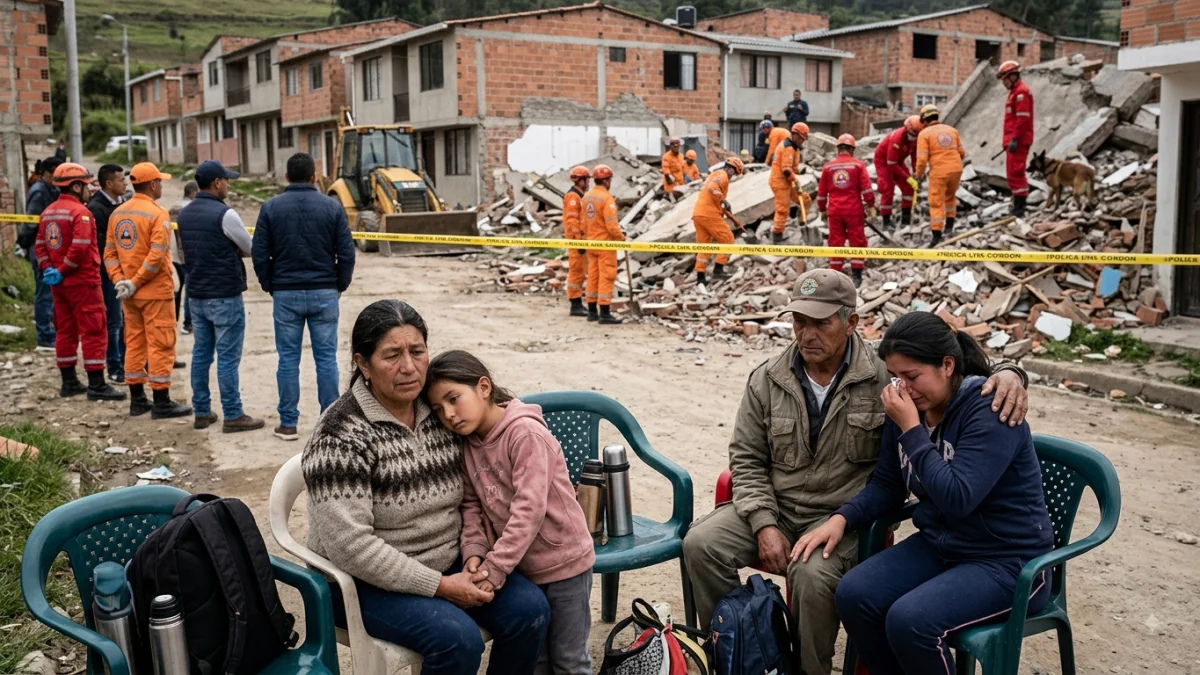


At a collapsed hotel in Pereira, the waiting had narrowed to one family and one hope.
Hernan Giraldo had remained near the ruins since Monday night, waiting for rescuers to reach his 24-year-old son, Juan Felipe, one of four people believed trapped inside. His son was due to be married on Sunday.


“My son is getting married on Sunday,” Giraldo told Reuters on Friday. “I’m waiting here to hug my son, alive.”
Nearly four days after the magnitude 7.4 earthquake struck western Colombia, Giraldo’s wait had become part of a much larger reckoning. Rescuers were still searching where there were signs that people might be alive, even as the operation across the country increasingly shifted toward recovering bodies, clearing debris and accounting for those still missing.
The earthquake struck shortly after 7:30 a.m. on Aug. 10, with its epicenter near San José del Palmar in the Chocó region. It damaged or destroyed homes, schools and hospitals across western Colombia, including in Cali and Pereira. By Friday, authorities said at least 287 people had died, nearly 4,000 were injured and almost 400 remained missing. Tens of thousands of homes had been damaged or destroyed.
For families, however, national totals could not capture the uncertainty of waiting for a name to appear on a list of survivors or victims.
In Pereira and Cali, some families were sleeping in parks because their homes were damaged or because aftershocks made returning unsafe. Others had no home to return to at all.
Ebert Jonathan Morales, a 38-year-old resident of Cali, said he, his wife and four children were trying to start again after their home was destroyed.
“There is no place to live, we lost everything,” Morales told the Associated Press.
The government said more than 100,000 people had been affected by the disaster. Authorities opened schools, parks and public buildings as shelters, while volunteers and neighbors supplied food, water and other necessities. In some areas, humanitarian assistance was still difficult to deliver, particularly in Chocó, where remote communities face poor infrastructure and longstanding insecurity.
For those still waiting beside collapsed buildings, the search remained intensely focused.
Rescuers from Colombia and Venezuela used specialized equipment, including thermal-imaging cameras, to look for signs of life beneath the debris in Pereira. Venezuelan rescuer Cristian Acevedo said his team would continue searching because people have survived for days under rubble.
“We’ll always have high hopes; we’ve found people alive even 10 days later,” Acevedo told Reuters. “The goal is to search and find people alive.”
That possibility had already been demonstrated elsewhere.
In Pereira, rescuers pulled Daniela Largo alive from rubble after a 12-hour operation. Crews created an opening to free her trapped arm while a doctor administered intravenous fluids. She was carried to an ambulance wrapped in a blue blanket as firefighters and onlookers reacted to her rescue.
Such rescues kept families listening for the same signal: a sound beneath concrete, a movement detected by equipment, or a rescuer calling for silence.
But the passage of time was changing the nature of the search. Aid agencies generally regard the first 48 to 72 hours as especially important for finding survivors, although people can survive longer when they have access to air, water or food. Aftershocks and unstable structures also exposed rescuers to continuing danger.
The earthquake has also exposed how unevenly Colombia’s communities can withstand disaster.
Chocó, where the earthquake was centered, is among the country’s poorest regions and has endured years of conflict, displacement and limited infrastructure. Damage and disrupted communications made the full impact there difficult to assess. Humanitarian organizations already working in the region shifted quickly toward emergency assistance.
María Mercedes Liévano, director of Save the Children in Colombia, described the disaster as a crisis striking communities that were already vulnerable.
“It’s a crisis on top of a crisis, leaving the population in a situation of extreme vulnerability,” she said.
For families displaced from their homes, survival was becoming less about the first hours after the earthquake and more about what came next.
Olga Castro, a mother of five in Cali, said a neighbor had given her family shelter.
“At least we survived, but right now we are practically on the street because we don’t have a home anymore,” she told the Associated Press.
The Colombian government has pledged subsidies for homeless families and said reconstruction would include hospitals, schools, homes, roads and airports. President Abelardo de la Espriella, who had taken office only days before the earthquake, said the government would need private-sector help to rebuild.
But reconstruction could not begin everywhere immediately. Engineers said damaged buildings would first require technical assessments to determine which could be occupied, repaired or demolished. Temporary housing, food, health care, basic services and economic assistance remained immediate priorities for families who had lost homes or livelihoods.
Meanwhile, in Pereira, the search continued at the hotel where Giraldo was waiting for his son.
His words carried the uncertainty confronting hundreds of families across western Colombia: the difference between a missing person and a survivor could still be hidden beneath tons of concrete.
“I’ve been here since Monday night in case something happens, to find him,” Giraldo said.
For rescuers, that possibility was reason enough to keep digging.