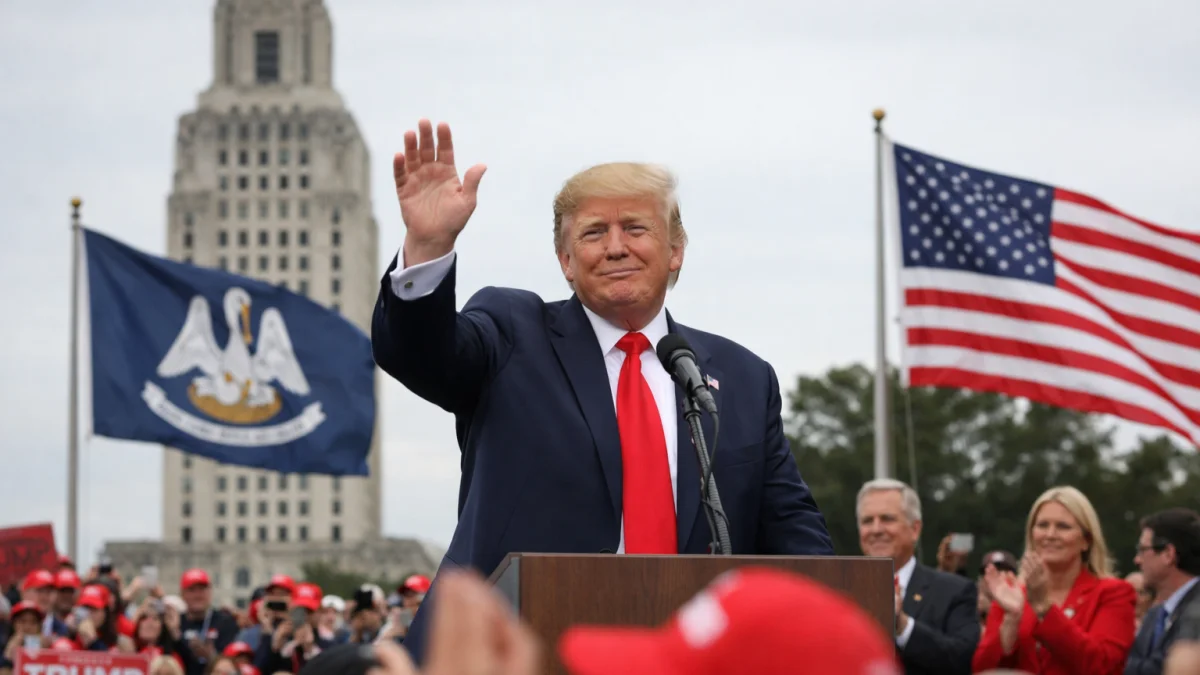
Republican Representative Julia Letlow has won the Republican Senate primary runoff in Louisiana, according to official results from the Louisiana Secretary of State, securing the party’s nomination after a contest in which she was endorsed by President Donald Trump.
The outcome confirms Letlow as the Republican nominee in a state where the party holds a structural advantage in federal elections, effectively making the primary the decisive stage of competition under Louisiana’s open “jungle primary” system, which places all candidates on a single ballot and advances the top finishers to a runoff if no candidate secures a majority.
Nut Graf: The result highlights the continuing influence of presidential endorsement—particularly Trump’s—on Republican Senate nomination contests, especially in states where primary electorates are effectively determining general election outcomes. It also reflects how GOP candidate selection has increasingly been shaped by alignment signals in intra-party contests where candidates often share broadly similar policy positions.
Louisiana’s election framework, established under state law, does not use separate partisan primaries in the traditional sense. Instead, all candidates compete in a single primary round regardless of party affiliation, with a runoff required if no candidate reaches a majority threshold. In practice, in strongly Republican states such as Louisiana, this structure tends to concentrate decisive competition within the Republican field, making the primary outcome effectively determinative for Senate representation.
Trump’s endorsement has remained a salient factor in Republican primaries since his emergence as the dominant figure in the party’s electoral coalition. Political science research on endorsement effects in low-information primary elections has found that cues from nationally prominent political figures can significantly influence voter behavior, particularly when candidates are not sharply differentiated on policy grounds. In this race, Republican candidates largely converged on core party positions, limiting policy-based distinctions as a driver of voter choice.
In that context, Trump’s endorsement functioned primarily as a signal of political alignment rather than a policy distinction between candidates. The outcome is consistent with a broader pattern in Republican nomination contests in which perceived alignment with Trump’s political brand has become a key variable in determining primary viability. Candidates have increasingly emphasized alignment with Trump’s positions on issues including immigration enforcement, judicial appointments, and regulatory policy as part of their campaign strategy.
The result also reflects how intra-party competition in safe Republican states has increasingly shifted toward alignment-based selection dynamics. In such environments, general election outcomes are often predictable, which elevates the importance of primary electorates in determining ideological representation in Congress. This reduces the moderating influence of general-election competition and increases the weight of intra-party signaling, including endorsements from high-profile political figures.
At the same time, the structural implications for Senate governance remain indirect. The U.S. Senate continues to operate under procedural rules that require broad consensus for most legislation, including the 60-vote threshold needed to overcome a filibuster on most substantive bills. As a result, while nomination dynamics influence the composition and ideological orientation of the Republican caucus, they do not directly determine legislative outcomes.
The Louisiana result also illustrates the asymmetry between primary and general election incentives in strongly partisan states. In such environments, the primary effectively functions as the decisive electoral contest, with the general election often serving to confirm the dominant party’s nominee. This dynamic increases the salience of intra-party alignment signals, including presidential endorsements, while reducing the relative importance of cross-party electability considerations.
Analysts note that the influence of Trump endorsements varies by electoral context. In more competitive states, Republican candidates face greater pressure to balance ideological alignment with general-election viability, which can limit the direct effect of intra-party endorsements. Louisiana represents a comparatively favorable environment for Republicans, amplifying the role of primary-stage political signaling.
Letlow is expected to face the Democratic nominee in the general election in a state that has historically leaned Republican in federal Senate races, according to recent election results. While turnout conditions and national political dynamics can influence margins, Republicans have maintained a consistent advantage in Louisiana Senate contests.
The outcome adds to a broader pattern in Republican Senate primaries in which Trump’s endorsement continues to function as a central organizing signal in candidate selection. What remains to be seen in future cycles is whether this dynamic persists in more competitive states, where general election constraints may more significantly shape primary outcomes.