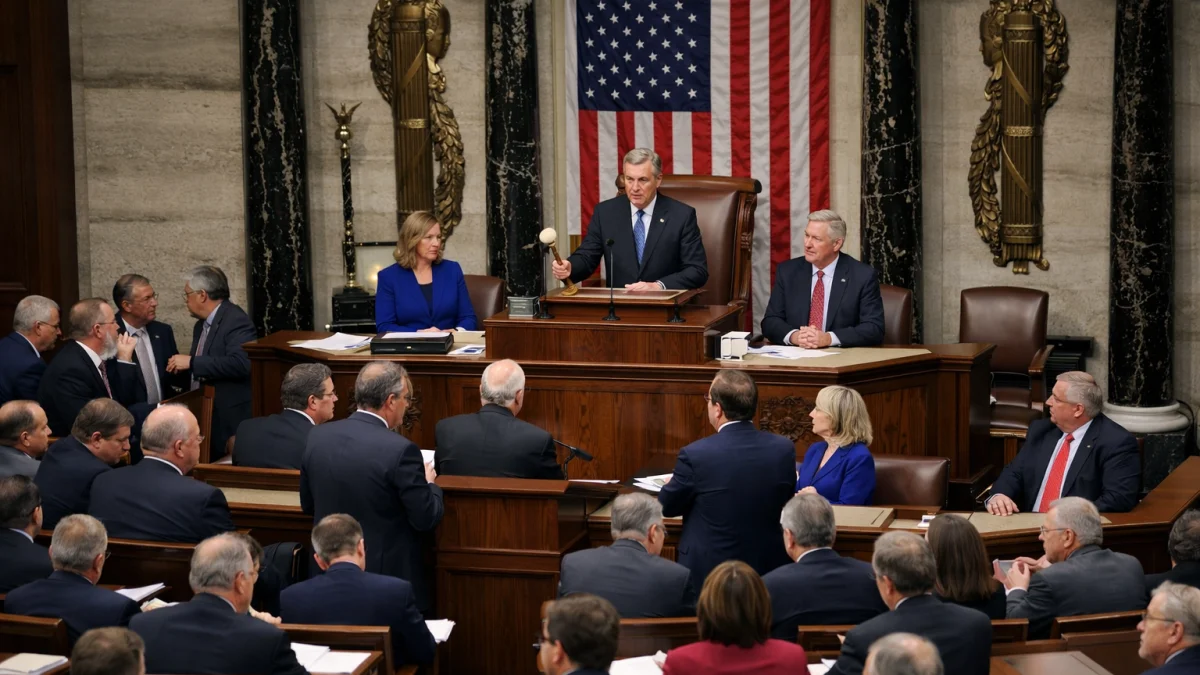
WASHINGTON — The Republican-controlled U.S. House of Representatives advanced a stopgap government funding measure this week, clearing the way for a final vote aimed at preventing a partial federal government shutdown before the start of the next fiscal year, according to congressional proceedings.
The House voted to open debate on the continuing resolution, a procedural step that allows lawmakers to consider the temporary spending bill on the House floor. According to House records, Republican leaders intend to hold a final vote before sending the measure to the Senate, where bipartisan support will be required for passage.
The stopgap measure would fund federal agencies through Nov. 21, giving Congress additional time to negotiate full-year appropriations legislation for fiscal year 2026, which begins on Oct. 1. The proposal also includes about $88 million for enhanced security for members of Congress, the Supreme Court and the executive branch following the assassination of conservative activist Charlie Kirk, according to the legislation and House leaders.
The White House has expressed support for the continuing resolution, while Democratic lawmakers have criticized the measure as a partisan proposal. Democrats introduced an alternative temporary funding bill that would extend government funding through the end of October and restore certain healthcare funding provisions that they said were removed under recent tax legislation. Senate Democratic Leader Chuck Schumer said the Democratic proposal could provide the basis for bipartisan negotiations.
"We have two weeks. They should sit down and talk to us, and we maybe can get a good proposal. Let's see," Schumer told reporters, according to Reuters.
Republican leaders rejected the Democratic proposal, with a Senate Republican leadership aide describing it as "partisan" and "not a serious proposal," Reuters reported.
Congress must approve funding legislation before the current funding authority expires to avoid a partial shutdown of federal agencies. While Republicans hold a majority in the Senate, the chamber's procedural rules generally require support from members of both parties to advance most spending legislation, according to congressional rules.
The annual appropriations process covers discretionary federal spending, while mandatory programs such as Social Security and Medicare are funded separately under existing law. Negotiators from both parties have continued discussions over broader appropriations legislation, though major differences remain on spending priorities.
The House is expected to hold a final vote on the continuing resolution later this week. If approved, the measure would move to the Senate for consideration. As of Friday, Senate leaders had not announced when the chamber would take up the legislation, and the outcome remained uncertain.