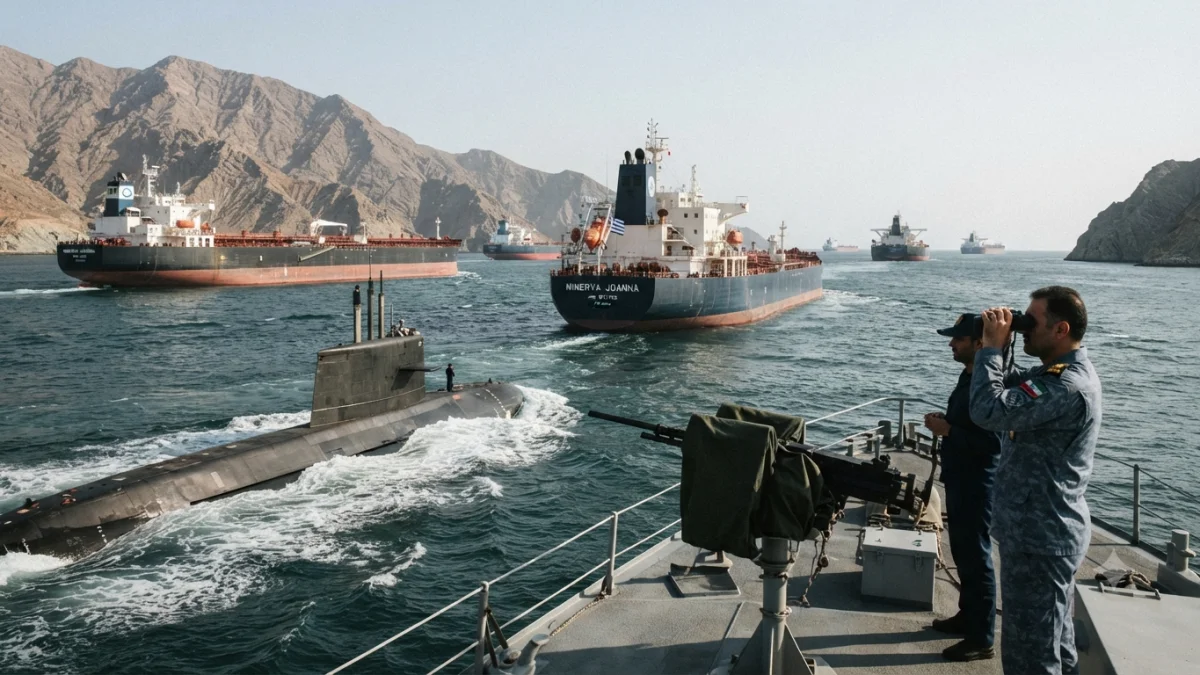


Iran’s assertion that a deal with Oman on managing navigation through the Strait of Hormuz is close, while insisting that the waterway will not fully reopen until the United States meets broader demands, has exposed the central weakness of the latest diplomatic effort: an arrangement to manage shipping is not the same as a settlement guaranteeing unrestricted passage.
The distinction matters because Hormuz is not simply another regional shipping lane. The strait carried about 20.9 million barrels per day of oil in the first half of 2025, equivalent to roughly one-fifth of global petroleum liquids consumption and about one-quarter of seaborne oil trade, according to the U.S. Energy Information Administration. Alternative pipelines operated by Saudi Arabia and the United Arab Emirates can bypass only a fraction of those volumes.


Iranian officials said on Aug. 8 that negotiations with Oman had made progress on a new shipping arrangement, but that such an agreement alone would not reopen the strait. According to Reuters, Tehran is seeking additional U.S. concessions, including compensation for wartime damage, sanctions relief and an end to what it describes as U.S. aggression. Iran has also rejected the existing traffic-separation arrangement and proposed a temporary route for commercial vessels.
That conditionality turns Hormuz into a test of whether the broader U.S.-Iran diplomatic process can translate a ceasefire framework into predictable maritime rules. It also creates a gap between the interests of the parties negotiating the arrangement and those of the international shipping industry. Oman can mediate between Tehran and Washington, but it cannot by itself guarantee that vessels will enjoy the freedom of navigation expected under international maritime law.
The International Maritime Organization has repeatedly stressed that point. In July, its council reaffirmed that transit passage through international straits should not be threatened, impeded, denied or suspended, and said measures regulating traffic must comply with international maritime safety rules. The IMO has also warned that commercial passage cannot be considered safe without credible security guarantees.
The economic consequences extend well beyond crude oil. The International Energy Agency said the effective closure of Hormuz during the conflict removed close to 20% of global LNG supply from international markets, producing sharp price volatility in Asia and Europe. Its July gas-market assessment said LNG flows through the strait had increased following the June U.S.-Iran interim agreement but remained well below pre-conflict levels, with the timetable for a full restoration still uncertain.
That experience has changed the nature of the energy-security calculation. A reopening that permits some vessels to transit is not necessarily equivalent to a return to normality. Tankers, LNG carriers, insurers and ship operators require confidence that passage will remain available, that routes will not change abruptly and that crews will not face detention, attack or conflicting instructions from military authorities.
The history of the crisis illustrates the problem. An earlier U.S.-Iran framework envisaged Iran restoring commercial shipping toward pre-war levels while Washington withdrew forces from Iran’s vicinity and lifted a naval blockade. Tehran’s state television said at the time that Iran would manage traffic in cooperation with Oman and that implementation would require tangible verification. The subsequent diplomatic process produced an interim agreement in June, which the IMO welcomed as a step toward restoring maritime security, while warning that implementation would require time and adequate safety guarantees.
The latest demands therefore raise a question of sequencing. Iran appears to be treating unrestricted reopening as an outcome that depends on a wider political settlement, whereas the United States and international shipping interests have a strong incentive to establish maritime access independently of unresolved disputes over sanctions, military deployments and compensation. The disagreement is not merely procedural: control over the strait gives Tehran significant leverage because alternative routes cannot quickly replace its full capacity.
For energy-importing countries, that leverage translates into continued exposure to price and supply volatility. The IEA has already described the 2026 disruption as a major shock to global gas markets and said the crisis demonstrated the need to strengthen international gas-supply security. For maritime operators, the security dimension is equally important. The IMO has documented dozens of attacks on international shipping since the conflict began and has repeatedly placed the safety of seafarers above commercial considerations.
The immediate significance of the Iran-Oman talks is therefore less that a reopening has been secured than that a possible mechanism for managing traffic remains under negotiation. Iran says progress with Oman is real but conditional; Oman has supported continued diplomacy, while the United States has sought an arrangement that restores commercial shipping. The unresolved issues are whether Tehran and Washington can agree on the conditions for reopening, whether any new traffic regime will preserve internationally recognized navigation rights, and whether security guarantees will be sufficient for shipping companies to resume normal operations. Until those questions are resolved and sustained commercial traffic is demonstrably restored, Hormuz will remain a central vulnerability for global energy security.