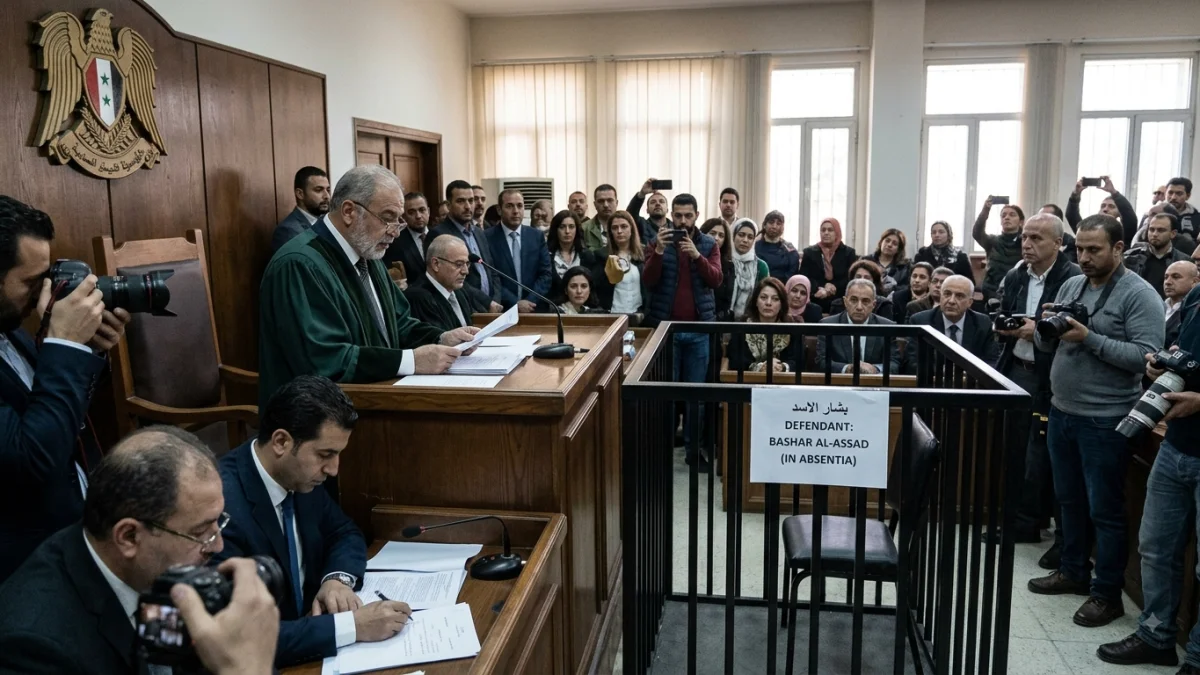


DAMASCUS — A Syrian court sentenced ousted President Bashar al-Assad to death in absentia on Tuesday, convicting him of crimes including killings, torture, arbitrary detention and crimes against humanity during the country's nearly 14-year war.
The ruling was the first conviction handed down by a Syrian court against Assad, who was overthrown in December 2024 after rebels swept through Damascus and ended his family's decades-long rule.


The court also sentenced Assad's younger brother, Maher al-Assad, to death in absentia. Maher commanded Syria's elite Fourth Armoured Division, which played a major role in suppressing opposition during the conflict. Atef Najib, a cousin of the Assad family and former security official in the southern province of Deraa, also received a death sentence. Najib was the only defendant tried in person.
The court convicted Assad over what the judge described as premeditated and intentional killings, including of children, as well as torture, arbitrary arrest and crimes against humanity.
Assad was not present for the proceedings. He fled Syria as rebel forces advanced on Damascus in December 2024 and was granted asylum in Russia along with his family. His absence means the sentence cannot immediately be carried out.
The case followed several months of proceedings before a criminal court in Damascus. Syrian authorities had previously formally declared Assad and other senior former regime figures fugitives after they failed to appear despite being notified of the proceedings.
The verdict drew celebrations in Damascus and Deraa, where residents gathered carrying photographs of people killed or detained during the war. Deraa was the birthplace of the 2011 uprising against Assad's government.
Noha al-Masri, a prosecutor involved in the case who lost her brother during a crackdown on a Deraa protest in 2011, said the ruling reflected the suffering endured by Syrians and the families of victims.
But legal expert Anwar al-Bunni, head of the Syrian Centre for Legal Studies and Research, questioned whether the sentence would help secure Assad's return from Russia. He argued that countries generally would be reluctant to extradite a person facing execution.
Assad became president in 2000 after the death of his father, Hafez al-Assad. His rule was dominated by the conflict that erupted after security forces violently suppressed anti-government protests in 2011. The war killed hundreds of thousands of people and displaced millions.
The death sentences mark a major step in Syria's efforts to pursue former regime officials through its new transitional justice process, while Assad remains outside the reach of Syrian authorities in Russia.