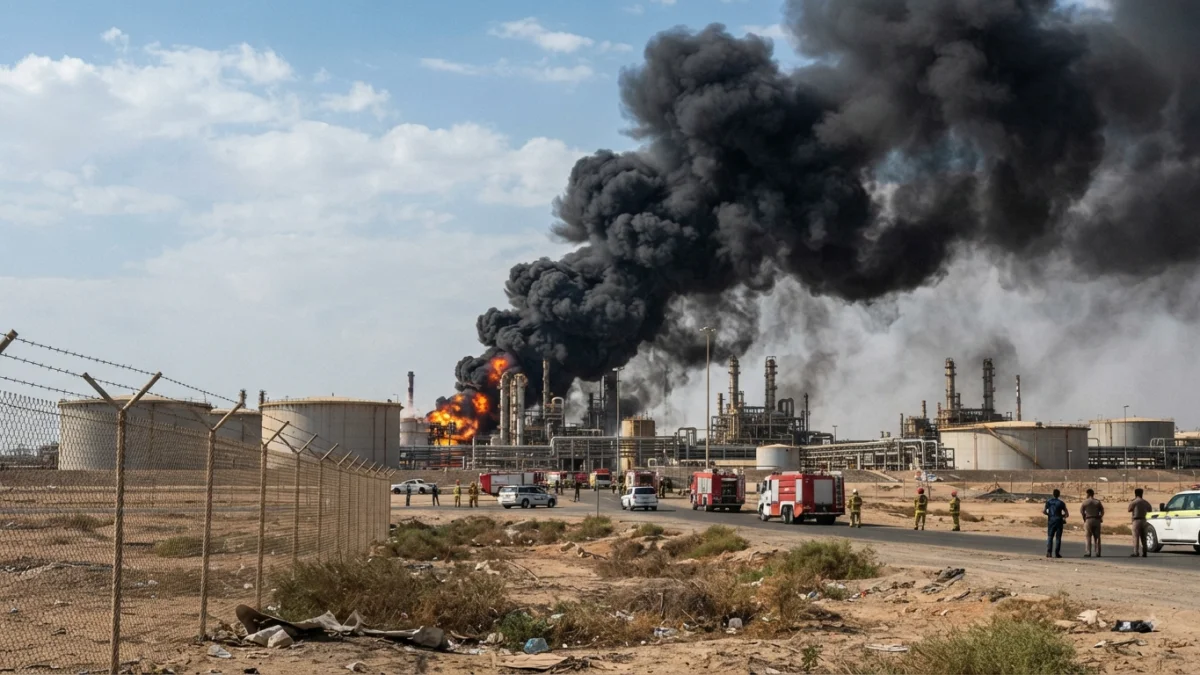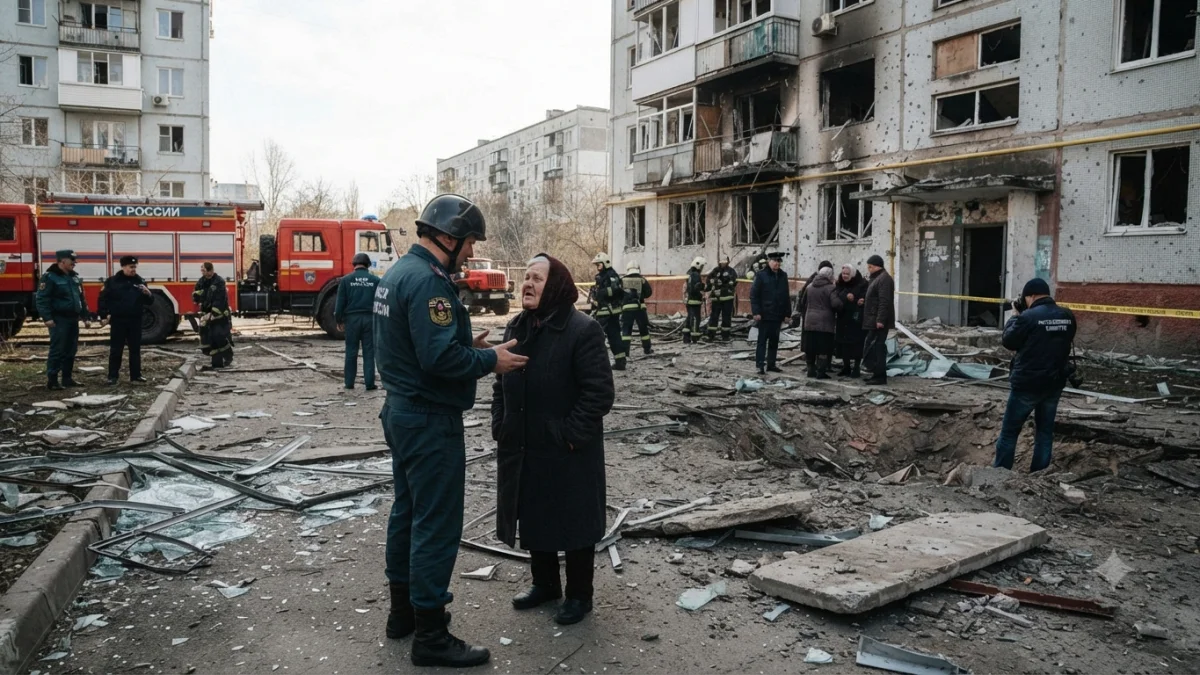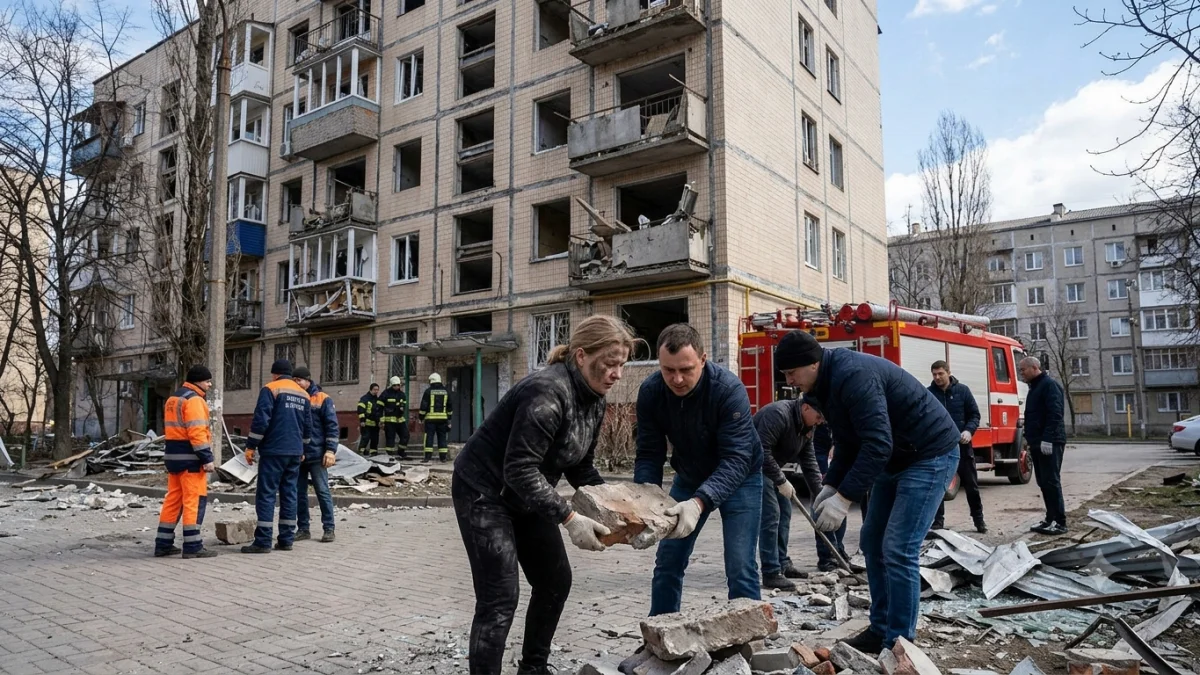


The first daylight revealed what the night had left behind: firefighters working through twisted metal, emergency crews lifting debris from shattered warehouses, and residents gathering outside damaged buildings to see what, if anything, remained. Across parts of Kyiv and the surrounding region, roads were strewn with broken glass and fragments of masonry after one of the most intense missile assaults on the Ukrainian capital in recent months.
For many residents, the morning became another exercise in rebuilding routines interrupted by war. Shop owners checked damaged storefronts, logistics workers surveyed warehouses that had supplied food and household goods, and families waited for permission to return to neighborhoods still being searched by rescue teams.


The overnight attack, carried out with ballistic missiles, cruise missiles and drones, killed at least 17 people and wounded more than 40, according to Ukrainian authorities. Officials said emergency crews continued searching damaged sites throughout the day as the casualty toll could still rise. Ukrainian President Volodymyr Zelenskiy said civilian infrastructure—including warehouses, transport facilities and businesses—had been among the targets, while Russia said it had struck military-related logistics facilities. Reuters could not independently verify the competing claims.
The attack underscored a reality that has become increasingly familiar in Ukraine's fifth year of full-scale war: reconstruction now begins almost as soon as rescue operations end. Even as smoke lingered above damaged districts, businesses were assessing losses, utility crews were restoring services and local authorities were coordinating repairs intended to keep daily life functioning.
Much of the destruction centered on logistics facilities that distribute goods across the capital and beyond. Ukrainian retailers including Epicentr, Silpo, Fozzy and Rozetka reported severe damage to warehouses, threatening supply chains that millions depend on. Officials announced emergency measures aimed at limiting disruptions to food distribution and essential commerce.
The damage extended beyond economics. Warehouses and distribution centers employ thousands of workers whose jobs now depend on how quickly damaged operations can resume. The destruction also highlighted how modern conflicts increasingly affect civilian infrastructure that supports everyday life, even when military objectives are disputed.
Emergency responders worked through the day amid unstable structures and scattered debris. Ukraine's State Emergency Service said firefighters extinguished multiple fires while rescue teams searched collapsed sections of damaged buildings. Images released by authorities showed heavy equipment clearing rubble as medics treated survivors nearby.
For Kyiv residents, air raid alerts have become a routine part of daily life, yet officials said this attack differed because Ukraine's air defenses intercepted nearly all of the drones but failed to stop the ballistic missiles. Ukrainian officials attributed that outcome to an acute shortage of Patriot interceptor missiles, which remain among the few systems capable of destroying incoming ballistic weapons.
Zelenskiy argued that additional air-defense systems could have saved lives, renewing appeals to international partners to accelerate deliveries. He said delays in providing interceptor missiles were contributing directly to civilian casualties. Western governments have continued discussions over military assistance, but deliveries have slowed amid competing security demands and political debates among Ukraine's allies.
The attack also reflected an evolving pattern in the conflict. Ukrainian officials say Russia has increased its use of ballistic missiles in large-scale strikes, exploiting gaps in Ukraine's defensive capabilities. Military analysts have noted that while drones can often be intercepted in significant numbers, ballistic missiles travel at speeds and trajectories that require specialized defensive systems.
Russia has consistently maintained that it targets military infrastructure supporting Ukraine's armed forces. Ukrainian authorities reject those assertions in many cases, saying recent attacks have struck civilian businesses, transportation facilities and residential areas. Independent verification of individual targets during active conflict is often difficult.
For residents living near damaged sites, those strategic arguments remain distant from the immediate task of recovery. Local authorities coordinated inspections of buildings to determine whether structures could be repaired or required demolition. Utility crews restored electricity where possible, while municipal workers cleared roads to reopen traffic.
Community organizations also mobilized quickly, helping distribute supplies and assisting residents displaced by the damage. Such volunteer efforts have become a defining feature of wartime life in Kyiv, where neighborhoods frequently organize support for families affected by missile strikes.
The capital has experienced repeated bombardments since Russia launched its full-scale invasion in February 2022. Earlier attacks heavily damaged residential buildings, schools, hospitals and energy infrastructure. Each reconstruction effort has become part of a broader campaign to preserve normal civic life despite continuing military pressure.
Businesses face their own cycle of recovery. Damaged warehouses can interrupt deliveries across large parts of the country, affecting everything from groceries to construction materials. Company executives said rebuilding operations would begin as quickly as safety inspections allowed, reflecting a determination shared by many Ukrainian firms that have repeatedly resumed operations after attacks.
International humanitarian organizations have warned that continued strikes on civilian infrastructure increase risks for both economic stability and public welfare, particularly as communities prepare for another winter shaped by uncertainty over energy supplies and security.
As daylight faded over Kyiv, cranes, excavators and emergency vehicles still occupied many of the damaged sites. Rescue workers continued searching through debris while investigators documented the destruction. Nearby, residents gathered belongings from buildings that remained standing and watched as repair crews prepared for another round of reconstruction.
The work unfolding across the city was not presented as a conclusion to the attack but as its immediate aftermath—a familiar sequence in a war that has repeatedly forced Kyiv's residents to move from survival to recovery with little time between the two.