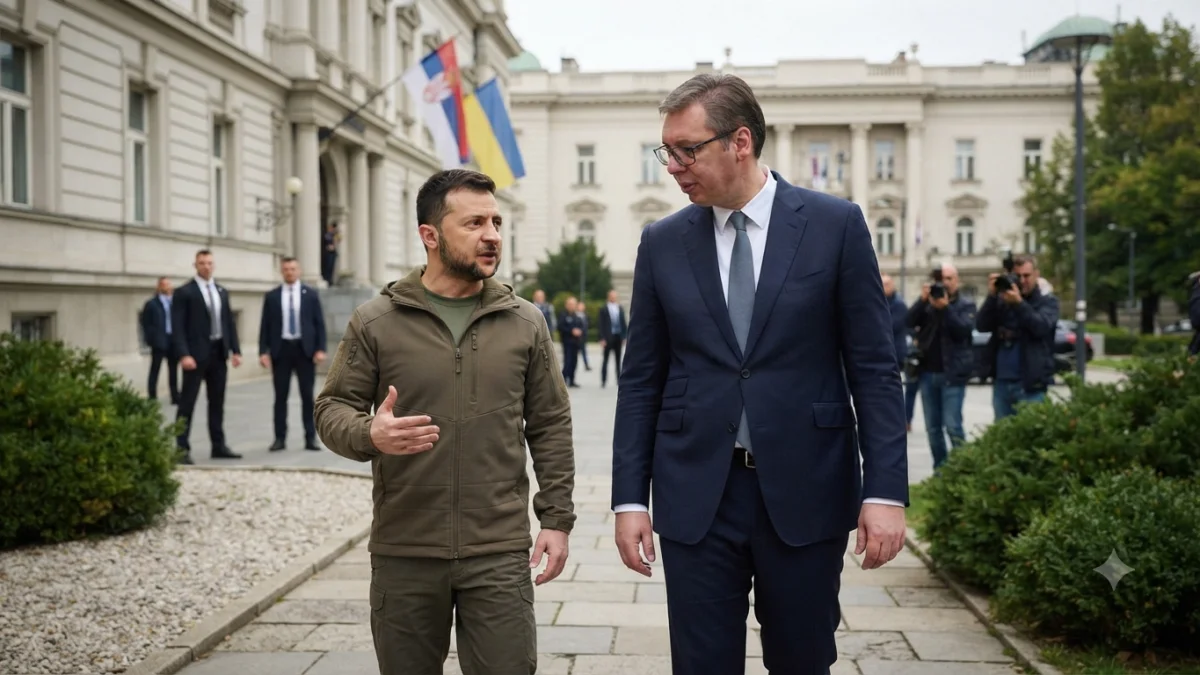


Ukrainian President Volodymyr Zelenskiy’s first official visit to Serbia has highlighted the increasingly consequential balancing act in the Balkans, where governments seeking European Union integration are navigating pressure to align with the West while preserving longstanding political, economic and energy ties with Russia.
Zelenskiy’s two-day visit to Belgrade, which concluded on Aug. 8, produced commitments to strengthen economic cooperation, work toward completing a long-delayed free-trade agreement and expand cooperation on infrastructure, energy and food security. Serbian President Aleksandar Vucic also reaffirmed support for Ukraine’s independence and territorial integrity, including territories seized by Russia since 2014. But he stopped short of committing Serbia to sanctions against Moscow, underscoring the limits of Belgrade’s shift toward Kyiv.


That distinction is central to understanding the visit. Serbia has condemned Russia’s invasion while declining to join Western sanctions and remains heavily dependent on Russia for natural gas. At the same time, Belgrade has maintained its strategic objective of joining the EU. The result is a foreign policy that seeks closer practical cooperation with European institutions and Ukraine without abandoning relationships with Moscow that remain important to Serbia’s energy security and domestic politics.
The visit therefore represents movement in Serbia’s relationship with Ukraine, but not a formal realignment against Russia. Vucic’s pledge to support Ukraine’s territorial integrity is significant because Belgrade’s position is closely connected to its own dispute with Kosovo. Serbia does not recognise Kosovo’s 2008 declaration of independence, while Ukraine has also declined to recognise Kosovo. Vucic explicitly linked the two issues during the visit, thanking Kyiv for maintaining its position on Kosovo.
The diplomatic shift has been building. Vucic visited Kyiv in July for the Ukraine-Southeast Europe summit, his first trip to Ukraine since Russia’s full-scale invasion began in 2022. There, Serbia supported Ukraine’s territorial integrity but did not sign the summit’s joint declaration. The episode illustrated the same pattern now visible in Belgrade: Serbia is willing to engage Ukraine and endorse principles of sovereignty while retaining room to avoid measures that would directly confront Russia.
Economic interests provide another reason for the relationship to deepen. Zelenskiy and Vucic agreed to seek completion by the end of the year of a free-trade agreement that has been stalled since 2005 because of disagreements over agricultural tariffs and quotas. Reuters reported that the agreement is important to Serbia’s World Trade Organization and EU ambitions, while the two governments also discussed infrastructure, energy and food-security projects aimed in part at strengthening Ukraine’s resilience after repeated Russian attacks on energy facilities.
For Serbia, closer economic links with Ukraine can also fit within a broader process of gradual integration with European economic structures. In May, the European Commission said 18 Serbian banks had joined the Single Euro Payments Area schemes, describing the development as a step toward deeper economic integration with the EU even before accession.
Yet the limits of Serbia’s European alignment remain clear. The EU has continued expanding sanctions against Russia, adopting its 21st sanctions package in July and extending broader economic restrictions through July 2027. Serbia has not followed the bloc on the central issue of sanctions against Moscow. That divergence remains one of the most important tests of whether Belgrade’s European orientation will eventually translate into full foreign-policy alignment.
Vucic has also recently expressed skepticism about rapid EU enlargement, saying candidate countries should not expect major expansion in the coming years. His comments reflect a broader uncertainty surrounding both Serbia’s and Ukraine’s accession paths, even as both governments continue to describe EU membership as a strategic objective.
The visit also carries implications for Russia’s position in the Balkans. Serbia remains one of Moscow’s closest traditional partners in Europe, and Russia is a major supplier of Serbian gas. At the same time, Belgrade has faced repeated Russian accusations that Serbian-made ammunition reaches Ukraine through intermediaries. Vucic has denied that Serbia directly supplies military assistance to Ukraine and said military cooperation was not discussed with Zelenskiy.
The confirmed outcome is therefore less a Serbian break with Moscow than an expansion of Belgrade’s engagement with Kyiv and the European sphere. Zelenskiy secured public backing for Ukraine’s territorial integrity and agreements aimed at stronger economic cooperation, while Vucic preserved Serbia’s existing position on sanctions and its ties with Russia. The developments now being watched are whether the free-trade negotiations advance, whether economic and energy cooperation produces concrete agreements, and whether Serbia changes its position on EU foreign-policy alignment toward Russia. Those steps will provide a clearer measure of whether the visit marks a durable adjustment in Serbia’s regional alignment or another stage in its policy of balancing competing relationships.