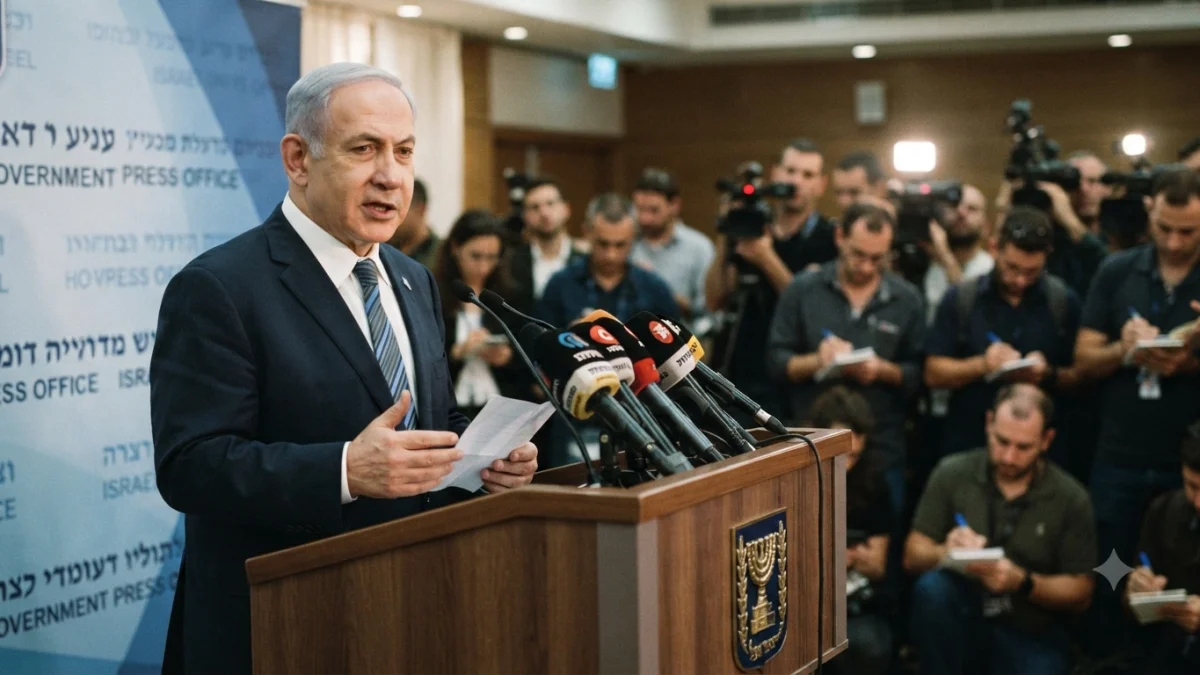


Israeli Prime Minister Benjamin Netanyahu’s rejection of a U.S.-backed 15-point plan for Gaza has exposed one of the clearest policy gaps yet between Israel and President Donald Trump, placing a central pillar of Washington’s effort to end the conflict at risk. Netanyahu said Israel would not withdraw its forces until Hamas was fully disarmed, while the U.S. plan envisages phased Israeli withdrawals linked to the verified decommissioning of Hamas weapons.
The disagreement matters because the plan was designed to resolve the sequencing problem that has repeatedly blocked progress: Hamas wants an Israeli military pullback and an end to attacks, while Israel has demanded that Hamas lose its military capability before accepting a lasting withdrawal. Trump’s roadmap attempts to bridge that divide through phased disarmament, international monitoring and an eventual transfer of Gaza’s administration to a Palestinian technocratic body. Netanyahu’s position effectively reverses that sequence by making complete disarmament a prerequisite for any Israeli withdrawal.


The U.S.-backed framework goes beyond a ceasefire. It calls for Hamas and other armed factions to surrender their military role, the destruction or decommissioning of weapons and military infrastructure under independent monitoring, and the deployment of a temporary International Stabilization Force. It also envisages a Palestinian technocratic committee administering Gaza under the supervision of the U.S.-led Board of Peace, with reconstruction and economic development proceeding alongside the security transition.
Hamas has endorsed the framework in principle, although important differences remain over the meaning and timing of disarmament. Reuters reported that Hamas has accepted the initial roadmap while disputing additional conditions concerning lighter weapons. That leaves Washington facing a difficult implementation problem even before resolving Israel’s opposition: the two principal parties do not agree on either the definition of disarmament or the order in which military withdrawal and weapons decommissioning should occur.
For Trump, the dispute creates a diplomatic test because the proposal is explicitly a U.S.-led framework rather than simply another round of indirect negotiations. The Board of Peace plan was presented as a mechanism for ending the war, stabilizing Gaza and creating conditions for reconstruction and eventual Palestinian self-determination. The United Nations has also recognized the broader Trump framework through Security Council Resolution 2803, which endorsed the plan and welcomed the establishment of the Board of Peace and an international stabilization force.
Netanyahu’s rejection therefore does not amount merely to disagreement over technical implementation. It challenges the ability of Washington to translate a diplomatic framework into Israeli policy. Reuters reported that Netanyahu’s government has already faced pressure from the United States while Israeli military operations in Gaza have diminished. His public refusal nevertheless shows that U.S. pressure has not produced Israeli acceptance of the proposed withdrawal timetable.
The confrontation also illustrates the limits of the unusually close Trump-Netanyahu relationship. Netanyahu has repeatedly described Trump as a close friend and, ahead of a July visit to Washington, said the two would discuss the major issues affecting Israel’s security. The Israeli government has also emphasized continued coordination with Washington. But cooperation on strategic questions does not eliminate fundamental differences over Gaza’s end state, the future role of Hamas and the conditions for an Israeli military withdrawal.
Washington retains substantial leverage through the breadth of the bilateral security relationship. Under the 2016 U.S.-Israel memorandum of understanding, the United States committed to $3.8 billion annually in security assistance and missile-defense funding for fiscal years 2019 through 2028, subject to congressional approval. Congress has also authorized substantial additional assistance since the October 2023 Hamas attack. That gives successive U.S. administrations important influence, although it does not automatically translate into control over Israeli battlefield or political decisions.
For Netanyahu, the immediate political calculation is also significant. Reuters reported that his government faces opposition from far-right coalition partners to aspects of the U.S. roadmap, while Israel is approaching an election. That creates competing pressures: accepting a phased withdrawal could demonstrate responsiveness to Washington and facilitate an end to the conflict, while rejecting the proposal preserves the government's longstanding emphasis on Hamas’s complete military defeat. Reuters has reported that Netanyahu has also rejected the establishment of a Palestinian state under his leadership, reinforcing the gap between his government’s stated position and the longer-term political horizon contained in the U.S. framework.
The immediate consequence is not necessarily a collapse of U.S.-Israeli cooperation. Netanyahu said discussions with Washington over the issue were continuing, and U.S. envoy Nickolay Mladenov remains involved in efforts to bridge the differences. But the public rejection makes the next phase of diplomacy more consequential: Washington must determine whether the plan can be revised sufficiently to secure Israeli participation without losing Hamas’s conditional support. The key issues being monitored are the definition and verification of Hamas disarmament, the timing of Israeli withdrawals, the deployment of the International Stabilization Force, and whether the United States can reconcile its Gaza strategy with the security requirements Netanyahu says Israel will not compromise.