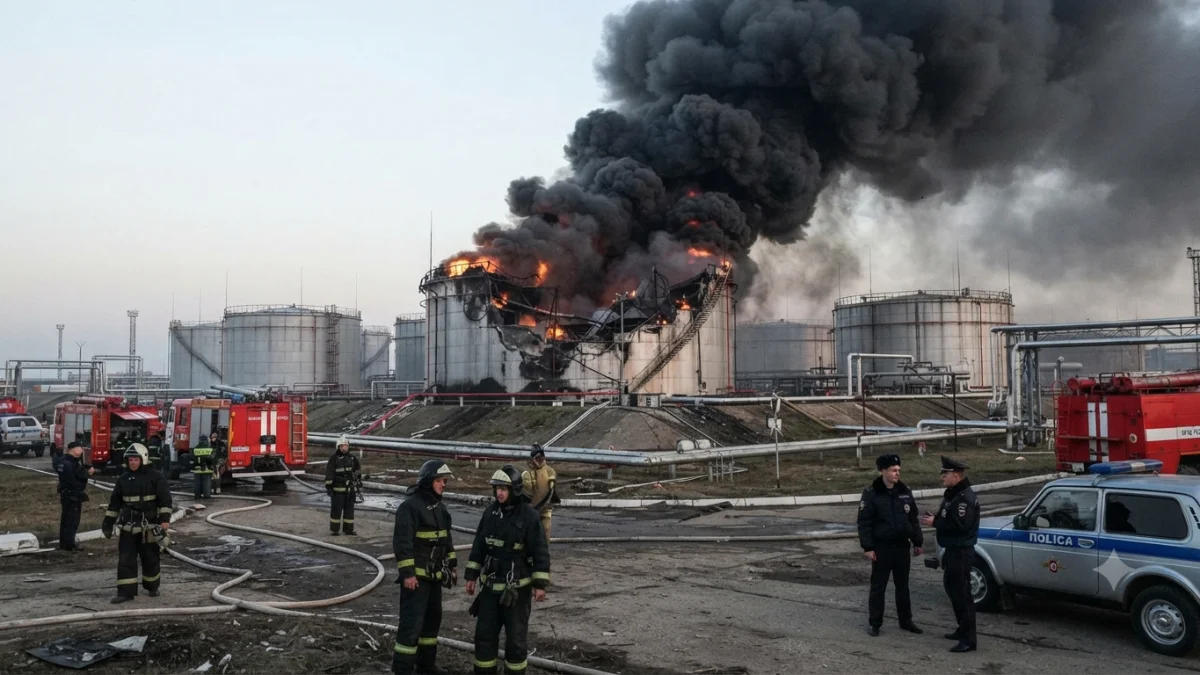


Ukraine’s latest long-range drone strike on the Russian city of Nizhnekamsk has underscored a widening vulnerability in one of Moscow’s most important energy-producing regions, while the civilian death toll has made the attack one of the most consequential Ukrainian operations inside Russia in recent months.
Russian authorities said at least 13 people, including a child, were killed and dozens injured in the Aug. 10 attack in Tatarstan, about 800 km (500 miles) east of Moscow. Ukrainian officials said their forces targeted the TANECO oil refinery, where a fire was reported. Russian authorities did not independently confirm the refinery as the specific target, although the city is a major oil-refining and petrochemical centre. Reuters reported that the attack struck industrial and residential areas and that Russian authorities opened a criminal investigation.


The significance extends beyond the immediate casualties. Nizhnekamsk is far from Ukraine’s front line and hosts some of Russia’s largest energy facilities. TANECO, operated by Tatneft, processed about 17 million tonnes of crude oil in 2024, according to Reuters. Ukraine has repeatedly targeted the complex this year, including strikes in June and July, making the latest operation part of a sustained campaign rather than an isolated attack.
The attacks illustrate how Ukraine has increasingly sought to move the economic effects of the war deep into Russian territory. Since early 2026, Ukrainian drones have struck refineries, oil terminals, storage facilities and other energy infrastructure across Russia. A July 8 wave of attacks reached targets from areas near Ukraine to the Ural Mountains, according to Ukrainian and Russian officials cited by Reuters. Ukraine has also demonstrated an ability to reach much farther east: on July 6, its military said drones struck the Omsk refinery in Siberia, roughly 2,700 km from Ukrainian-held territory. Russian authorities confirmed that attack.
The operational objective is significant because oil refining is more difficult to replace quickly than crude-oil production. Damage to a processing unit can remove fuel-production capacity for an extended period, while repairs may require specialised equipment and time. Ukraine has therefore concentrated on facilities that convert crude into gasoline, diesel, aviation fuel and other products needed by both the civilian economy and Russia’s military.
There are already indications that this strategy has imposed costs. Reuters reported in June that fuel shortages had spread across parts of Russia, including southern regions, Siberia and, in some cases, Moscow. President Vladimir Putin acknowledged that Ukrainian drone attacks had contributed to shortages but said the government was addressing the problem. Earlier in June, Reuters also reported that Russian petroleum-product and coke production had fallen 13.5% year on year in May, while the Moscow oil refinery was expected to remain offline for at least six months after earlier attacks.
That does not mean refinery strikes alone can cripple Russia’s energy system. Russia has a large and geographically dispersed refining network and can redirect supplies between regions, draw on inventories, alter refinery operating patterns and use imports where necessary. The Kremlin has also demonstrated an ability to impose administrative measures to manage domestic fuel markets. The effects therefore depend less on any single refinery than on whether repeated attacks can prevent Moscow from restoring damaged capacity or compensating for lost output elsewhere.
The Nizhnekamsk attack also highlights a second dimension: the growing difficulty Russia faces in protecting infrastructure spread across its enormous territory. Russian authorities said hundreds of Ukrainian drones were intercepted during the latest overnight attacks, including 456 nationwide, but the reported casualties and damage demonstrate that interception figures do not necessarily translate into complete protection of strategic sites. Independent verification of the full number of drones launched or intercepted was not immediately available.
For Ukraine, the campaign carries its own risks. Strikes against energy infrastructure inside Russia can generate civilian casualties, as the Nizhnekamsk death toll demonstrates, and Moscow has portrayed such attacks as terrorism. Kyiv says its operations are directed at Russia’s war effort and has repeatedly linked them to Russia’s attacks on Ukrainian cities. The competing claims over intent and responsibility for civilian harm remain politically and legally significant, particularly as both sides continue to conduct large-scale attacks far from the front line.
The immediate impact on TANECO’s operations is also not yet fully established. A fire or individual impact does not by itself establish how much refining capacity has been lost or for how long. Previous attacks have shown that the consequences depend on which processing units, power systems, storage facilities or other critical components are damaged.
What is confirmed is that Ukraine has demonstrated the ability to repeatedly reach a major Russian industrial centre deep inside the country, while the latest attack produced a substantial civilian death toll. The key issues now being monitored are the extent of damage at TANECO and surrounding industrial facilities, whether refinery operations are disrupted, how Russian authorities respond to the security challenge and whether further Ukrainian strikes continue to put pressure on Russia’s fuel infrastructure.