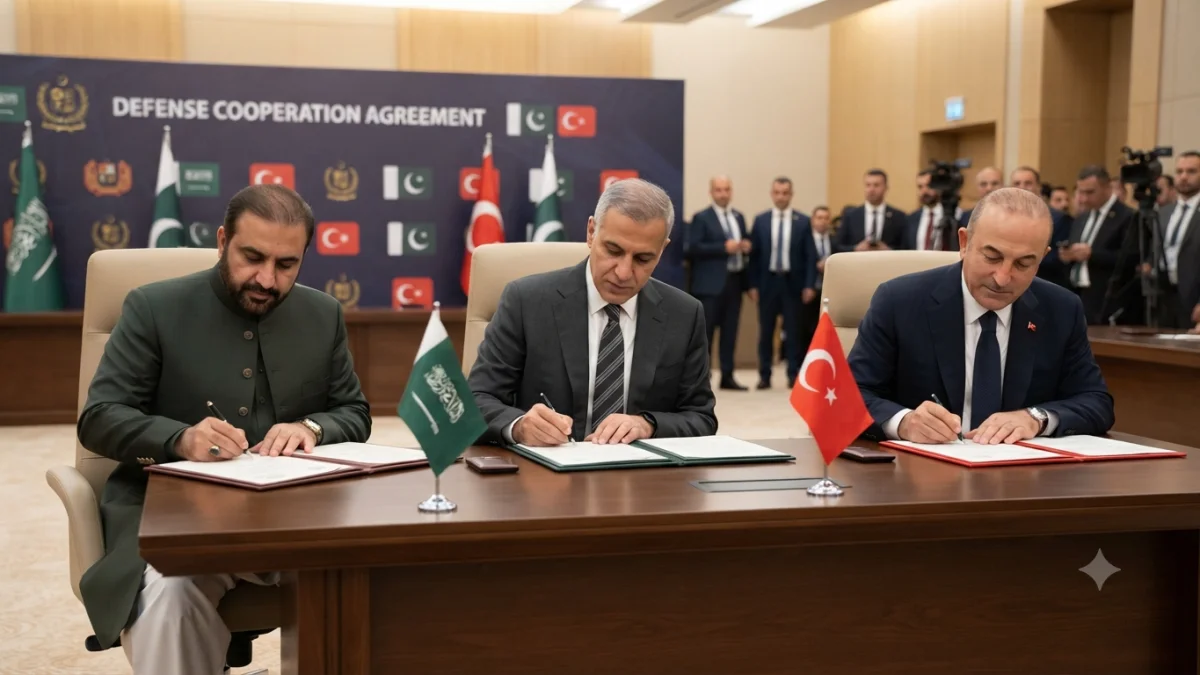


RIYADH — Saudi Arabia, Pakistan and Turkey signed a joint defence agreement in Mecca on Friday that commits the three countries to treat an armed attack against any one of them as an attack against all, strengthening security cooperation amid heightened tensions across the Middle East.
The agreement, signed by Saudi Crown Prince Mohammed bin Salman, Pakistani Prime Minister Shehbaz Sharif and Turkish President Tayyip Erdogan, establishes a framework for closer military and security coordination among the three countries.


The pact, known as the Mecca Joint Defence Agreement, was concluded as regional governments faced continuing security concerns linked to conflicts and military tensions in the Middle East. The three countries have also been working with Egypt through a broader consultative grouping known as R4.
Under the agreement, an armed attack against one member is to be regarded as an attack against all three. Turkish Foreign Minister Hakan Fidan said on Saturday that the provision was technically comparable to Article 5 of the NATO treaty, while stressing that the agreement does not target a particular country.
Fidan said implementation would involve consultations on the nature and extent of assistance required in response to an attack, rather than establishing an automatic military response. He said negotiations over the agreement had taken nearly three years.
The agreement expands on an existing strategic defence relationship between Saudi Arabia and Pakistan. The two countries signed their own Strategic Mutual Defence Agreement in September 2025, under which aggression against either country was to be treated as aggression against both. Pakistan has since provided military forces for exercises and defence cooperation in Saudi Arabia under that arrangement.
Saudi Arabia and Turkey have also deepened defence ties. Their governments agreed earlier this year to strengthen implementation of existing defence cooperation arrangements as part of broader bilateral security coordination.
The trilateral agreement comes as Saudi Arabia, Turkey and Pakistan seek greater coordination on regional security. The countries, together with Egypt, have held consultations on developments affecting the Middle East, maritime security and regional stability.
Fidan said the new framework remained open to other countries, with Egypt potentially joining after outstanding technical issues are resolved. The agreement is expected to be coordinated through a ministerial committee and a general secretariat based in Saudi Arabia.
The three governments have not indicated that the pact is directed against any specific state. Its immediate confirmed purpose is to formalize collective defence cooperation and establish mechanisms for consultation and coordination among the three signatories.