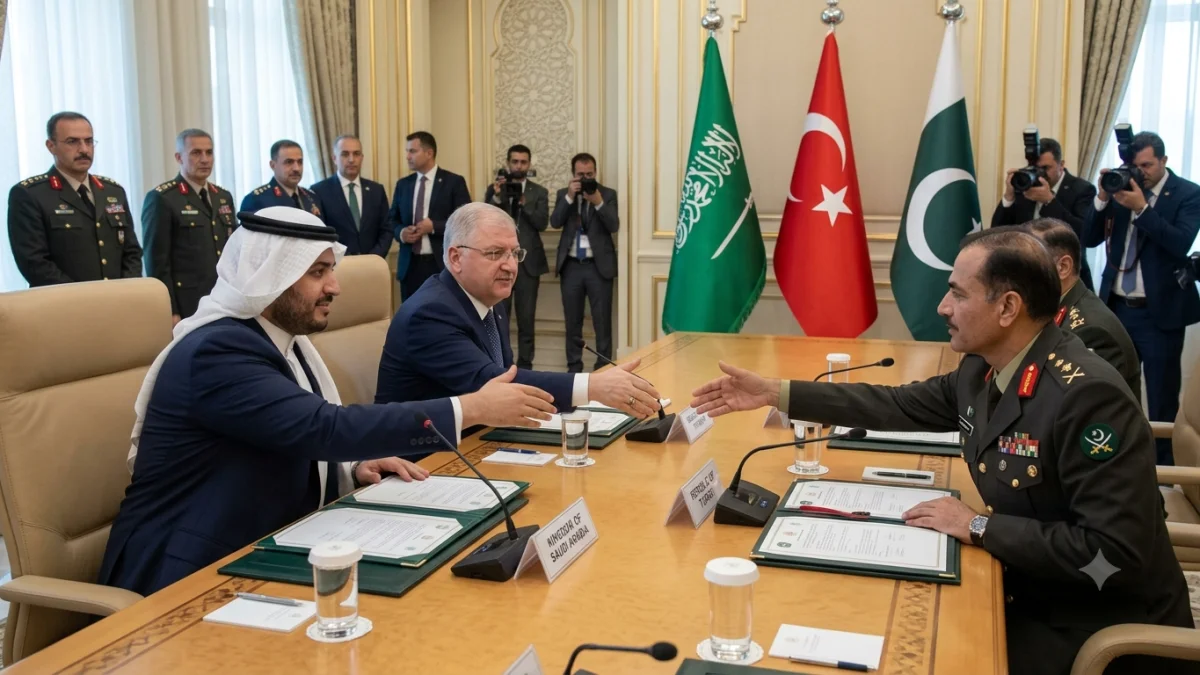


Saudi Arabia, Turkey and Pakistan have formalized a joint defense agreement that significantly deepens security cooperation among three of the Muslim world's most influential military powers, marking one of the most consequential regional security realignments in recent years. The accord, signed in Mecca by Saudi Crown Prince Mohammed bin Salman, Turkish President Recep Tayyip Erdogan and Pakistani Prime Minister Shehbaz Sharif, commits the three countries to mutual defense while expanding cooperation in military planning, intelligence sharing, defense technology and joint exercises.
The agreement's significance lies less in the creation of entirely new military ties than in the formalization of relationships that have been strengthening over several years. Saudi Arabia has steadily expanded defense cooperation with Pakistan, including a bilateral strategic mutual defense agreement signed in 2025, while Turkey has emerged as an increasingly important supplier of advanced defense technologies and unmanned systems across the Middle East. The trilateral framework brings these existing partnerships into a single institutional arrangement, potentially improving coordination during regional crises.


The timing is central to understanding the pact. It comes amid heightened instability across the Middle East, including continued confrontation involving Iran and its regional partners, attacks on Saudi territory by Iran-aligned groups, and broader uncertainty over regional security architecture. Saudi officials have recently warned of intelligence indicating possible attacks against critical infrastructure, underscoring Riyadh's emphasis on strengthening deterrence while simultaneously pursuing diplomatic efforts to reduce tensions.
Saudi Arabia has sought to portray the agreement as a defensive measure rather than the creation of an exclusive military bloc. According to official statements, the pact is intended to reinforce collective security and regional stability without replacing or undermining existing bilateral partnerships or international commitments. That messaging reflects Riyadh's broader foreign policy approach, which has combined expanded regional diplomacy with efforts to diversify security relationships beyond traditional frameworks.
Each participant contributes distinct strategic capabilities. Saudi Arabia provides financial resources, growing defense investment and a central geographic position in the Gulf. Turkey contributes an increasingly sophisticated domestic defense industry, including combat drones, armored vehicles and missile technologies that have gained international prominence. Pakistan brings one of the region's largest and most experienced armed forces, extensive operational expertise and established military cooperation with Gulf states developed over decades. Analysts widely view these complementary strengths as a principal rationale for institutionalizing trilateral cooperation.
The agreement also reflects broader changes in regional security planning. Middle Eastern governments have increasingly sought greater strategic autonomy by strengthening cooperation among regional powers while maintaining relationships with external partners, including the United States and other Western allies. Turkey remains a NATO member, Saudi Arabia continues extensive security cooperation with Washington, and Pakistan maintains relationships with multiple major powers. Rather than replacing those partnerships, the new arrangement appears designed to provide additional regional mechanisms for consultation and deterrence.
Regional reactions have illustrated the agreement's geopolitical sensitivity. Iranian officials have criticized the initiative while questioning its practical impact. Independent analysts, however, have offered differing assessments. Some argue the pact could improve coordination against shared security threats and strengthen deterrence during periods of instability. Others caution that the three countries maintain different strategic priorities and foreign policy interests, potentially limiting how far military integration can progress beyond intelligence cooperation, joint exercises and defense-industrial collaboration.
Historical experience supports both interpretations. Saudi Arabia and Pakistan have maintained close military ties for decades through training, exercises and security cooperation, while Turkish-Saudi relations have improved after earlier periods of political tension. Formal agreements can enhance coordination, but translating political commitments into integrated operational planning typically requires sustained institutional development, compatible command structures and continued political alignment.
The agreement may also carry implications beyond the Middle East. Pakistan's participation links South Asian security considerations with Gulf strategic planning, while Turkey's role bridges European, Mediterranean and Middle Eastern security environments. Although the accord emphasizes collective defense among the three signatories, analysts note that its practical implementation during future regional crises will depend on political decisions taken at the time rather than treaty language alone.
For now, the Mecca agreement represents a significant institutional expansion of defense cooperation among Saudi Arabia, Turkey and Pakistan at a time of elevated regional uncertainty. The confirmed facts establish a mutual defense commitment and broader military collaboration, while officials continue to emphasize its defensive character and compatibility with existing international partnerships. The effectiveness of the framework will ultimately be measured by how rapidly its mechanisms are implemented, how consistently the three governments coordinate policy, and whether the arrangement contributes to regional stability without intensifying existing geopolitical tensions.