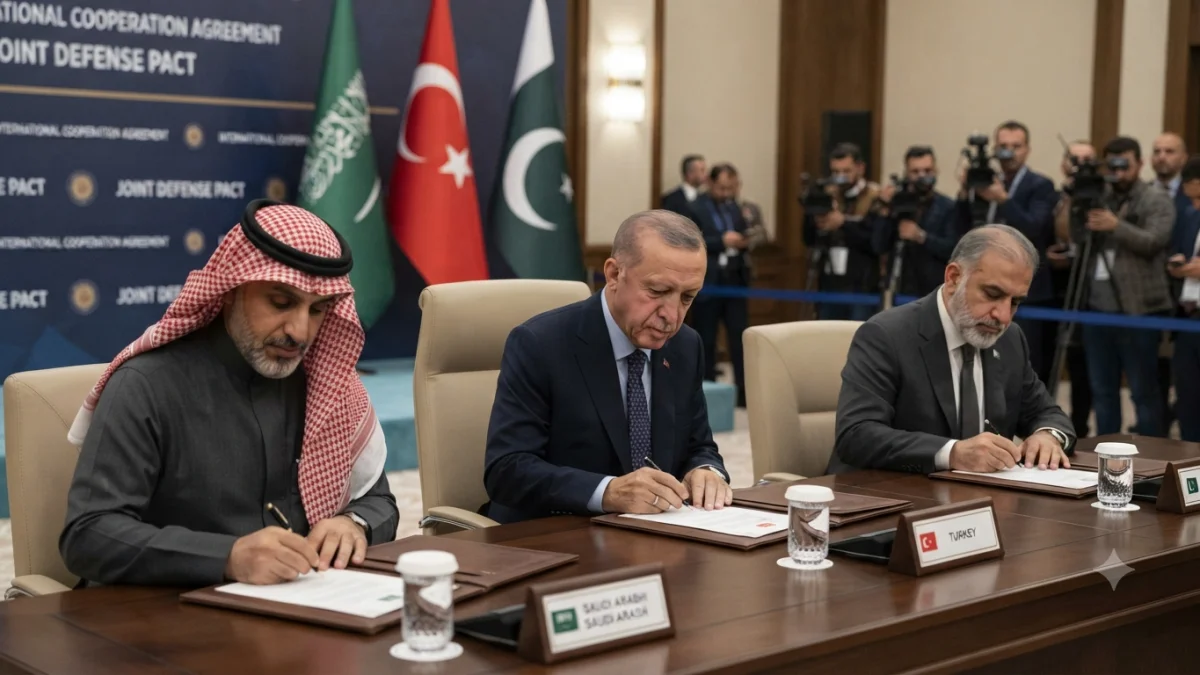


MECCA — Saudi Arabia, Turkey and Pakistan signed a joint defense agreement on Friday that commits the three countries to treating an armed attack against any one of them as an attack against all, deepening security cooperation amid heightened regional tensions.
The Mecca Joint Defense Agreement was signed in the Saudi holy city by Saudi Crown Prince Mohammed bin Salman, Turkish President Recep Tayyip Erdogan and Pakistani Prime Minister Shehbaz Sharif, according to statements from the three governments. The agreement is intended to strengthen collective deterrence and expand cooperation across defense matters.


The pact does not specify the military obligations each country would undertake in response to an attack, leaving unclear what form any collective response would take. Turkish officials said the agreement is defensive in nature and is not directed against a particular country. They also said it does not replace or cancel existing bilateral or multilateral agreements.
Saudi officials likewise said the accord was not intended to create a military axis or sectarian bloc, and said it was not connected to nuclear ambitions or an arms race. Erdogan said the agreement was based on collective deterrence, while also calling for deeper defense cooperation, joint defense-industry projects and increased efforts against terrorism.
The agreement builds on longstanding military ties among the three countries. Saudi Arabia and Pakistan signed a separate mutual defense pact in September 2025, under which an attack on either country would be considered an attack on both. Pakistan has also provided military training and technical assistance to Saudi forces, while Turkey and Pakistan have cooperated on military equipment and training. Saudi Arabia is a major customer of Turkish defense products.
The new agreement comes as the Middle East faces intensified security pressures, including the conflict involving Iran and attacks affecting Gulf states and regional infrastructure. Saudi Arabia has sought to broaden its defense partnerships as threats to its territory and energy interests have increased.
Iranian lawmaker Ebrahim Rezaei criticized the agreement, saying it would not provide Saudi Arabia with greater security. Iran's government had not immediately issued a formal response, according to reports.
The three governments said the agreement was aimed at strengthening regional security and stability. Its practical military commitments and implementation arrangements were not detailed in the initial statements.