

Somali Mothers Walk for Days as Drought Leaves Families With Nothing
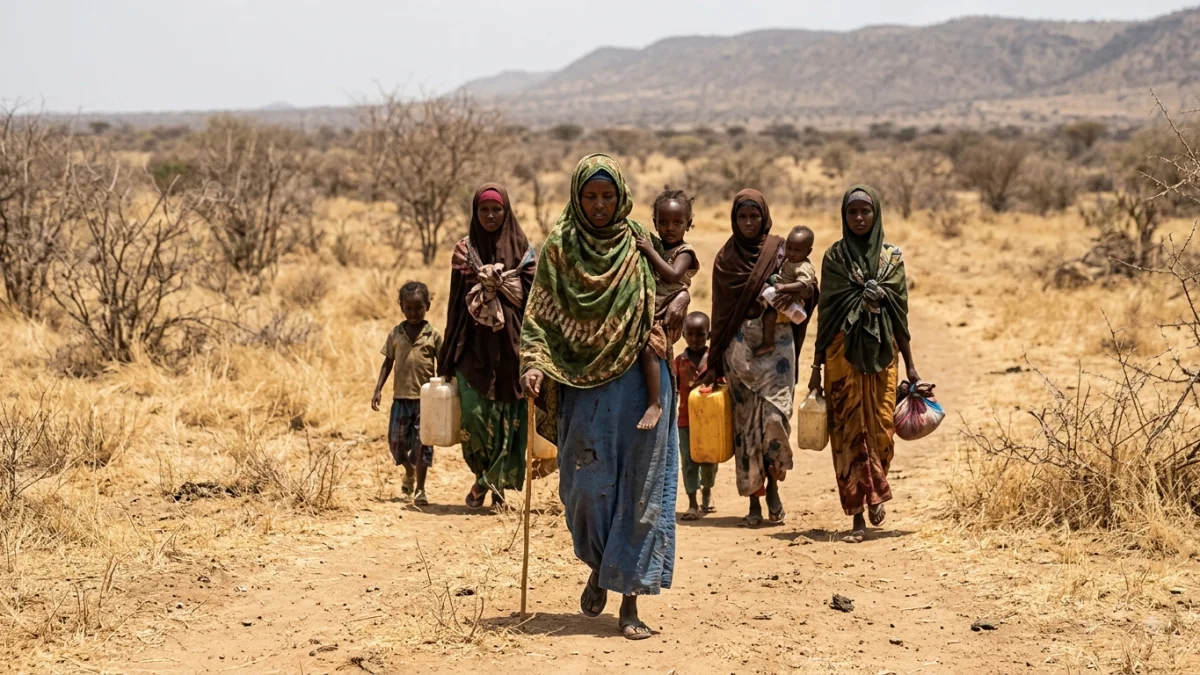
BAIDOA, Somalia — After nearly two weeks on the road with her five children, Luul Mohamed reached Baidoa on Aug. 3 with no food and little idea of what would come next.


Mohamed had left Saakoow, more than 300 kilometers away in Somalia’s Middle Jubba region, after drought stripped her family of its means of survival. The family moved from village to village before reaching Baidoa, one of the country’s main destinations for people displaced by drought, insecurity and hunger.
“We are very hungry and in a desperate situation,” Mohamed said. “We have nothing to eat and can only place our hope in God.”
Her journey is one small part of a much larger movement across Somalia, where years of failed rains are pushing families from rural communities toward towns and displacement camps. For many mothers, the decision to leave comes only after livestock have died, crops have failed and there is little left to sell or eat.
The scale of the crisis is again approaching levels that Somalia has struggled with before. United Nations agencies warned in May that about 6 million people — nearly one-third of the population — were facing crisis-level food insecurity or worse. Nearly 1.9 million people were classified at the Emergency level, while about 1.9 million children were expected to suffer acute malnutrition during 2026.
In Baidoa, the consequences are visible in the arrival of families who have exhausted their options at home.
Habiba Adan left her settlement in Awdiinle, in the Bay region, after four consecutive years of drought destroyed crops and killed livestock. She eventually reached Baidoa with her two older daughters and settled in a displacement camp.
She wants to return home, she said, but repeated crop failures have left little prospect of rebuilding.
“The drought we are experiencing has stretched for four consecutive years, and this year, most crops have again been decimated,” Adan said. “Farmers were only able to harvest enough to sow their fields for the next season, leaving our future bleak.”
At the camp, she said, there was still no food, water or money.
The choices facing women such as Mohamed and Adan have narrowed with each failed rainy season. Somalia’s rural economy depends heavily on livestock and agriculture, making prolonged rainfall shortages especially destructive. The World Food Programme says most regions have endured three failed rainy seasons and that the country recorded its lowest seasonal crop harvest in three decades.
The drought has also driven a new wave of displacement. The International Organization for Migration recorded more than 61,000 new arrivals across five priority districts during the first quarter of 2026, with drought accounting for 75% of the recorded movements.
Other accounts from the affected areas show how long and difficult these journeys can become. In April, Hawa Moalim, 33, arrived in a Baidoa displacement camp after leaving Wajid in the Bakool region with six children and the few goats that had survived. The animals died along the journey. By the time the family arrived, they had nothing left.
For some women, reaching a town does not mean reaching safety.
Baidoa has become a major refuge for drought-displaced people, but its camps are struggling to absorb those arriving. Plan International estimates that about 1.6 million people are in the city, nearly half of them displaced, while one in five families lacks reliable access to water. Many must buy water delivered by truck at prices they cannot easily afford.
Health services are under similar pressure.
At Baidoa Hospital, nutritionist Dr. Omar Abdikarin said patients were arriving from Bay as well as neighboring Bakool and Gedo regions.
“Malnutrition is prevalent in this region, and the majority of patients treated at this hospital suffer from malnourishment,” he said.
Médecins Sans Frontières reported that 11,800 children with moderate or severe acute malnutrition had been admitted to its ambulatory therapeutic feeding centre in Baidoa between January and May. Nearly 6,000 children remained in active care in early June, while hundreds of pregnant and breastfeeding women had also received nutritional support.
The crisis is unfolding as humanitarian funding shrinks. MSF said in August that funding for nutrition programs had fallen by more than 80%, while its teams had treated about 22,000 malnutrition cases during 2026, an increase of roughly 80% from the previous year.
The World Food Programme says 6.5 million Somalis are projected to face crisis-level hunger or worse, including about 2 million at Emergency levels. It says it currently has enough funding to reach only a fraction of those in need and requires $131 million to sustain assistance to the most vulnerable through October.
For families who have already lost crops, animals and homes, the next threat may come from the opposite direction.
The Food and Agriculture Organization has projected a greater than 90% probability of El Niño conditions developing from mid-2026 and strengthening during Somalia’s October-to-December rainy season. That could bring severe flooding to communities already weakened by drought, damaging farmland, contaminating water sources and forcing some families to move again.
For Mohamed, the immediate problem was simpler.
After reaching Baidoa with her children, she was still waiting for her husband. He had gone to farms on the outskirts of the city looking for work or something the family could eat.
The journey had ended. The search for food had not.