

The first signs of danger came as smoke spread across the lower deck of the ferry carrying hundreds of people from Surabaya in East Java toward Makassar in South Sulawesi. Within minutes, according to survivors, passengers were fastening life jackets, gathering on the upper decks and, for many, making the decision to jump into the sea as flames consumed the vessel.
For those who escaped the burning Mutiara Sentosa 2, survival depended not only on their own actions but also on the swift response of nearby ships and rescue teams that pulled people from the water off the coast of Madura Island.


By Monday, rescuers were still searching for dozens of people after the ferry caught fire during its voyage on Sunday. East Java police said at least five people had died, 238 people had been rescued and 28 remained missing as search efforts continued across a wide stretch of sea. Authorities said the cause of the fire remained under investigation.
The disaster has again drawn attention to the risks faced by millions of Indonesians who depend on ferries to travel across an archipelago of more than 17,000 islands. Sea transport is often the fastest or most affordable option for families, workers and businesses, yet Indonesia has experienced repeated maritime accidents linked to safety shortcomings, inaccurate passenger manifests and difficult operating conditions.
Among those rescued was Ahmad Abdul Karim, who described how the fire appeared to begin on the vehicle deck.
According to Karim, a truck caught fire before strong winds helped spread the flames rapidly through the vessel. His account, reported by the Associated Press, reflected the speed with which the emergency unfolded and the limited time passengers had to react.
Video circulating on Indonesian media and verified by multiple news organizations showed passengers wearing orange life jackets gathered along the ferry's railings as thick black smoke rose above them. Some climbed down the sides of the vessel before entering the water, while others waited for rescue boats to reach them.
Nearby commercial vessels became some of the first responders.
Authorities said tugboats and cargo ships in the area began rescuing passengers before larger naval and search-and-rescue assets arrived. The Indonesian Navy later deployed additional vessels, including a corvette, while helicopters joined the operation from the air. Seven boats searched an area spanning roughly 20 miles around the site of the fire, with officials planning an operation lasting up to seven days and potentially longer if necessary.
The ferry's official manifest listed 232 passengers and 39 crew members, for a total of 271 people on board. But as rescue efforts progressed, authorities acknowledged uncertainty over whether the manifest reflected everyone who had boarded, a recurring challenge in Indonesian maritime disasters.
Officials told reporters they were continuing to verify passenger records while accounting for those rescued, hospitalized and still unaccounted for.
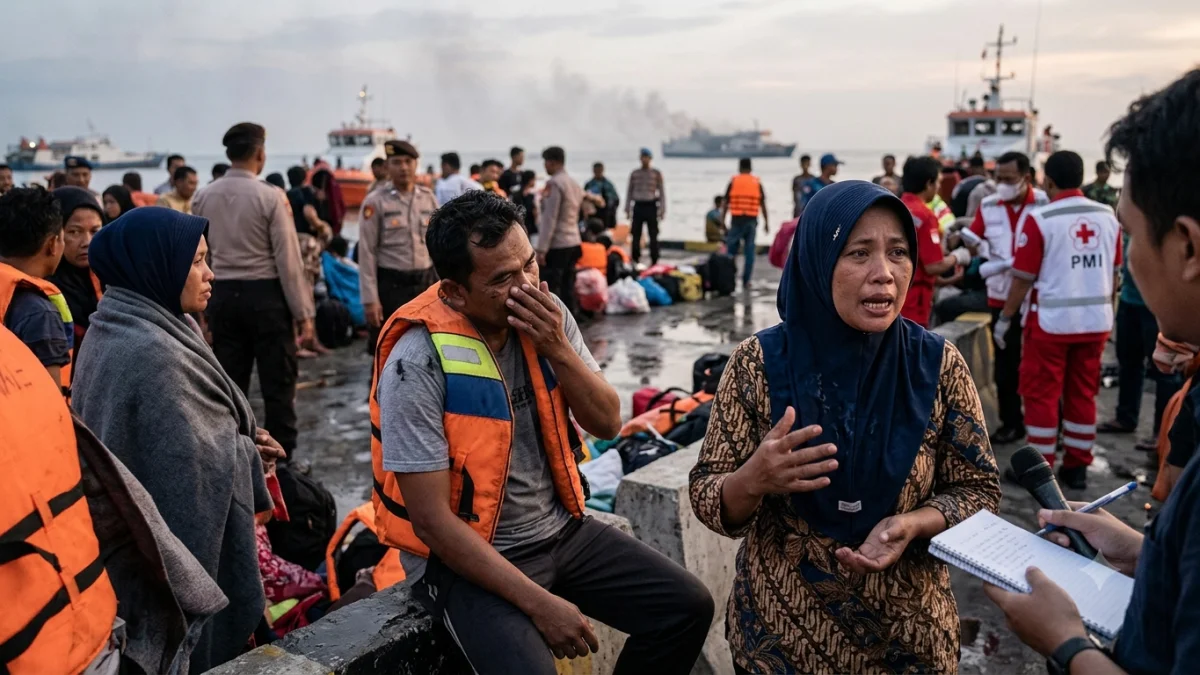
All rescued passengers were transported to Surabaya's Gapura Surya Nusantara Port, where families gathered to await news of relatives. Medical teams assessed survivors after they came ashore, while investigators began interviewing crew members and witnesses as part of the inquiry into the cause of the blaze.
The Mutiara Sentosa 2, built in Japan in 1992 and later sold for service in Indonesia, was capable of carrying substantially more passengers than were listed aboard on Sunday, according to vessel information cited by authorities and media reports. It was also transporting scores of vehicles, including trucks and heavy equipment. Investigators have not determined whether any cargo contributed to the fire.
Indonesia's dependence on maritime transport makes ferry safety a persistent public concern. Ferries connect remote islands, transport food and commercial goods and enable millions of routine journeys every year. But the country's long record of maritime accidents has repeatedly exposed weaknesses in safety enforcement and passenger documentation.
Only a year earlier, another ferry tragedy near Bali claimed multiple lives, reinforcing calls for stronger oversight across Indonesia's extensive domestic ferry network.
For the survivors of Sunday's fire, however, those broader questions remain secondary to the experience of escaping a burning ship.
Many entered the water wearing life jackets, waiting to be spotted by rescuers amid smoke, waves and floating debris. Others remained aboard until rescue vessels reached the ferry. Their accounts, together with images recorded during the evacuation, have become the clearest record of how hundreds of people survived one of Indonesia's latest maritime disasters while search teams continue looking for those who never returned home.