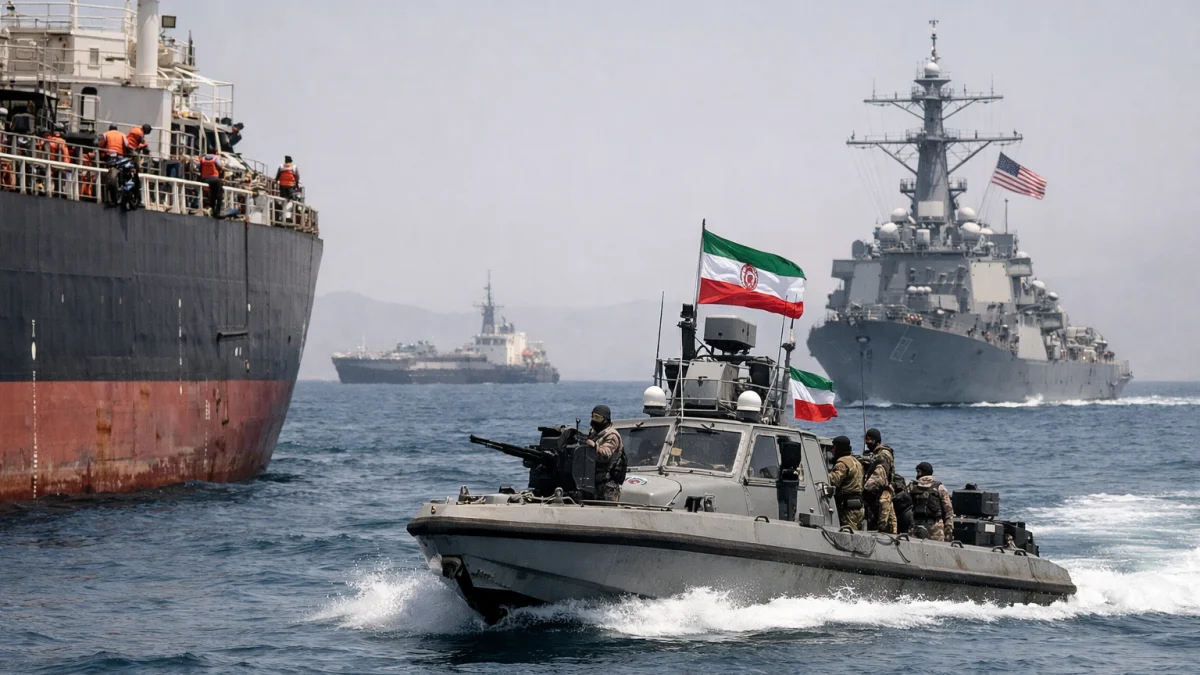


The latest escalation between the United States and Iran has renewed concerns over the security of the Strait of Hormuz, one of the world's most strategically important maritime chokepoints, underscoring how regional military confrontation can rapidly evolve into a global energy security challenge. Following renewed exchanges of U.S. and Iranian strikes and Iranian declarations restricting navigation through the waterway, governments, shipping companies and energy markets are reassessing risks to oil and liquefied natural gas (LNG) supplies moving from the Gulf to international markets.
The significance of the latest developments extends beyond the immediate military confrontation. The Strait of Hormuz links the Persian Gulf to the Gulf of Oman and the Arabian Sea and serves as the principal export route for major oil producers including Saudi Arabia, Iraq, Kuwait, the United Arab Emirates and Qatar. Around one-fifth of globally traded oil typically transits the narrow waterway, alongside a substantial share of internationally traded LNG. Even temporary disruption can affect energy prices, shipping costs and inflation expectations far beyond the Middle East.


The current crisis represents a shift from diplomatic tensions toward direct risks to commercial navigation. According to U.S. officials, Iranian attacks on commercial vessels prompted retaliatory American strikes against Iranian military targets, including coastal missile and drone infrastructure associated with maritime operations. Iran subsequently declared the Strait closed to unauthorized shipping while asserting greater control over navigation, although U.S. military officials and maritime authorities have disputed the practical effectiveness of that declaration, reporting that commercial traffic has continued through alternative shipping lanes under heightened security.
That distinction between political declarations and operational reality is central to understanding the current risk. Maritime security organizations have reported that some vessels continue transiting the Strait, but operators are exercising greater caution through route adjustments, higher insurance coverage, additional naval coordination and, in some cases, voyage delays. Such precautionary measures can increase transportation costs even without a complete closure of the waterway.
Energy markets historically respond not only to actual supply disruptions but also to perceived risks. Previous crises involving the Strait—including the "Tanker War" during the 1980s Iran-Iraq conflict and episodes of tanker seizures in recent years—demonstrated that uncertainty alone can produce sharp movements in oil prices and shipping insurance premiums. Current market reactions similarly reflect concern that continued military exchanges could reduce confidence in one of the world's most important energy corridors rather than evidence of sustained physical supply losses.
Another important factor is the limited availability of alternative export routes. Some Gulf producers have invested in pipelines bypassing the Strait, including Saudi Arabia's East-West Pipeline and the UAE's Abu Dhabi Crude Oil Pipeline to Fujairah. However, these alternatives cannot fully replace the Strait's total export capacity. Qatar, among the world's largest LNG exporters, remains particularly dependent on maritime access through Hormuz, meaning prolonged disruption could affect global gas markets alongside crude oil supplies.
The confrontation also illustrates the close relationship between maritime security and broader geopolitical stability. The United States has long maintained that freedom of navigation through international waterways is a core strategic interest, while Iran has repeatedly argued that regional security should reflect its own security concerns and sovereignty. These competing positions have periodically produced military incidents involving naval vessels, commercial shipping and unmanned systems. The latest escalation has revived those longstanding strategic disagreements while complicating ongoing diplomatic efforts.
International institutions have responded by emphasizing de-escalation. The United Nations and maritime organizations have called for restraint and the protection of civilian shipping, warning that attacks on commercial vessels increase risks to international trade regardless of broader political disputes. Analysts note that preserving confidence in maritime transport is essential not only for energy markets but also for global supply chains, as Gulf shipping routes carry petrochemicals, refined products and other commercial cargoes.
For importing economies, especially across Asia and parts of Europe, the implications extend beyond fuel availability. Higher oil and gas prices can feed inflation, raise transportation costs and complicate monetary policy. Energy-intensive industries may also face increased input costs if shipping disruptions persist. Governments holding strategic petroleum reserves could be better positioned to absorb temporary shocks, but sustained instability would place greater pressure on both producers and consumers to stabilize supply.
The evolving situation also highlights the importance of commercial risk management. Shipping companies, insurers and commodity traders increasingly rely on real-time maritime intelligence, naval escorts where available, and revised contractual arrangements to manage exposure in conflict zones. Even if physical exports continue, elevated insurance premiums and security measures can increase the overall cost of delivering energy to global markets.
As of July 13, 2026, military exchanges between the United States and Iran continue to raise concerns over the security of the Strait of Hormuz, although shipping has not ceased entirely and officials continue to dispute the practical impact of Iran's declared restrictions. Diplomatic contacts remain active alongside military operations, while governments, maritime authorities and energy markets continue monitoring commercial vessel movements, regional security conditions and any verified changes affecting freedom of navigation through the strategic waterway.