

Zambians Line Up to Vote as Economic Gains Meet the Reality of Daily Costs
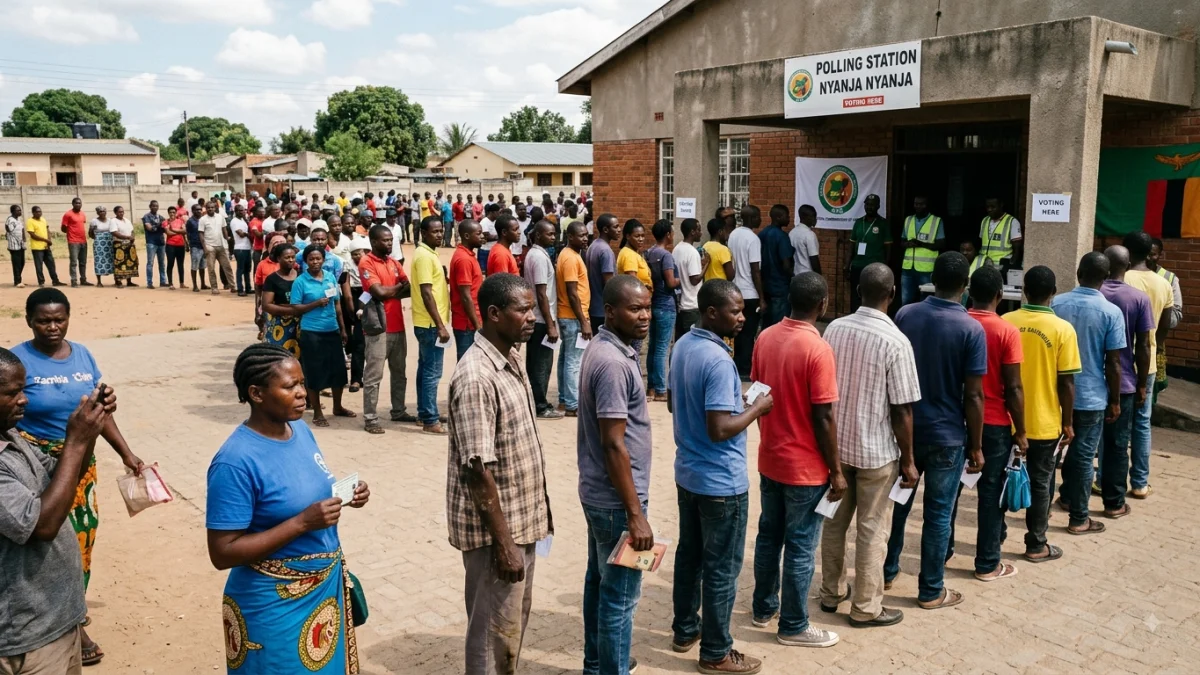
Long lines formed at polling stations in Zambia on Thursday as voters cast ballots in an election that has turned into a test not only of President Hakainde Hichilema's political leadership but of whether the country's improving economic figures have made a meaningful difference in everyday life. Some polling stations reported delays and confusion as voters waited to cast ballots for president, parliament and local government representatives.


For many voters, the decision was being made against the backdrop of a simple economic question: what has changed in the household budget since Hichilema took office in 2021?
Zambia's economy has made significant progress since the country defaulted on its sovereign debt in 2020. Hichilema's government has overseen debt restructuring, sought to attract investment and promoted increased copper production, while the International Monetary Fund forecasts economic growth of 4.3% in 2026. Annual inflation has fallen sharply from the double-digit levels seen in 2025, reaching 6.5% in June, according to the Zambia Statistics Agency.
But falling inflation does not mean that prices have returned to where they were before the surge. For households trying to pay for food, energy and other necessities, the cost of living remains a central concern.
The Jesuit Centre for Theological Reflection, which tracks the cost of basic household needs, said the cost of its basket for a family of five in Lusaka reached 12,112.88 Zambian kwacha in June, compared with 11,365 kwacha in January. The basket was also higher than a year earlier. The centre said the increase showed a continuing gap between improving macroeconomic indicators and the pressures experienced by households.
The figures help explain why economic performance has become such a personal issue in this election.
James Phiri, a 29-year-old student at the University of Zambia, told Reuters that he voted for Hichilema because he believed the president cared about people. Phiri pointed specifically to the restoration of meal allowances for university students, a policy Hichilema had promised during his campaign and reinstated after taking office.
His experience contrasts with that of Samuel Chitendwe, a 47-year-old welder and father of four, who told Reuters he voted for opposition candidate Brian Mundubile. Chitendwe said he had just dismissed an employee and was tired of hearing about economic progress.
Their contrasting choices capture the broader argument confronting voters at the polls.
Hichilema's supporters point to stabilization after the debt crisis, improved investor confidence, debt restructuring and measures that have benefited groups such as students. The government has also sought to expand Zambia's mining sector, particularly copper, which is central to the country's hopes for stronger growth and greater foreign investment.
Opposition politicians have argued that the benefits of those improvements have not reached ordinary citizens quickly or widely enough. Mundubile has made the cost of living a central part of his campaign, while criticizing Hichilema's record on governance and promising a different approach to the distribution of the country's mineral wealth.
That debate is unfolding in a country where copper has become increasingly important to the economic outlook. Zambia is Africa's second-largest copper producer after the Democratic Republic of Congo, and its mineral resources have attracted growing interest from both China and the United States. Higher production and investment could strengthen government revenues and employment, but the political question is whether that wealth will translate into improvements that households can see in their daily lives.
For voters, those expectations extend beyond the price of food. Employment, electricity and household expenses have featured prominently in concerns about living standards. The election has therefore become a judgment on both the direction of the national economy and the pace at which recovery is being felt at home.
The pressure is particularly significant for a government that has spent its first term arguing that economic repair requires time. Zambia's debt restructuring and declining inflation are important indicators of that repair, but household costs can remain elevated even when the rate at which prices rise begins to slow. The June data from the Jesuit Centre showed that distinction clearly: the cost of its basic-needs basket had increased by 747.88 kwacha between January and June even as annual inflation fell.
The vote is also about more than the presidency. Zambians are choosing members of the National Assembly and local government representatives, giving voters an opportunity to judge the administration and the opposition across several levels of government. The Electoral Commission of Zambia scheduled polling from 6 a.m. to 6 p.m. on August 13, with counting and verification to follow.
Hichilema entered the election as the incumbent and was widely regarded as the favourite, helped by the advantages of office and a divided opposition. But the cost of living has remained one of his principal vulnerabilities, creating uncertainty over how voters will weigh economic stabilization against the prices and opportunities they encounter in their own lives.
As the queues moved through polling stations across the country, the choice facing voters was therefore not simply between competing political figures. It was also a choice about how they understood the country's recovery: whether improving national indicators were evidence of progress that should be given more time, or whether the continuing strain on household budgets demanded a change in direction.
For voters such as Phiri and Chitendwe, the answer was expressed in two different ballots on the same election day — one seeing progress worth supporting, the other seeing an economic recovery that had yet to reach his household.