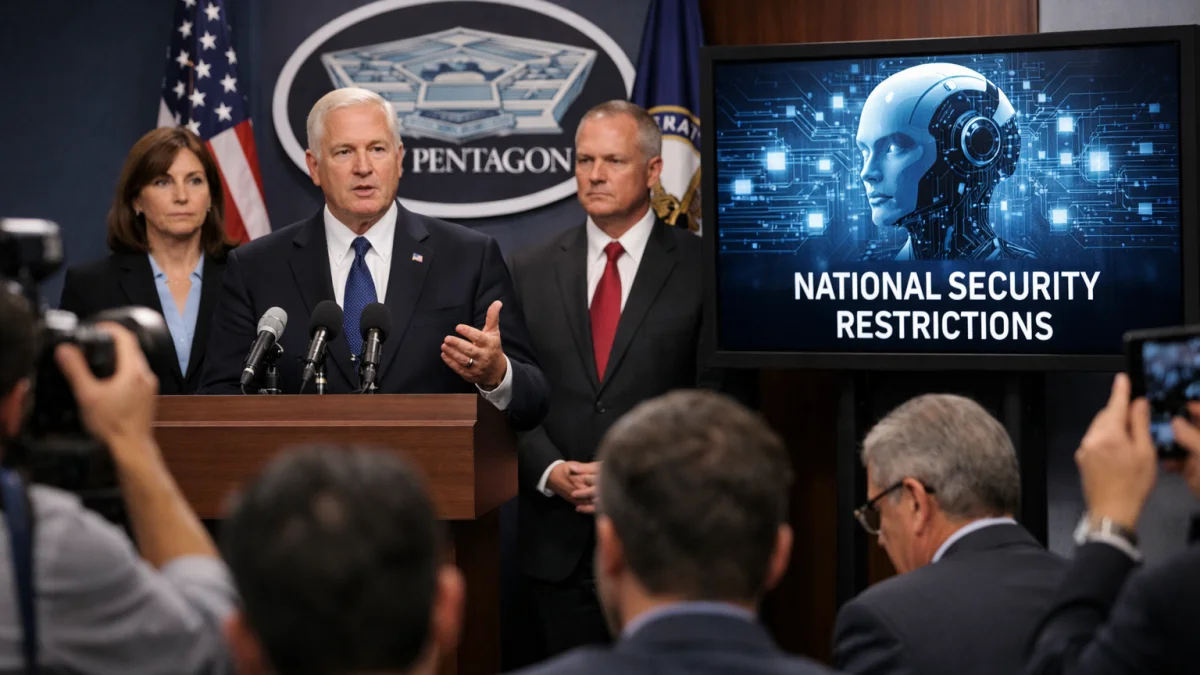


WASHINGTON — The U.S. government has imposed new restrictions on access to some of the most advanced artificial intelligence models, citing national security concerns, prompting a dispute between federal officials and AI developer Anthropic and drawing responses from cybersecurity experts and industry groups.
Anthropic said it had taken its latest AI models, known as Fable 5 and Mythos 5, offline after receiving a U.S. government directive requiring the company to suspend access for foreign nationals. The company said the order was issued under export control authorities and affected users both inside and outside the United States.


The restrictions represent one of the most significant known efforts by the U.S. government to limit access to advanced AI systems on national security grounds. According to Anthropic, officials expressed concern that safeguards within one of the models could potentially be bypassed, allowing users to identify software vulnerabilities. The company said it disagreed with the government's assessment but complied with the directive.
In a statement released after the order, Anthropic said it hoped to restore access as soon as possible and called for a process that is “transparent, fair, clear, and grounded in technical facts.” The government has not publicly released detailed technical evidence supporting its concerns.
The White House has recently increased its focus on AI oversight within the national security sector. Earlier this month, President Donald Trump signed directives intended to strengthen the government's ability to evaluate advanced AI systems and accelerate the adoption of secure AI technologies across defense and intelligence agencies, according to White House documents.
The restrictions have also generated opposition from parts of the cybersecurity industry. On Monday, more than 50 cybersecurity leaders from companies including Nvidia and Adobe urged the administration to lift the limits, arguing that access to advanced AI tools is important for identifying and addressing software vulnerabilities. The group said the affected models were not uniquely dangerous compared with competing systems.
Administration officials have defended the move as a precautionary measure tied to national security. Reports published Monday indicated that concerns extended beyond potential model vulnerabilities, although details remain unclear and some reported claims have not been publicly confirmed by the government.
The dispute comes amid broader debates over how governments should regulate increasingly powerful AI systems while maintaining technological competitiveness. Recent executive actions have emphasized both AI innovation and security, reflecting the growing role of advanced AI in economic and strategic policy.
As of Monday, the restrictions on Fable 5 and Mythos 5 remained in effect. Anthropic said discussions with federal officials were continuing, while industry groups and cybersecurity organizations pressed for further clarification regarding the government's concerns and the future scope of AI export controls.