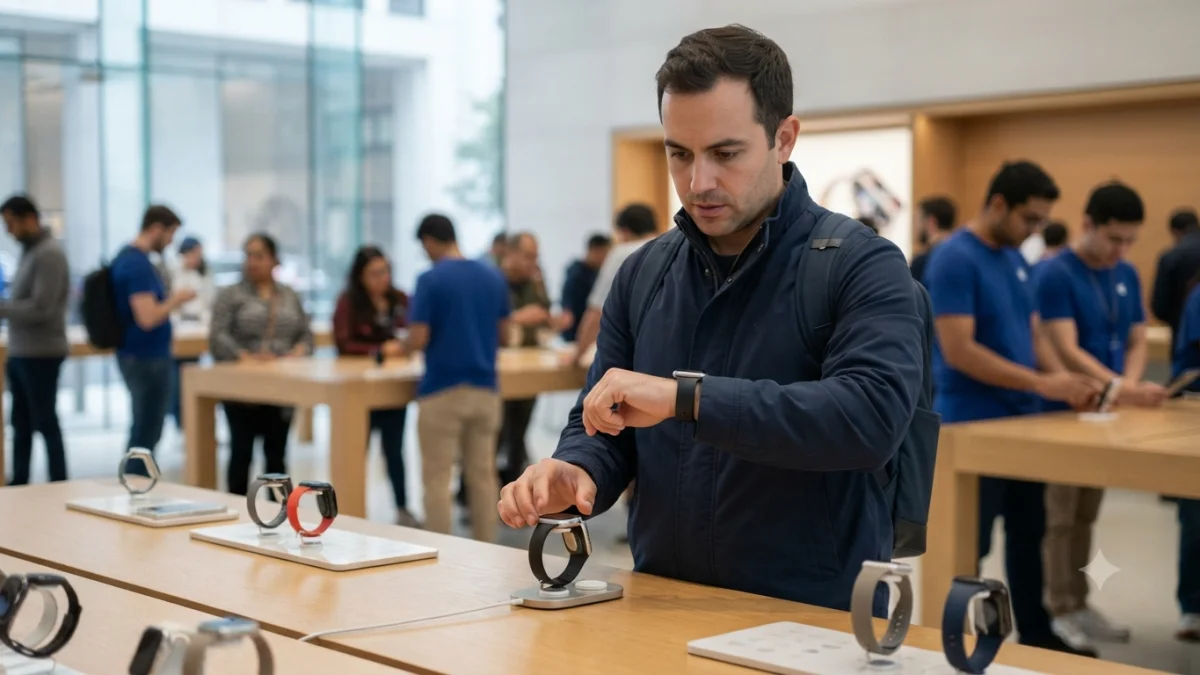


For years, the Apple Watch has asked a simple question of its owner: what can a computer on the wrist do? Now Apple appears to be asking a different one — does that computer need to look, or even behave, like a watch at all?
Apple’s industrial design team has spent the past year exploring a broader rethink of its smartwatch lineup, including concepts with no display, different screen designs and sizes, according to a report published Sunday by Bloomberg. The company has also considered round displays, although such concepts are not expected necessarily to reach consumers.


The exploration comes as Apple’s wrist-worn devices have entered a period in which changes are increasingly happening beneath a familiar exterior. The Apple Watch Series 11, introduced in September 2025, brought new health features, longer battery life and a thinner design, while the Apple Watch Ultra 3 added satellite communication and the longest battery life in the Apple Watch family. Yet the basic visual language of the products has remained recognizable for years.
That tension — between a mature physical design and rapidly changing software — helps explain why the latest reported experiments matter.
The Apple Watch began as an extension of the iPhone, putting notifications, messages and other functions on the wrist. Over time, Apple shifted much of its emphasis toward health and fitness. The Series 11 added hypertension notifications and sleep score, while watchOS introduced features including Workout Buddy, a redesigned Workout app and more context-sensitive information through Smart Stack.
Apple’s next challenge may be to make the watch less dependent on the traditional smartwatch model itself.
The company is considering devices without displays, Bloomberg reported, opening the possibility of a wearable whose primary purpose would be sensing and health tracking rather than presenting information on the wrist. Such an approach would put Apple closer to products such as Whoop and other screen-free or screen-light health wearables, while potentially allowing users to interact with information through an iPhone or other Apple devices.
For Apple, that would represent a significant shift in the role of the wrist.
A screenless device could be smaller and less visually intrusive, while still collecting health information. It could also address one of the persistent compromises of smartwatches: the need to fit sensors, battery and a display into a device small enough to wear continuously.
But removing the screen would also remove one of the Apple Watch’s defining advantages. Users can currently see workout data, notifications, timers and navigation information without reaching for a phone. Community reactions to the reported exploration have reflected that divide, with some users welcoming a simpler health-focused band and others saying a display remains essential during exercise and everyday use.
The debate illustrates a broader change in wearable technology. As sensors have become more capable, the value of a device increasingly lies not only in what it displays but in what it can measure continuously.
Apple has been moving in that direction for years. Its watch now tracks sleep, heart-related information, wrist temperature and activity, while newer models can provide health notifications and emergency connectivity. Apple says the Series 11 is its thinnest and lightest design, while the Ultra 3 combines a larger display with satellite connectivity for situations outside cellular and Wi-Fi coverage.
At the same time, Apple is pushing artificial intelligence deeper into the ecosystem.
At its June 2026 Worldwide Developers Conference, the company introduced a new version of Siri powered by Apple Intelligence and said it would be integrated across Apple devices, including Apple Watch. Apple said Siri AI would be capable of using personal context, understanding information on screen and carrying out actions across applications.
That could change what people expect from a wearable. If information can be delivered through voice, haptics or other forms of interaction, a conventional touchscreen becomes less essential for some tasks.
Apple’s reported exploration also includes potential new premium models and more affordable concepts, suggesting the company is examining the smartwatch market as a broader family of devices rather than a single product line.
None of those concepts is guaranteed to become a commercial product. Apple has a long history of experimenting with technologies and designs that never reach customers, and reports about future products can change substantially before launch.
For now, the company’s existing strategy remains one of incremental physical refinement paired with increasingly ambitious software. Apple’s most recent watches have not abandoned the familiar rectangular form; instead, the company has concentrated on health capabilities, battery performance, connectivity and software.
That makes the reported design exploration notable precisely because it questions the assumption that Apple’s next major wearable breakthrough must be another Apple Watch in the conventional sense.
The company that helped establish the modern smartwatch may now be looking beyond the screen that helped define it — toward a wearable that measures more, talks more and perhaps shows less.
Whether that becomes Apple’s next product or remains an experiment inside its design studios, the question marks a new stage for a category that is no longer defined simply by putting a small computer on a wrist.