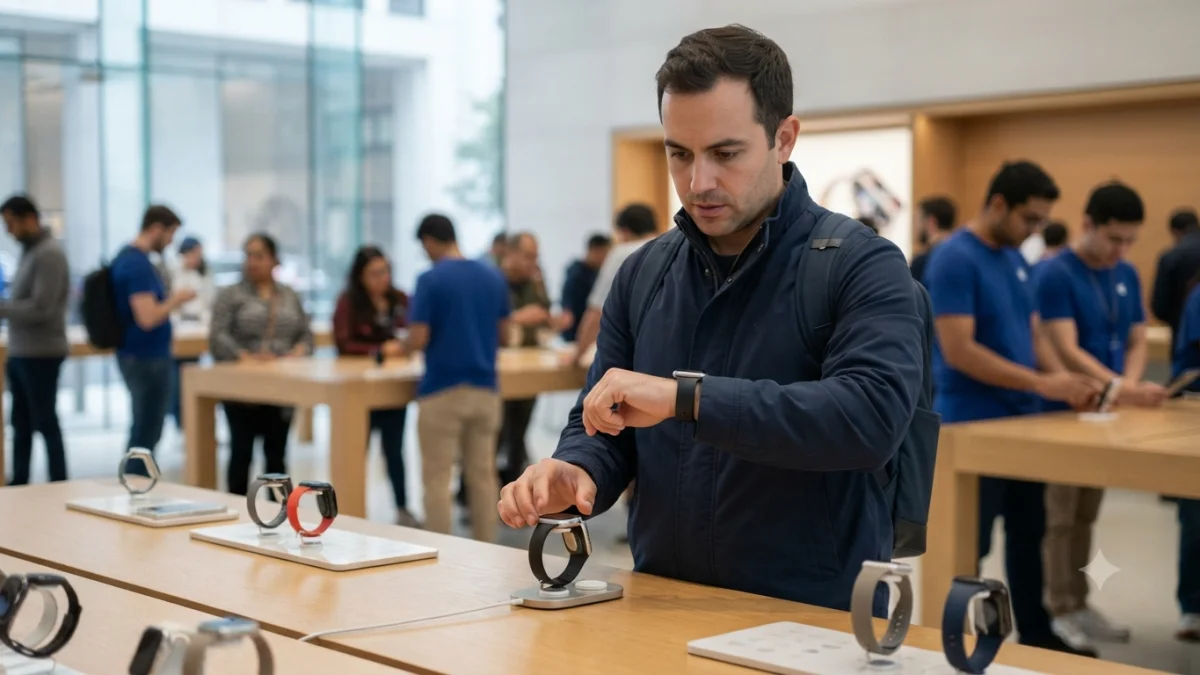


Apple is considering a broad rethink of its smartwatch strategy, including devices without displays, alternative screen designs, additional sizes and new positions at both the premium and lower-cost ends of the market, according to reporting attributed to Bloomberg’s Mark Gurman. The work remains exploratory, with no indication that Apple has finalized which concepts, if any, will reach consumers.
The significance lies less in the prospect of a screenless Apple Watch itself than in what it says about the direction of wearable technology. For more than a decade, Apple has developed the Watch as a small computing device that combines notifications, communications, applications, fitness tracking and health monitoring. A screen-free product would represent a different proposition: a wearable designed primarily to collect information and interact with other Apple devices rather than function as a self-contained interface.


That shift would align with a broader move in the wearables market toward passive health and fitness monitoring. Products such as Whoop and Oura have emphasized continuous measurement, sleep and recovery tracking and relatively limited screen interaction. Apple has so far concentrated on a more conventional smartwatch model, making the reported exploration potentially important because it would allow the company to address consumers who want health tracking without wearing a miniature smartphone on their wrist.
The idea also fits Apple's increasingly explicit emphasis on health and artificial intelligence. In June, Apple announced its next generation of Apple Intelligence and a new Siri AI, with support planned for watchOS 27. The company said Apple Intelligence would be available on compatible Apple Watch models, including Series 9 and later, Ultra 2 and later, and SE 3 when paired with a suitable nearby iPhone. Apple also said Siri AI would enter testing on watchOS 27.
That software strategy could eventually change the role of the physical device. If more processing and interpretation occur through Apple's AI systems and Health ecosystem, the wearable does not necessarily need to reproduce the full range of functions on its own display. A sensor-focused device could instead gather biometric and activity information continuously while sending more complex interactions to an iPhone, headphones or another Apple product. That is an inference from Apple's stated software direction and the reported hardware exploration, rather than a confirmed product plan.
Apple's existing Watch strategy already shows how heavily the company has invested in health as a differentiator. The Series 11, introduced in 2025, added sleep scoring, longer battery life, 5G connectivity and additional health capabilities, while Apple has continued expanding health-related features across the platform. The company says the sleep score was developed and tested using data from more than 5 million nights in its Apple Heart and Movement Study.
The reported redesign discussions also come after several years in which Apple Watch hardware has evolved incrementally. The current standard design dates to the Series 10 introduced in 2024, while the Ultra design originated in 2022 and has subsequently received iterative changes. A June report citing an industry leaker said a major redesign could arrive in 2027, potentially including changes to the band attachment system. Earlier reporting about a more radical "Apple Watch X" redesign did not materialize with the 10th-generation model, underscoring the difference between Apple's internal experimentation and products that ultimately ship.
A screenless device would nevertheless create difficult product questions. Removing the display could improve simplicity and potentially reduce the demands placed on the battery, but it would also eliminate immediate access to information and controls that distinguish a smartwatch from a conventional fitness band. Apple would have to determine whether the value of continuous health monitoring and longer, less intrusive use outweighed the loss of functions such as viewing notifications, checking workouts and making payments directly from the wrist.
The competitive implications are similarly mixed. A cheaper, simpler tracker could broaden Apple's reach among users who do not want a full smartwatch, while premium variants could give the company more ways to segment its wearable business. At the same time, Apple would be entering categories already occupied by specialized health trackers and smart rings, where long battery life, discreet form factors and continuous monitoring are central selling points.
For now, the confirmed situation is narrower than some headlines suggest. Apple has publicly committed to expanding intelligence and health capabilities across its existing Watch platform, but it has not announced a screenless Apple Watch or a definitive new hardware architecture. Reports indicate that multiple concepts are being evaluated and that some may never reach the market. The key developments to monitor are therefore Apple's forthcoming Watch hardware announcements, the rollout of Siri AI and watchOS 27, and any official changes to the company's health strategy or wearable product range.