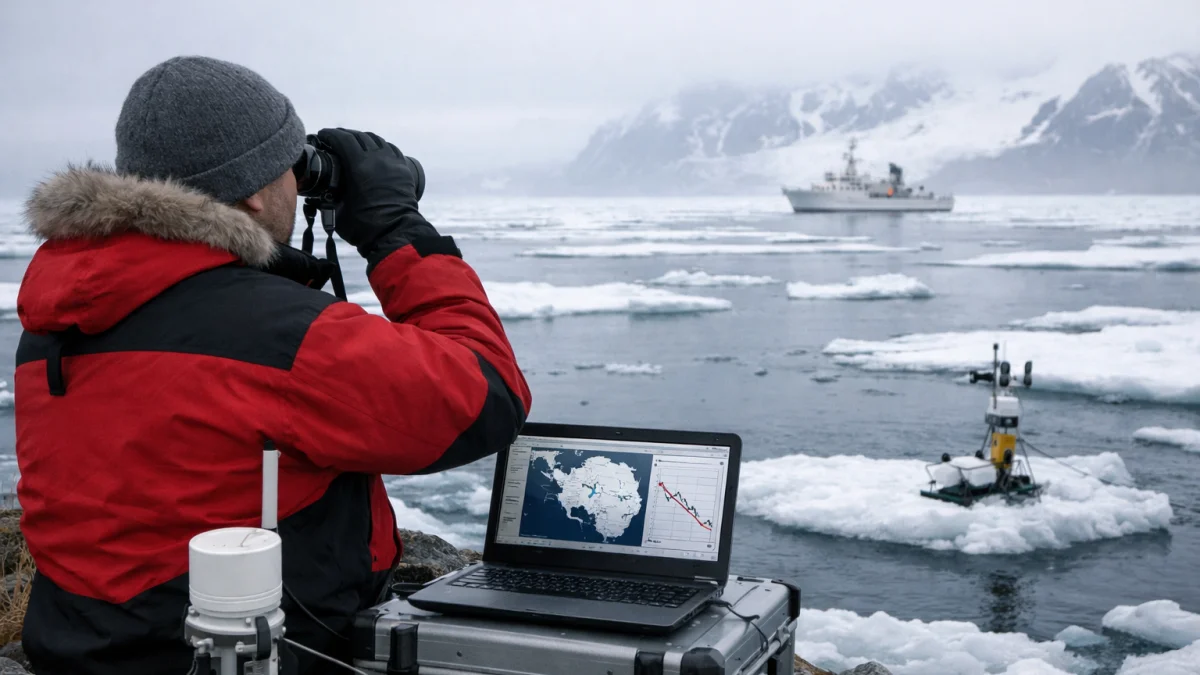
ARCTIC — Satellite monitoring of Arctic sea ice indicates continued below-average extent and a long-term declining trend during the current melt season, according to recent assessments by operational climate and meteorological agencies.
The UK Met Office reported in a June 2026 briefing that Arctic sea ice extent remained among the lowest recorded for the date, placing it around the fifth lowest in the satellite record. The agency said extent measured about 11.18 million square kilometres on 10 June, based on the OSI SAF Sea Ice Index, and noted that seasonal melting had begun early across multiple Arctic marginal seas. The briefing added that the winter maximum recorded in March 2026 was the lowest on record, continuing a pattern of weak winter growth.
The observed decline is consistent with long-term satellite records showing sustained reductions in Arctic sea ice since 1979, according to the U.S. National Snow and Ice Data Center (NSIDC), which maintains one of the primary global sea ice datasets. The NSIDC Sea Ice Index is widely used to track both monthly and daily extent changes and is based on passive microwave satellite observations.
Scientists attribute year-to-year variability in Arctic sea ice largely to atmospheric circulation patterns and ocean heat conditions, while emphasizing that long-term decline trends reflect persistent warming of the Arctic region. The Met Office briefing noted that ice extent was particularly low along the Atlantic sector of the Arctic Ocean, including areas such as the Barents Sea, where warmer air and ocean conditions have contributed to reduced ice coverage.
The National Oceanic and Atmospheric Administration (NOAA) Arctic program has similarly documented downward trends in both maximum and minimum seasonal sea ice extent over recent decades, with June sea ice showing a multi-decade decline in extent relative to late 20th-century averages.
Officials and scientists caution that while early-season extent provides insight into conditions heading into the melt period, it does not by itself determine the September minimum, which is influenced heavily by summer weather patterns such as winds, cloud cover, and ocean heat transport.
The Met Office said early-season conditions show extensive regional variability, with some Arctic sectors exhibiting near- or above-average ice thickness, even as overall extent remains suppressed compared with historical norms. It added that current conditions cannot be used to produce a confident forecast of the September minimum at this stage in the melt season.
As of mid-June 2026, monitoring agencies continue to track daily changes in extent using satellite-based products, with updated figures expected throughout the summer melt season as the Arctic approaches its annual minimum in September.