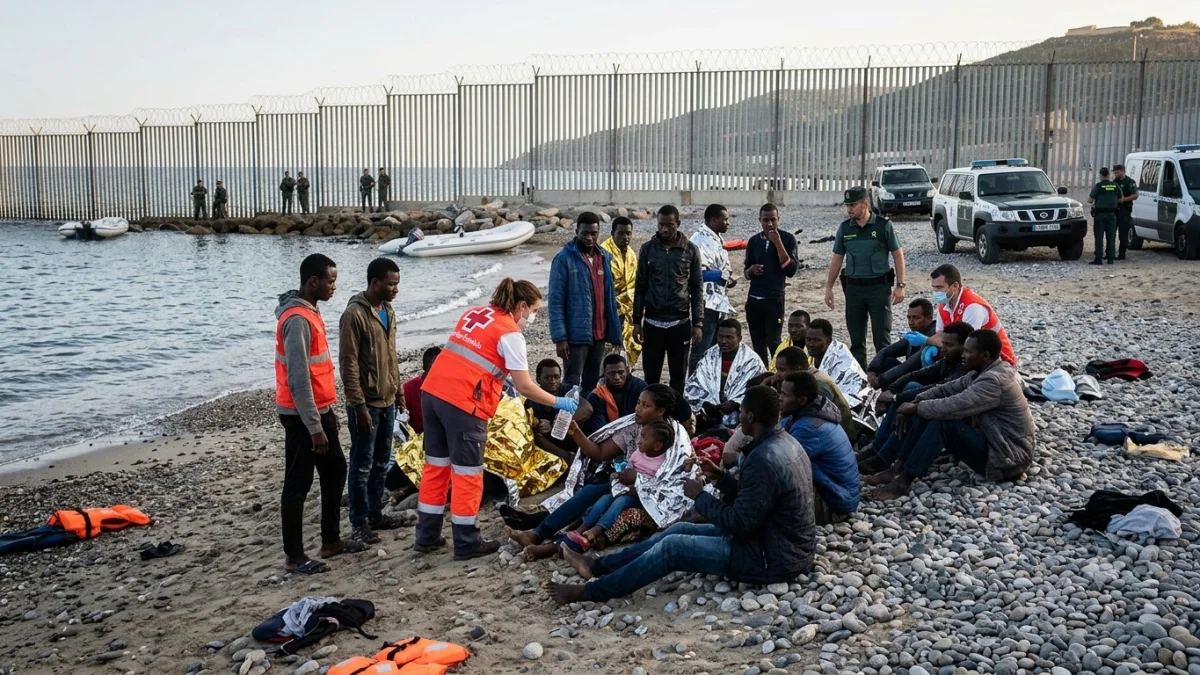


The mass crossing of migrants from Morocco into the Spanish enclave of Ceuta has moved from an acute border emergency to a broader test of European migration policy, Spanish-Moroccan relations and the resilience of the European Union’s external frontier.
Spanish authorities say most of the roughly 60,000 people who entered Ceuta over several days in late July and early August have since returned voluntarily to Morocco or been repatriated, easing immediate pressure on the enclave of about 83,500 residents. Yet the scale and speed of the influx have left political, humanitarian and diplomatic questions unresolved, while exposing the vulnerability of one of Europe’s most sensitive borders.


The episode is significant not only because of the numbers involved, which far exceeded previous migration surges at Ceuta, including the 2021 crisis when around 8,000 people entered the enclave, but because it demonstrated how rapidly misinformation, smuggling networks and regional political tensions can converge at the EU’s external border. Moroccan authorities attributed the movement partly to false claims circulated on social media that migrants reaching Spanish territory by sea could avoid immediate return, while Spain has also pointed to the role of trafficking groups that exploited those perceptions.
Ceuta occupies a unique place in European migration policy. Together with Melilla, it represents the EU’s only land border with Africa. The territory has long served as a focal point for irregular migration from Morocco and sub-Saharan Africa, and migration pressure had already been increasing in 2026 before the latest events. Spanish Interior Ministry figures cited by regional media showed arrivals into Ceuta had risen sharply during the first months of the year, suggesting the enclave was becoming a more active route into Europe.
The crisis also revived debate over the balance between border control and asylum obligations. Human rights organizations and legal experts have for years scrutinized Spanish practices at Ceuta and Melilla, particularly the use of rapid returns and collective expulsions. Court rulings in Spain have found some pushback cases unlawful, while advocacy groups argue that access to asylum procedures remains limited for many migrants arriving through North African routes.
At the European level, the events in Ceuta have again highlighted divisions over migration management. Italy’s temporary decision to impose additional checks on arrivals from Spain underscored how migration pressures at one external frontier can quickly affect internal EU politics and the functioning of the Schengen free-movement area. Some governments have argued for stronger border enforcement, while others have emphasized solidarity mechanisms and shared responsibility.
Spain and Morocco remain central actors in determining whether similar episodes recur. Their cooperation has historically been crucial in managing migration flows, with Moroccan security forces regularly intercepting attempted crossings before migrants reach Ceuta or Melilla. Analysts note that migration management has also been linked at times to broader diplomatic tensions, including disputes over trade, energy and regional influence, although direct evidence regarding political motivations behind the latest events remains limited and contested.
The humanitarian consequences are also likely to endure beyond the immediate crisis. Several deaths and disappearances have been reported during attempts to swim to Ceuta, underlining the risks associated with increasingly dangerous migration routes. Research on Mediterranean migration suggests official fatality figures may understate the true toll because some incidents are never recorded.
For Ceuta itself, the impact has been social as well as political. Residents and local authorities have described disruptions to public services, heightened security concerns and fears that future surges could overwhelm the enclave again. Spanish authorities have responded by reinforcing border controls and expanding security measures, while maintaining cooperation with Morocco on returns and prevention efforts.
The current situation remains fluid. Most migrants who entered Ceuta have left, reducing immediate pressure on the enclave, but Spanish and Moroccan authorities continue to investigate the role of social media campaigns, trafficking networks and the circumstances that enabled such a large movement in a short period. European governments are also monitoring whether the episode becomes an isolated event or signals broader changes in migration patterns across the western Mediterranean route.