

When the first shot rang out at Debsirin Nonthaburi School on Friday morning, 14-year-old Khim and her classmates initially looked toward a construction site, trying to understand the noise.
Then came more shots.


A teacher ushered the students into a classroom, checked a messaging group and confirmed what they feared: an active shooter was inside the school.
Khim and her classmates pushed desks against the door, switched off the lights and stayed near the windows. She told Reuters she heard multiple gunshots and felt they might not survive.
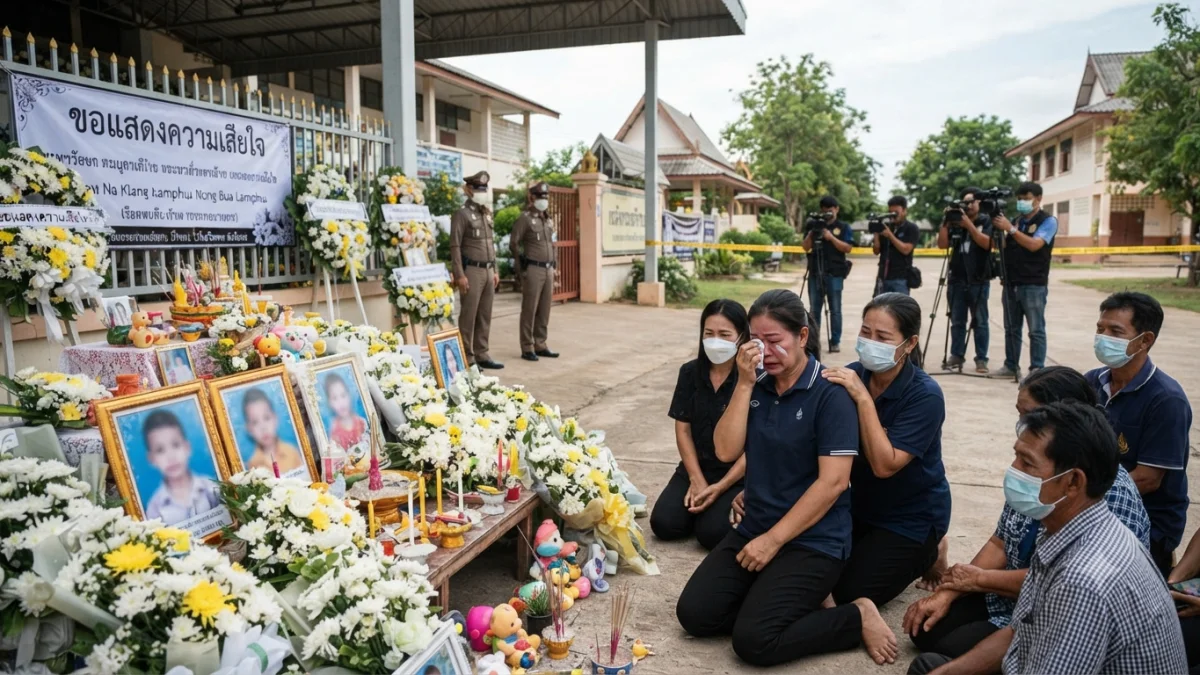
For families in Nonthaburi, a densely populated province bordering Bangkok, the hours that followed turned an ordinary school day into a search for children, relatives and colleagues. By Saturday, the death toll had reached nine, including the 14-year-old student authorities identified as the shooter. Twenty-three people were wounded. Five of those killed at the school were teachers or administrators, while police said the boy had also killed his grandparents at home before going to school.
The shooting has left a community trying to absorb a loss that extended beyond the school gates. Students were confronted not only with the deaths of adults who worked at their school, but with the possibility that someone they knew as a fellow student had carried a gun into the place where they were expected to learn.
Khim's experience captured the uncertainty of those minutes. Her older sister was sheltering in another building at the school, while their mother, Kwan, was working a shift as a nurse. When Kwan learned there had been a shooting, she remained on the phone with her daughter and tried to help her assess what was happening.
Kwan asked her daughter to count the gunshots, believing that the number of rounds fired might indicate how much ammunition remained. She also called an emergency hotline and told the operator where her daughter was hiding. At one point, the phone connection was cut. Her daughter later called back unharmed.
The family eventually reunited at home.
For Khim, seeing her sister again carried a significance that ordinary family disagreements had obscured. "But seeing her this time, I've never loved her this much before," she told Reuters.
The attack had begun hours before the shooting at school. Police said the teenager shot his grandparents at their home and then travelled roughly 18 km by bus to Debsirin Nonthaburi School, where classes were already under way. The school has about 3,000 students and nearly 150 teachers, according to data from the previous year.
At the school, witnesses described students hiding in classrooms while gunfire came from another building. Police eventually entered and helped clear students from the premises. A restaurant owner near the school told The Associated Press that students fled onto the street as the shooting continued.
The circumstances have also complicated the community's understanding of what happened. Prime Minister Anutin Charnvirakul said the student had shown signs of stress connected to school. Relatives interviewed by AP, however, said family members had not been aware of serious problems at home or school and described the teenager as someone who generally kept to himself and was a good student.
Authorities said the firearm had been legally registered to the teenager's grandfather. The case has therefore raised questions not only about what happened inside the school but about how a young person was able to gain access to a gun in the first place.
Those questions have become harder to separate from the country's wider experience with firearms.
Thailand has one of Asia's highest rates of civilian gun ownership. A 2017 Small Arms Survey estimate cited by Reuters put civilian firearm possession at about 15 guns per 100 people, or an estimated 10.3 million firearms. The country's licensing system does not currently require mental-health screening for prospective gun owners or periodic reassessment of licence holders, according to experts cited by Reuters.
The school shooting was not Thailand's only recent encounter with gun violence involving young people. In February, a teenager opened fire at a public school in southern Thailand after taking a weapon from police, killing a school director and injuring others. The latest attack has intensified attention on how firearms reach young people and how schools can respond when violence enters their campuses.
For schools, the immediate response has been security.
Classes at Debsirin Nonthaburi were suspended from Aug. 10 to Aug. 14, with staff instructed to work from home during the closure. On Monday, as students returned to classrooms at another Debsirin school in Bangkok, authorities introduced metal detectors and tighter screening. School director Withan Promsintusak said the measures were intended to reassure parents and protect students.
"We never imagined that a school, which should be the safest place, is where something like this would happen," he said.
The government has said it will develop new school-safety protocols over the next three months, including mental-health screening, emergency-response drills, measures to address bullying and improved detection of weapons and prohibited items. Prime Minister Anutin has also ordered tougher enforcement against carrying firearms in public and announced police checkpoints as part of a broader firearms crackdown.
Yet for the students who were inside the school, the immediate reality is less about policy than about returning to a place whose meaning has changed.
The questions facing officials — about guns, security, mental health and warning signs — will take time to answer. The students and families of Nonthaburi have begun confronting a different task: living with memories of a morning when a school classroom became a place to hide, and when a familiar community was suddenly divided between those who came home and those who did not.
For Khim and her family, the first measure of safety came when the sisters were together again.
The broader question for Thailand is how to make sure that the next school day can again be understood simply as a school day.