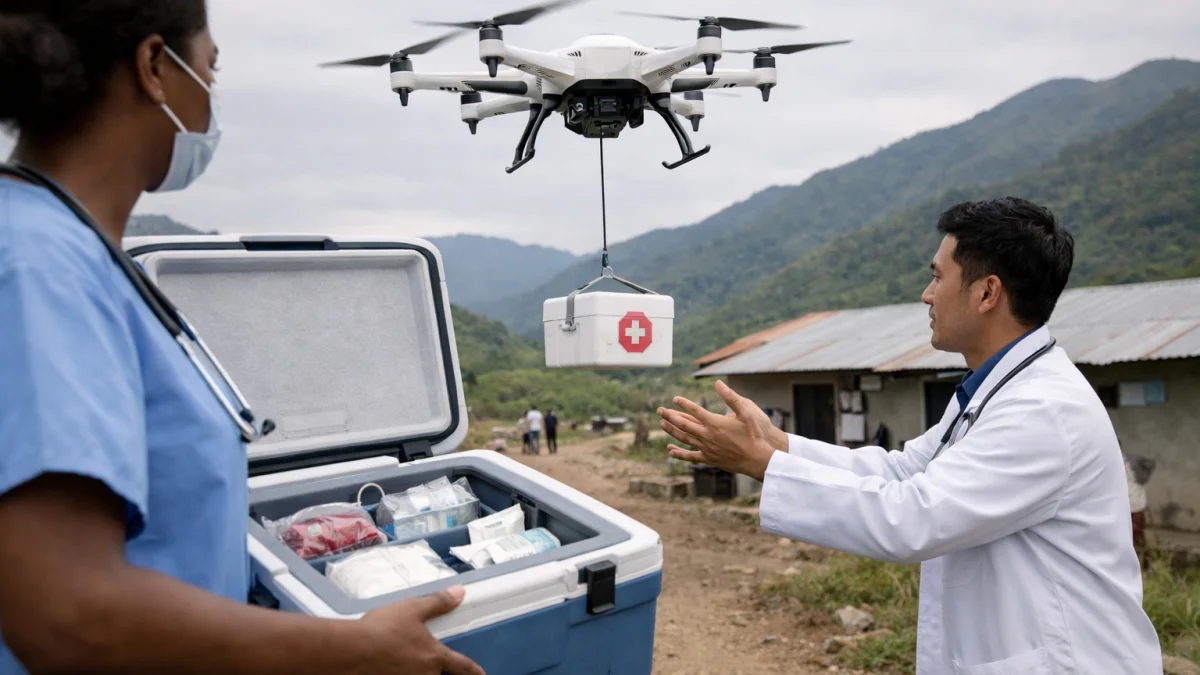
DENVER—Drone delivery companies are expanding the use of autonomous aircraft to transport medical supplies to remote and underserved regions in 2026, with operators reporting broader deployments across Africa, Asia and parts of the United States as part of efforts to reduce delivery times for critical health products, according to company statements and industry reports.
The expansion is part of a wider shift in healthcare logistics in which drones are increasingly being integrated into national and regional supply chains to address gaps in road infrastructure and improve access to vaccines, blood products and emergency medicines. Industry operators say the systems are moving beyond pilot projects toward regular operations supporting hospitals and clinics in rural and hard-to-reach areas.
U.S.-based logistics company Zipline, one of the largest operators in the sector, has continued scaling its autonomous delivery network in 2026, including additional distribution hubs in countries such as Nigeria and Rwanda, according to company announcements. In Nigeria, the company has said it plans to expand its network from three to 15 distribution centers by 2028 to reach about 20,000 health facilities, the company said in a statement in May.
“Zipline is increasingly positioning itself as a technology-driven logistics company, leveraging artificial intelligence, robotics, autonomous drones…to strengthen medical deliveries in underserved and remote communities,” the company said in a May update on its Nigeria operations.
In Rwanda, authorities and Zipline said earlier in February that the country is expanding its nationwide autonomous delivery coverage, building on a system that has been used since 2016 to transport medical products such as blood and vaccines to health facilities. The expansion is intended to extend coverage to additional facilities, according to the government and company.
Industry competitors, including Wing, Flytrex and Amazon Prime Air, are also developing drone-based delivery systems, though most large-scale medical deployments remain concentrated in specific regions and partnerships with health ministries or hospital networks.
In the United States, drone delivery services have also expanded into commercial logistics, with companies such as Zipline and others conducting operations in cities including Houston and Phoenix in early 2026, focusing primarily on retail and select healthcare deliveries, according to company and media reports.
Separately, research published in early 2026 on medical drone systems highlights ongoing engineering work to improve flight reliability, payload handling and navigation systems under variable weather conditions, which remain key technical constraints for wider deployment.
Zipline CEO Keller Rinaudo Cliffton said in a statement earlier this year that demand for autonomous logistics has increased as delivery times shorten and operational capacity expands, adding that “when deliveries are faster, cleaner, safer, and cheaper, demand isn’t just high, it grows exponentially,” according to a company statement issued in January.
The company and other operators did not provide specific global totals for medical deliveries in 2026, though they said expansion plans are continuing across multiple regions with additional hubs expected to come online later this year.