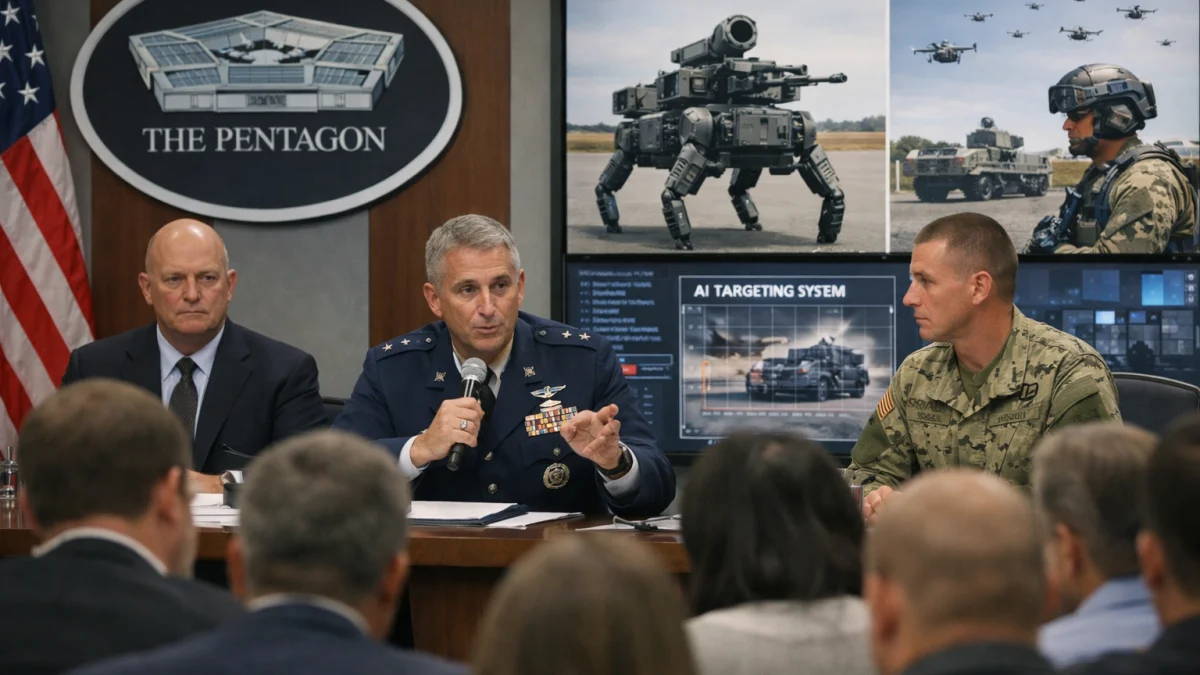
The Pentagon is advancing plans to update its core policy on autonomous weapons systems as part of a major push to accelerate artificial intelligence integration into military capabilities, backed by tens of billions of dollars in proposed spending.
This effort, driven by a Trump administration national security directive, highlights the tension between rapid technological adoption to maintain strategic advantage—particularly against competitors like China—and longstanding concerns over human oversight, safety, and accountability in lethal systems. The development underscores how evolving AI capabilities are outpacing existing governance frameworks originally designed for slower technological cycles.
The immediate catalyst is National Security Presidential Memorandum 11, signed by President Donald Trump on June 5, 2026, which directs the Pentagon to revise Department of Defense Directive 3000.09 within 90 days and implement annual reviews thereafter. The 2012 directive, last updated in January 2023, establishes policy for autonomous and semi-autonomous weapon systems. It requires "appropriate levels of human judgment over the use of force" and mandates senior-level reviews for development and fielding, with provisions for waivers in urgent cases.
The update aims to eliminate perceived barriers to deploying commercial and open-source AI technologies while adapting to rapid advancements in machine learning and autonomous operations. Pentagon officials have signaled that the current framework, which emphasizes minimizing unintended engagements through testing and human oversight, does not fully account for today's threat environment or the scale of planned deployments.
This policy shift coincides with a dramatic budget expansion for autonomous systems. The Pentagon's fiscal 2027 proposal includes more than $54 billion for the Defense Autonomous Warfare Group (DAWG), a massive increase from roughly $225 million in the prior year. The funding supports uncrewed systems across air, land, and sea domains, including "Drone Dominance" initiatives and AI-driven targeting integration. Broader Pentagon AI and autonomy spending has already reached around $13 billion in fiscal 2026.
The move reflects lessons from recent operations, including conflicts involving Iran, where officials cited needs for faster autonomous responses to threats like hypersonic missiles and mine-seeking capabilities. Under Secretary of Defense for Research and Engineering Emil Michael has noted varying risk levels across systems and the necessity for policies that evolve with technology and adversary capabilities.
Critics, including lawmakers, have raised questions about the pace. Sen. Ruben Gallego (D-Ariz.) sent a letter to Defense Secretary Pete Hegseth on June 15, 2026, seeking details on measures to mitigate risks of unintended harm to U.S. forces, allies, and civilians amid the accelerated timeline. Congressional oversight provisions in recent National Defense Authorization Acts require notification of policy changes and annual reporting on lethal autonomous systems.
U.S. policy has long maintained that it does not prohibit lethal autonomous weapon systems (LAWS), defined as those that can select and engage targets without further human intervention once activated. Officials have indicated the U.S. may develop such systems if adversaries do, while stressing compliance with the law of war, including principles of distinction, proportionality, and precaution. The directive establishes an Autonomous Weapon Systems Working Group to support reviews.
Internationally, debates continue over potential regulation or bans on LAWS, with ethical concerns centered on accountability and escalation risks. The U.S. has advocated for a flexible approach allowing "appropriate" human judgment tailored to missions, rather than rigid "meaningful human control" standards pushed by some nations and NGOs.
Partnerships with technology firms add another layer. The Pentagon has pursued agreements with AI companies for classified work, though some vendors have imposed contractual limits on fully autonomous lethal applications. These arrangements highlight ongoing negotiations over guardrails as the military seeks to leverage commercial innovation.
The current situation shows the Pentagon moving forward with both policy revision and substantial investment in autonomous capabilities to address perceived gaps in speed and scale relative to adversaries. Uncertainties remain regarding the specific content of the updated directive, implementation timelines, and how new oversight mechanisms will balance innovation with risk mitigation. Officials are monitoring technological developments, operational testing outcomes, and congressional responses as the 90-day mandate progresses.