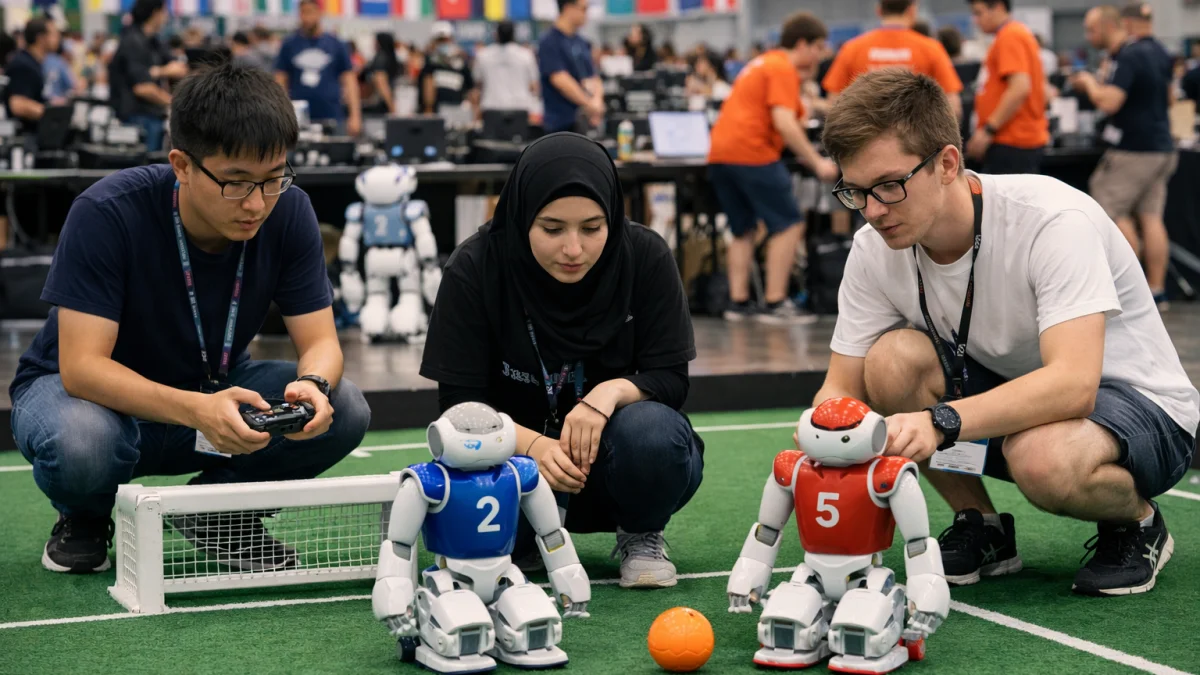
Students crouch beside compact robots, laptops open and tools scattered across tables, making last-minute adjustments before autonomous machines are released onto competition fields. Some robots chase a football, others navigate simulated disaster zones or perform household tasks without human control. The scenes have become a familiar part of RoboCup, an international robotics competition that has evolved over nearly three decades into one of the world's largest gatherings of young engineers, researchers and aspiring innovators.
As RoboCup prepares to open its 2026 competition in Incheon, South Korea, organizers expect more than 3,000 competitors, researchers, students and professionals from dozens of countries, along with roughly 15,000 visitors. The event marks the first time South Korea has hosted the competition since RoboCup was founded in 1997 with an ambitious long-term goal: to develop a fully autonomous robot soccer team capable of defeating the human FIFA World Cup champions by 2050.
That vision has always extended beyond the robots themselves. While the competition showcases advances in artificial intelligence and autonomous systems, it has also become an educational pathway for students who often begin with simple programming challenges before tackling increasingly sophisticated engineering problems.
RoboCupJunior, the competition's youth program, introduces students up to 19 years old to robotics through project-based learning. Participants design, build and program robots for challenges ranging from rescue simulations to creative performances and robot soccer. According to the RoboCupJunior organization, the initiative has spent more than 25 years encouraging teamwork, coding, engineering and problem-solving while providing a progression from beginner projects to advanced robotics research.
For many students, the attraction lies in building machines that solve practical problems rather than simply completing classroom exercises.
In rescue competitions, robots navigate obstacle-filled environments while locating simulated victims. In home-service events, autonomous machines identify objects, understand spoken instructions and complete domestic tasks. Soccer competitions require robots to perceive their surroundings, coordinate with teammates and make decisions in real time without human intervention. Each challenge mirrors technical problems that researchers continue to address in industries ranging from manufacturing to healthcare.
Those technical demands also foster skills that extend beyond engineering.
Academic researchers studying RoboCupJunior have found that the competitions encourage logical thinking, teamwork and sustained engagement with science, technology, engineering and mathematics. A long-running study of regional RoboCupJunior events in Australia concluded that the program helped build pathways into university engineering while exposing students to collaborative problem-solving and practical computing.
Teachers who mentor student teams often describe similar outcomes.
In Australia's Darling Downs region, robotics teacher Jay Wright said competitions give students opportunities to understand technologies that are reshaping society while learning how those tools can be applied responsibly. Speaking during preparations for a regional RoboCup competition, Wright said students were programming robots to complete simulated rescue missions using sensors, motors and coding rather than simply experimenting with technology for its own sake.
"Competitions like this allow kids to understand the world they are going into but also succeed, thrive, and be very talented in the area of technologies," Wright said. He added that introducing students to robotics and artificial intelligence also creates opportunities to discuss the responsible use of emerging technologies.
Parents have also observed broader effects.
Leisa Davies, whose son William participated in the same Australian robotics program, said the supportive environment helped him gain confidence. She described robotics as a creative outlet where students encouraged one another while working together on technical challenges.
Those personal experiences help explain why RoboCup has continued expanding even as robotics technology has advanced dramatically.
What began primarily as a research competition has grown into a meeting point for universities, schools, industry and government agencies. Alongside competitive events, RoboCup hosts scientific conferences, technical workshops and demonstrations where researchers share new developments in robotics, artificial intelligence and autonomous systems. Students who arrive as competitors often leave having interacted with university laboratories, engineers and companies working at the forefront of robotics research.
The competition's organizers argue that this combination of education and research remains central to RoboCup's mission.
The federation describes RoboCup as an international scientific initiative dedicated to advancing intelligent robots through ambitious benchmark challenges that encourage collaboration across disciplines. Its leagues now cover robot soccer, rescue operations, domestic service, industrial automation and youth competitions, reflecting the growing range of applications for autonomous systems.
As teams gather in Incheon, many participants will still be focused on immediate goals: debugging software, refining mechanical designs or preparing robots for another match. Yet the event's longer-term significance lies less in which team wins a competition than in the students who gain experience designing systems that increasingly resemble technologies used outside the arena.
For some, RoboCup serves as a first exposure to robotics. For others, it represents another step toward careers in engineering, artificial intelligence or scientific research. Together, they embody the competition's enduring premise: that building better robots begins with giving young people opportunities to imagine, test and improve them, one challenge at a time.