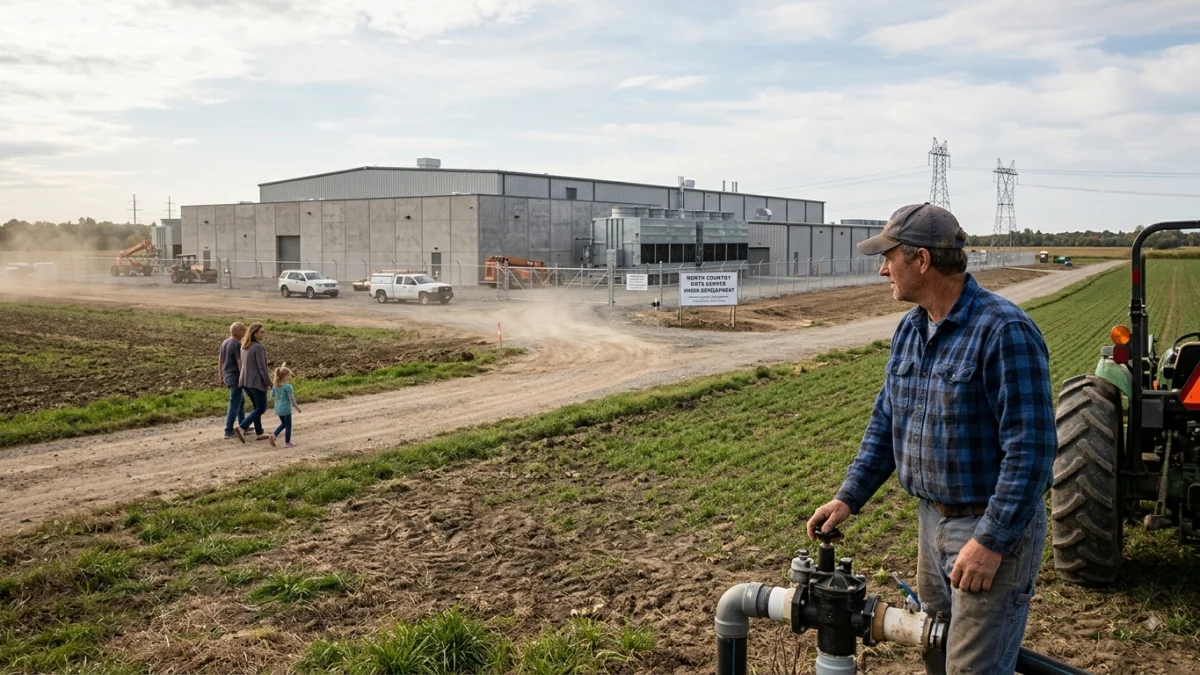


Families in the small North Dakota town of Ellendale have found themselves adapting to an economic transformation set in motion by a technology most will never see.
The arrival of a large data center campus from Applied Digital has brought construction workers, new business activity and the prospect of jobs to the community of about 1,100 people. It has also pushed up demand for housing, forcing some families to reconsider where they can afford to live.


Jamie Walker saw the change from close range. She previously managed an apartment complex in Ellendale and moved away after construction began. Her former husband remains in town, where he works as a security guard at Applied Digital, and Walker returns to collect and drop off their children, according to South Dakota Searchlight. She said the monthly rent for a one-bedroom apartment at the complex rose from about $600 to more than $1,200 as construction workers competed for limited housing. Some families, she said, left Ellendale because they could no longer afford the increases.
“The construction is ‘good money for the town,’” Walker told South Dakota Searchlight, while warning that housing costs could drive families with children away.
Ellendale illustrates a broader tension emerging across the United States as artificial intelligence drives investment in the physical infrastructure needed to train and operate AI systems. Data centers can inject capital, construction work and tax revenue into communities, but their demands for land, electricity and workers can also reshape household finances and local services.
New research from the National Bureau of Economic Research found that data-center growth is associated with increases in employment, construction activity, household income and home prices, while also affecting local electricity prices. The researchers described the expansion as a local policy trade-off: communities can gain investment and jobs while facing greater demand for power, land and grid capacity.
For Ellendale, the effects have arrived unusually quickly.
Applied Digital's campus is being expanded to three facilities with an expected power demand of as much as 530 megawatts. The company has said the development could create up to 350 jobs in the town. Mayor Don Flaherty has estimated that the population could grow by hundreds of people as workers and their families arrive.
The transformation is not limited to permanent employment. Construction workers have been living temporarily in Ellendale and nearby communities, creating demand that local housing markets have struggled to absorb. More than 1,000 construction workers have also been staying in nearby Aberdeen, South Dakota, according to economic-development officials cited by South Dakota Searchlight, increasing traffic at restaurants, hotels and other businesses.
That influx has created opportunities for some households while complicating life for others. A town that once struggled with population decline is now confronting the problems that accompany rapid growth: scarce housing, pressure on roads and the question of whether temporary construction activity will translate into lasting prosperity.
Research from Georgia Tech published in July found that the economic effects of data centers vary sharply depending on where they are built. The researchers reported average increases in employment, wages, business establishments and household income after data centers opened, but found that metropolitan counties captured much of the broader economic benefit. In non-metropolitan counties, they found no measurable gains in employment or new business activity on the same scale.
That distinction matters for places such as Ellendale. A large facility can represent billions of dollars of investment without automatically producing a comparable number of permanent local jobs. Georgia Tech's research found that rural facilities often employ fewer than 100 permanent workers and rely on specialized contractors and services from outside the county.
For residents, the arithmetic of the boom can therefore look different from the headline investment figures.
A family renting a home experiences the shortage through a monthly payment. A local business may experience it through fuller restaurants and hotels. A city government may see additional tax revenue, while a utility confronts a major new electricity customer. Those effects can occur simultaneously, leaving households with different assessments of whether the transformation is helping them.
Public opinion reflects that divide. A Pew Research Center survey of 8,512 U.S. adults conducted in January found that Americans were more likely to view data centers positively for local jobs and tax revenue than negatively. But respondents were substantially more likely to see negative effects on home energy costs, the environment and quality of life for people living nearby.
The debate is becoming more consequential as communities compete for AI infrastructure. In western Kentucky, the U.S. Department of Energy announced in July a partnership involving a planned data-center campus and new energy infrastructure. The government said the more than $100 billion privately funded investment was expected to create about 8,000 construction jobs and 600 permanent jobs.
Such projects show why local officials continue to pursue the industry even as opposition grows elsewhere. But they also highlight a question increasingly being asked at kitchen tables and town meetings: how much of the economic value created by AI infrastructure will remain with the people who live around it?
Ellendale is still working out its answer.
The town's experience suggests that adapting to the AI economy is not simply a matter of finding workers for new technology jobs. It can mean finding homes for construction crews, accommodating children and families, expanding roads and services, and deciding how quickly a small community can absorb an investment designed for a much larger technological economy.
For families such as Walker's, the AI boom is therefore not an abstract race over computing power. It is reflected in the practical choices that follow when a familiar housing market suddenly changes.
And for towns seeking a future in an increasingly digital economy, the challenge is becoming clear: attracting the data centers may be only the beginning. The harder task is making sure the communities around them can afford to grow with them.