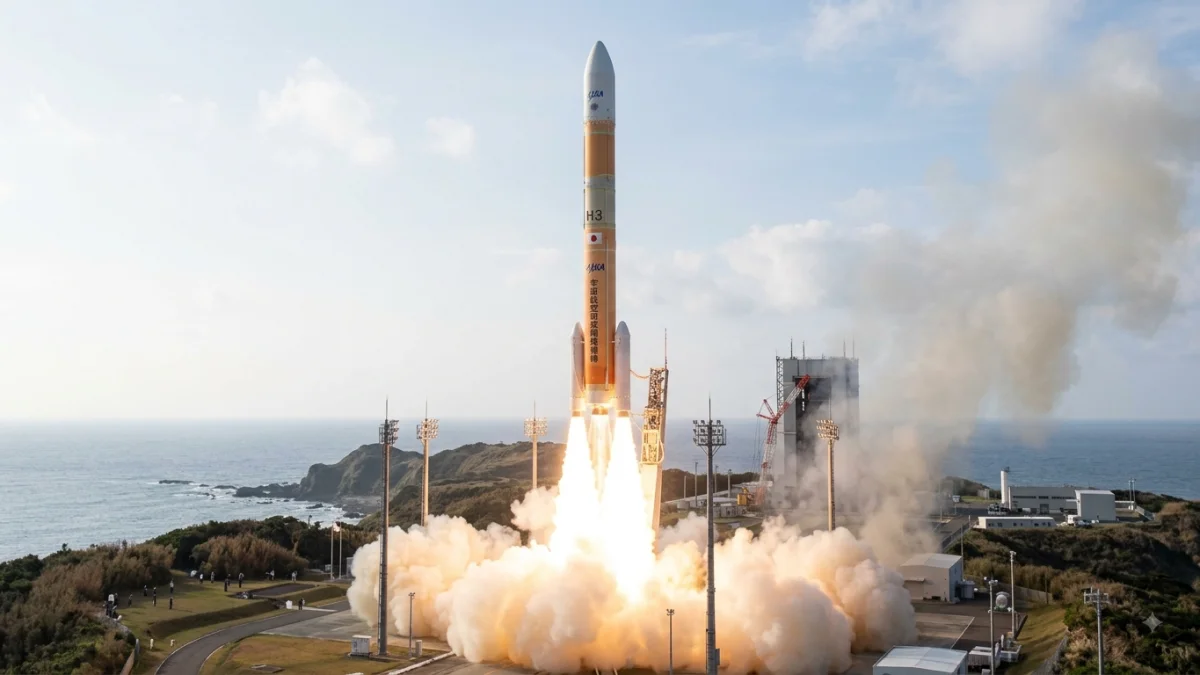


Japan’s H3 rocket successfully placed the Michibiki 7 positioning satellite into orbit on Aug. 11, marking an important recovery for the country’s flagship launch vehicle and advancing Tokyo’s effort to strengthen its independent satellite-navigation infrastructure.
The mission is significant on two fronts. For the H3 programme, the successful flight helps rebuild confidence after the failure of H3 Flight 8 in December 2025, when the Michibiki 5 satellite was lost. For Japan’s space policy, Michibiki 7 moves the Quasi-Zenith Satellite System (QZSS) closer to its planned seven-satellite configuration, intended to provide more resilient and accurate positioning services while complementing, rather than simply replacing, the U.S. GPS system. Japan’s Cabinet Office has described QZSS as important infrastructure for the country’s economy and society.


The launch also demonstrates the importance of reliability in Japan’s attempt to make the H3 a dependable domestic and commercial launch platform. Developed by Japan Aerospace Exploration Agency (JAXA) and Mitsubishi Heavy Industries, H3 was designed to offer greater flexibility, reliability and cost performance than its predecessor, H-IIA. JAXA has said the programme is intended to meet a broad range of satellite-launch requirements.
That objective has been tested repeatedly. H3’s first flight in March 2023 failed, but subsequent missions demonstrated recovery, including successful flights in 2024 and 2025. The December 2025 failure was particularly consequential because it involved another Michibiki satellite. JAXA and Mitsubishi Heavy Industries subsequently postponed the planned launch of H3 Flight 9 while investigating the failure and assessing its implications for later vehicles.
The decision to resume the Flight 9 mission therefore carried significance beyond a single launch. Japan’s space authorities had to demonstrate that corrective measures were sufficient to permit another H3 to fly with a high-value government satellite. In June, Japan’s science minister said the government wanted to rebuild confidence in H3 by accumulating successful launches, while emphasizing that continued performance would ultimately determine how the rocket was assessed.
Michibiki 7 is equally important to Japan’s positioning strategy. QZSS operates in orbits designed to keep satellites at high elevations over Japan and surrounding areas, improving the availability of positioning signals in environments where conventional GPS reception can be degraded, including mountainous terrain and dense urban areas. The system provides GPS-compatible signals as well as augmentation services designed to improve positioning accuracy. Japan has also developed services supporting high-precision applications and disaster-related communications.
The strategic objective is not to eliminate GPS dependence. QZSS is designed to work with GPS and other global navigation satellite systems, allowing receivers to use multiple sources of positioning information. But expanding the Japanese constellation gives Tokyo greater control over a critical layer of infrastructure whose applications extend from transportation and surveying to logistics, communications, agriculture and disaster response.
The seven-satellite goal also reflects lessons from the loss of Michibiki 5. Before that satellite was lost, Japan operated a five-satellite QZSS constellation, according to government statements. Officials said the addition of Michibiki 7 would improve the stability of high-precision positioning services, while longer-term plans call for an expanded constellation of 11 satellites to provide greater redundancy.
The broader economic implications depend partly on whether Japan can translate satellite capability into sustained commercial use. High-precision positioning is increasingly relevant to automated machinery, precision agriculture, surveying and transportation. Research has demonstrated potential applications of QZSS augmentation services in autonomous construction equipment, including situations where conventional reference-station-based positioning can be difficult to maintain.
For the H3 programme, however, one successful mission does not by itself establish long-term reliability. Japan has several demanding missions planned for H3, including scientific and cargo spacecraft. The rocket’s performance across those missions will be closely watched as JAXA seeks to establish a consistent launch cadence and strengthen its position in the international launch market. JAXA’s stated objectives for H3 include reliability and cost competitiveness, making repeated successful operations essential to the programme’s longer-term credibility.
The confirmed picture is therefore one of recovery rather than completion. Michibiki 7 strengthens Japan’s positioning architecture, while the H3 mission provides another successful data point for a launch system still establishing its reliability record. Officials will continue to monitor the satellite’s post-launch operations and integration into QZSS, as well as the performance of subsequent H3 missions. The longer-term test will be whether Japan can sustain both a resilient navigation constellation and a dependable launch system capable of supporting the country’s expanding space programme.